
HORSE DRAWN TRAM IN COLABA
MARINE DRIVE 1950

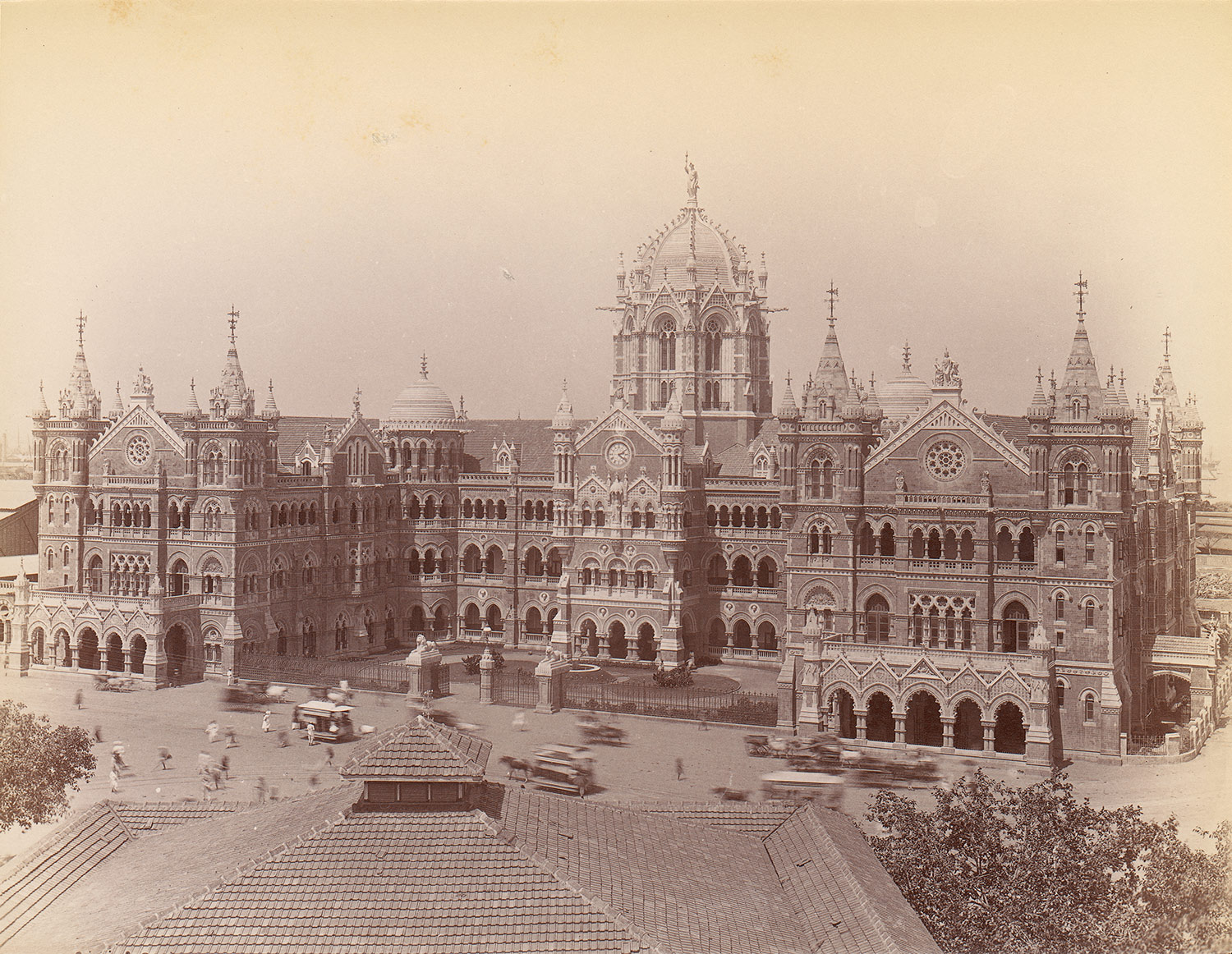
VT STATION 1885 SHOWING HORSE TRAMS(BEFORE ARRIVAL OF CARS)

Bhendy Bazaar, Mumbai (1880)
Reversing Stations and Catch sidings

BOMBAY B.E.S.T. TRAMS

B.E.S.T[ BOMBAY ELECTRIC SUPPY AND TRANSPORT]. BUS BOMBAY 1926

SINGLE DECKER SKODA -TROLLEY BUS

BEST VESTIBULE BUS


VESTIBULE BUS

SINGLE DECKER ELECTRIC TRAM IN FRONT OF VT STATION BOMBAY

DOUBLE DECKER TRAM ;B.E.S.T. COMPANY;BOMBAY

BEST TOURIST BUS 1926

Limited Bus Service

BEST TROLLEY BUS

BEST TRAILER BUS

BEST TRAIN TYPE[ONE PULLING SECOND] BUS


PASSENGER SHIPS ;BEFORE AIR TRAVEL BECAME POPULAR IN 1950/60


In 1881 Mahatma Gandhi sailed from Bombay (now Mumbai) to Marseilles on P&O's Clyde. 50 Years later he repeated the journey onboard Rajputana from where is this picture with Captain H.M. Jack. Rajputana was torpedoed in 1941 .


The Duke of Marlborough (4th from left) and Consuela, Duchess of Marlborough (2nd from left) relaxing on board the P&O liner Arabia on its trip from Marseilles to Bombay en route to the Delhi Durbar. Original Artwork: From the Durbar Delhi Album 1902/3

P&O 'Ranchi' Lounge

LIFE ON P&O LINES 1940-60
The SS Ranchi was built for the Peninsular & Oriental Steam Navigation Company (P&O) by Hawthorn Leslie & Co. at Newcastle Upon Tyne, England and was launched on 24 January 1925. Her gross registered tonnage was 16,650, her length was 547 feet and her beam 71 feet. She was one of the P&O 'R' class liners from 1925 that had much of their interiors designed by Lord Inchcape's daughter Elsie Mackay[1].
Named after Ranchi, the capital city of Jharkhand state in eastern India, she sailed on a regular route between England and Bombay, India. Later she sailed to the Far East. She carried 600 passengers.
The SS Ranchi was requisitioned into the Royal Navy on 27 August 1939 (at the onset of World War II) and commissioned on 23 October 1939 as the armed merchant cruiser HMS Ranchi (Pennant F15). As an armed merchant cruiser, her gross registered tonnage was 16,738.
Her sister ships SS Rawalpindi, SS Rajputana and SS Ranpura were also converted to armed merchant cruisers. Except for small corvettes, the converted passenger ships like HMS Ranchi were the only armed protection for most of the early convoys. With their six-inch guns, they were the only escorts that could engage German surface ships. Very few convoys received the protection of the larger cruisers or battleships.
From October 1939 until February 1942 she served the East Indies Station; from March 1942 until January 1943 she was part of the Eastern Fleet (Indian Ocean). She was returned and use as a troopship by the Ministry of War Transport (MoWT) on 16 March 1943.
Two months after the end of World War II in the Pacific, in October 1945 the Ranchi sailed from Singapore to Southampton carrying amongst others released prisoners of war and civilian internees recently liberated from Japanese camps. Hilda Bates, who had been interned in Batu Lintang camp at Kuching, Borneo, wrote on 23 October 1945: "We are now speeding towards England aboard the S.S. Ranchi, which is packed with troops and other ex P.O.W.s like ourselves ... In our cabin there are twelve women, - five of who[m] are returning home as widows.
the company’s 172-year history. 


Photos of life aboard the P&O’s Chusan during the 1950s and 1960s.

SS Iberia as seen from the SS Chusan. 1960s.
Many Americans and Canadians can join in this search for historical information on the ships.

Officers and Passengers – 1958 – the beginning of the Love Boat? Aboard the Orcades docked in Sydney.

Cunard’s RMS Queen Mary and P&O’s Iberia in New York during the 1960s.
P&O is appealing to travelers and collectors to find souvenirs, keepsakes and mementoes of past voyages so they can be put on display on Azura during her maiden season, and then exhibited as part of a traveling heritage display on the line’s fleet of seven ships.

Family returns from Australia to England aboard the Canberra in the 1960s.
Managing director Carol Marlow said: “P&O Cruises began in 1837 and is proud of its long and illustrious history as Britain’s oldest cruise line. The launch of Azura seemed a fitting time to celebrate this heritage by exhibiting memorabilia and works of art associated with our fleet.
Play this YOUTUBE video of P&O’s SS HIMALAYA – with photos of the famous ship. The ship served on the liner run from the UK to Asia, Australia and the North America. She later cruised from Alaska to the Carribean. This collection of “cruise history” is what P&O is looking for in connection with their new ship AZURA.
“I am sure that many people have items of historical importance and sentimental relevance which we would love to share with all our passengers and have on loan for Azura’s maiden season.

P&O merged with the Orient Lines. This is a scene in Hong Kong of the Orcades arriving.
“So whether people have Canberra on camera, images of Iberia or a souvenir from Strathaird or Strathmore, we want to share the stories. Our ships have played a significant part in the shaping of the cruise industry and I am sure that this collection will evoke many memories of cruises past.”


Scenes aboard various P&O liners during the 1960s. Deck Quoits and Horse Racing.
If you have anything you think might be suitable, send a photograph and a description of the item in an envelope marked “Memorabilia” to Michele Andjel, P&O Cruises, Carnival House, 100 Harbour Parade, Southampton SO15 1ST
Or email it to michele.andjel@carnivalukgroup.com

A P&0 dance orchestra on Spanish Night.
But don’t plan on making a fortune by snapping up souvenirs on eBay and selling them to P&O for a profit. The items will be on loan, and your kindness and generosity will be marked by having your name on a card in a glass display case.


British Officer and Indian Steward from Goa aboard P&O.

Young Officers relaxing on the CANBERRA.

P&O’s SS CHUSAN

First Class Lunch Menu on the SS Chusan – 1960.


BRITISH COLONIAL SOLDIERS TRAVELLING BY TRAM

1931 BOMBAY FLYING CLUB
The Troopships 1902 to 1922
TAROBABuilt: 1902;Dumbarton.

Built at the same yard as her sister Tara with the same problem of passenger distribution she entered service on the Calcutta - Singapore route. She was requisitioned for three periods as a transport between 1914 to May of 1916 during which time she trooped India to Aden, loaded horses and mules at Marseilles for discharge at Basra and finally picked up troops at Suez. She served in the Liner Requisition Scheme from 1917 to 1919 and then returned for service with British India until finally being sold for scrap to purchasers in Genoa on the 13th May 1924 who then moved her on at a profit to other Italian Shipbreakers.
COCONADABuilt: 1910 Glasgow.

Coconada along with her sister Chilka were built for the Coromandel Coast Rangoon service. She became an Indian Expeditionary Force Transport from August of 1914 to July of 1916 in the main trooping the Meeruts Karachi - Marseilles and Karachi - Suez.
In November of 1916 she broke from her buoys during a cyclone at Madras leaving her Commander Captain Lime with no other option but to put to sea and ride out the storm. In total darkness he managed to steer his ship through a harbour full of drifting ships in itself a magnificent piece of seamanship with only slight damage to the forecastle caused by the starboard anchor. In May of 1917 she came under the Liner Requistion Scheme and served as an Expeditionary Force Transport from November 1918 until November 1919 where she spent sometime in the Pacific sailing from Vancouver to Hong Kong via Japan. She ran aground six miles south of Gopalpur on the 12th of October 1921 fortunately being successfully refloated and towed to Coconada by the Purnea. She was sold on the 1st of September 1933 to the Scinda Steam Navigation Company of Bombay and renamed Jaladurga. She was requisitioned once more for war duties in February of 1941 and at War's end was transferred to the Singapore - Bangkok trades, it was whilst on these trades that she sank in Bombay. She was successfully raised and repaired and continued on her normal services before being finally called to the colours once more when she carried Indian trrops to Korea in 1953. She was finally sold for scrap in 1954 and work commenced at Bombay in the following year after an incredible 44 years of service.
EGRABuilt : 1911 Belfast.

She entered service in August of 1911 and in September of 1914 trooped to Marseilles, she also attended the Basra Landings in the December of the same year and spent the remainder of the war as a Troop Transport. In 1922 she ran aground off Amoy but the remainder of her pre- Second War career was uneventful. She served as a Troop Transport from July 1940 to November of 1946 seeing service Karachi Basra April 1941, August 1941 Bombay- Port Swettenham. On the 26th of November 1943 she was in convoy with Rohna when the latter was sank by a glider bomb and in January of 1945 she was a Supply and Troop Transport for the Kyaukpyu Landings in Burma. Just before decommissioning she grounded in the Hooghly on the 27th of October 1946 and it wasn't until the 7th of November that she was refloated. She remained in service until January 1950 before being sold for scrap to the Steel Corporation of Bombay on the 1st of February at the time she was the longest serving ship in the BI Fleet
ERINPURA
The Erinpura was one of seven sisters built at four different shipyards for the Bpay of Bengal/Singapore Straits Service, one of the most successful, profitable and long lasting groups in the History of British India. It was also said that these ships were amongst the handsomest and graceful ships that the Company had ever built, certainly powerful lookers. Erinpura also had the distinction of being the first British India ship built for Eastern Service to be fitted with radio. She was distinguished from her sisters by the fact her Bridge deck extended right aft.

In 1914 she boarded troops at Karachi and joined a massive convoy mainly British India, bound for Marseilles, she then trooped to Sanniya in Iraq. On Christmas Eve of 1914 she ran aground crossing the Muhanrah Bar whilst on passage up the river to Abadan. After applying full power astern she was able to release herself but unfortunately was unable to slow and found herself striking the opposite bank damaging her rudder. After jury-rigging using the aft winches Erinpura was able to make the return voyage to Bombay.
Erinpura in Hospital Ship Livery
In 1915 she was again engaged in trooping this time between Marseilles and Port Said. In August of 1916 she was converted to a Hospital Ship for the Indian Expeditionary Force having 475 beds and a medical staff of 104, she was employed mainly on the Basra-Bombay Service from November 1917 to June 1919 she became an Ambulance Transport on the same route.
On the 15th June 1919 she ran aground homeward bound Bombay/Marseilles on the Mushejera Reef in the Red Sea, ninety-six miles North West of Perim. HMS Topaze answered her call for assistance, lifting all her passengers and troops before transporting them onto Aden. HMS Topaze returned with Perim Salvage Co.'s tug and attempted to pull Erinpura free. Their efforts failed and the ship remained stuck. Even British India ships calling with stores all attempted to pull her off, none succeeded and with the bad weather season approaching the ship was abandoned leaving just a skeleton maintenance crew onboard. It was decided to cut the ship just for'd of the Bridge returning the stern section to Aden and leaving the bow firmly in the grip of the reef. British India had to repurchase the stern section from the insurers and placed an order for a new bow from her original builders Dennys. The Company's ships Waroonga and Kapurthala successfully towed the stern section to Bombay, I believe at this time she was jokingly referred to as the longest ship in the world 'bow in Dumbarton, stern in Bombay'.

Military aviation came to India in Dec 1915, when a flight of Bristol BE2cs of the Royal Flying Corps (RFC) arrived in Bombay and moved to Risalpur and Nowshera to support various Royal Army expeditions in the NWFP.

Bristol Bombay - K 3583
The first production
Bristol Bombay - K 3583
- flew in March 1939 and was to be the basis for the post War Bristol Type 170 Freighter, Wayfarer and Superfreighter
Following the success during the Second World War of the twin engined
Bristol Type 130 Bombay

The Bristol Bombay was built to Air Ministry Specification C. 26/31 which called for a monoplane bomber-transport aircraft to replace the Vickers Valentia biplane in use in the Middle East and India. ... Bristol's design, the Type 130, was a high-wing cantilever monoplane of all-metal construction.
utility aircraft in the Middle East theatre of operations, the Bristol Type 170 was devised along similar lines but with a much larger fuselage and simplified single fin tail and two-spar wing construction. It was also to be more specialised as a rugged heavy duty freighter with low initial and running costs and easy maintainance without the use of any special tools. Indeed, initial projections were for just one man hour of maintenance per aircraft hour of flight.The production
Type 130 Bombay
had been introduced in 1939 as one of the first large twin engined monoplane designs to serve with the Royal Air Force. Built to meet Air Ministry specification C.26/31 for an aircraft capable of carrying 24 fully armed troops, 10 stretcher cases as an air ambulance or equivalent mixed freight, the high seven-spar cantilever winged fixed-undercarriage Bombay used lessons learned from Bristol's unique twin engined Bagshot fighter ( J7765 ) of 1927. The oval sectioned monocoque steel strip and aluminium fueslage frame of the Bombay was covered by a stressed Alclad skin. Alclad - an American invention - consisted of the lightweight but potentially corrosion prone Duralumin coated with a thin film of pure aluminium.
For civil aircraft specification 22/44 Bristol designer Archibald E. Russell had retained the wide tracked fixed undercarriage of the Bombay but gave the wing - with the same section and taper ratio - a swept leading and straight trailing edge.

The Indian Gift Squadrons and CITY OF BOMBAY AND BOMBAY CITY bomber planes gifted to royal air force 1943
Jun 12, 2017 - A look at RAF Squadrons gifted by Indian people ..
WORLD WAR II
The Indian Gift Squadrons
A look at RAF Squadrons gifted by Indian people
Spitfire VB BM 252 “Bombay City” while serving with No 132 Bombay Gift Squadron RAF in 1942

Flt Lt HJL Hallowes at Turnhouse with “City of Bombay” another Indian gift Spitfire given to No. 122 Squadron, RAF. The aircraft is BM 252, MT-E.
|

“Assam one” an Indian gift Spitfire Mk IIA P 8167 of No 266 Sqn RAF at Wittering in Jul 41

Royal Aircraft factory BE2c “Punjab 40 Lahore 3” was presented for £1,500 in the first war

Vickers Gunbus FE2b |
Royal Aircraft factory FE2b Gunbus “Bhopal”
Messerschmit Bf 109 E (?) shot down by No 253 Hyderabad Gift squadron over Britain. The wreck (right) finally ended up in a Gulbarga Engineering College (now in Karnataka) and is embroiled in a legal battle over its dubious sale to a British collector.

Mechanics stand in front of their Bombay Aircraft. July 1939

car was an Indian member of a ship's crew. The P&O began using them when the company's routes extended east of Suez in the 1840s. Traditionally they were recruited from along the coasts of India and from the Laccadive and Maldive islands. The P&O's Captain Baillie said of Indian crew members in 1957 "I have never failed to appreciate the cleanliness, discipline and comfort of our ships in which the deck hands are lascars and the stewards mostly Goanese".. Image from National Maritime Museum
model of 'Sir Lancelot' (Br, 1865)-After 1883 the 'Sir Lancelot' traded mainly between Bombay,


House flag, Anchor Line Ltd-1856- In 1875 the company started a service to Bombay and in 1882 another to Calcutta.

House flag, Bibby Line Brothers and Co.1805-By the 1830s Bibby Ships were sailing to Bombay


House flag, Scindia Steam Navigation Co. Ltd

House flag, Bombay Steam Navigation Co. Ltd
The house flag of the Bombay Steam Navigation Co. Ltd, Bombay. A white burgee with a red five-pointed star in the centre. The flag is made of a wool and synthetic fibre bunting. It has a cotton hoist and is machine sewn.

The Indiaman 'Thomas Coutts'

The capture of Geriah, February 1756
 Attack made on the Fort of Geriah .
Attack made on the Fort of Geriah .

Geriah was a stronghold of the notorious and formidable Maratha pirate Tulagee Angria. One of a family of Indian pirates plundering the trade carried in East India Company ships, he operated off India's Malabar coast between Bombay and Goa, known as the Pirate Coast. Angria had strongholds on the little island of Severndroog, which had been captured by Commodore James in 1755, south of Bankote, or Fort Victoria, and at Geriah, south of Ratnagiri. Late in 1755 an expedition consisting of Royal, Company and Mahrattan ships was organised to destroy it, together with a contingent of Company troops under Lieutenant Colonel Clive. The expedition was commanded by Rear-Admiral Watson with Rear-Admiral Pocock as his second in command. In anticipation of an attack, Angria made a deal with the Mahrattans to give them Geriah, if the attack was called off. Although they agreed, Watson was determined to destroy it, and carried out a bombardment on 12 February 1756. Although he silenced the defence batteries, it was necessary to open fire again on 13 February before the final surrender the next day. Apart from the destruction of Angria's arsenal and fleet, 130,000 of spices and valuables were found. Angria's wife and family were spared and Angira himself escaped and fled.. Image from National Maritime Museum
Loss of the East Indiaman 'Kent': catching fire, 1 March 1825

One of a pair of paintings, showing the East Indiaman 'Kent' catching fire on 1 March 1825, see also BHC2273. The ship was owned by Stewart Marjoribanks and came into service with the East India Company in 1820. It undertook two voyages for the Company to Bengal, Bombay and China before disaster struck in 1825. Commanded by Henry Cobb, the 'Kent' sailed from the Downs on 19 February 1825 for a third voyage to Bengal and China. However, on 1 March 1825 in the Bay of Biscay, following two days of storms, the ship caught fire, reportedly from an accident with a naked light by malefactors attempting to steal liquor from her hold. The 'Kent' was carrying some 700 people, mainly soldiers of the 31st regiment and their families, when the fire broke out. Efforts were made to extinguish the flames by scuttling the lower ports to flood the hold, but fearing the vessel would sink the ports had to be shut. A sailor sent aloft reported another vessel nearby and an elaborate rescue effort commenced. In mountainous seas the ship's boats were used to ferry passengers and crew to the brig 'Cambrian', captained by Captain Cooke and bound for Vera Cruz carrying Cornish miners. Having saved the majority of the ships complement the overcrowded brig made for Falmouth and after two days and three nights arrived safely. However a number of those saved from the 'Kent' perished during the journey, including a substantial number of children..

National Maritime Museum - Greenwich London

East Indiamen in the China seas;This large painting is believed to depict the 'Winchelsea' and other Indiamen at sea. The subject of Indiamen in the East was a familiar one to Huggins who had probably begun his working life at sea and served in the East India Company as a steward and assistant purser on board the 'Perseverance', which sailed for Bombay and China in December 1812, returning in August 1814. He had established himself as a marine painter by 1817, close to the London headquarters of the Company in Leadenhall Street, where he worked for the rest of his life.. Image from National Maritime Museum
Additional information
'John Wood Approaching Bombay', c1850. At this time the East India Company was still governing India. The company was founded in 1600 to challenge the Dutch and Portuguese dominance of the spice trade from the Far East. The East India Company lost its administrative functions in India in 1858 after its role in the Indian Mutiny the previous year.'John Wood Approaching Bombay', c1850 |

Product
John Wood Approaching Bombay, C1850 ...
art.com · In stock


DOUBLE DECKER TRAM CAR BOMBAY
 IndiaTICCA GADIS. These horse-drawn Victorian carriages that were the only mode of transport to come to Bombay in 1882 after The Bombay Tramway Company Limited was formally set up in 1873. Motor taxis were introduced in 1911 whereas motor buses started plying in 1926. Today, the Victorias in front of the Taj have been replaced by black and yellow taxis. But, one can still hire a Ticca Gadi for a negotiated sum and drive along the sea face for an experience.
HORSE DRAWN TRAM IN COLABA
HORSE TRAMS AND HORSE CARRIAGES SHIPS AND OTHER VEHICLES -BOMBAY-OLD
near Gateway ofIndiaTICCA GADIS. These horse-drawn Victorian carriages that were the only mode of transport to come to Bombay in 1882 after The Bombay Tramway Company Limited was formally set up in 1873. Motor taxis were introduced in 1911 whereas motor buses started plying in 1926. Today, the Victorias in front of the Taj have been replaced by black and yellow taxis. But, one can still hire a Ticca Gadi for a negotiated sum and drive along the sea face for an experience.
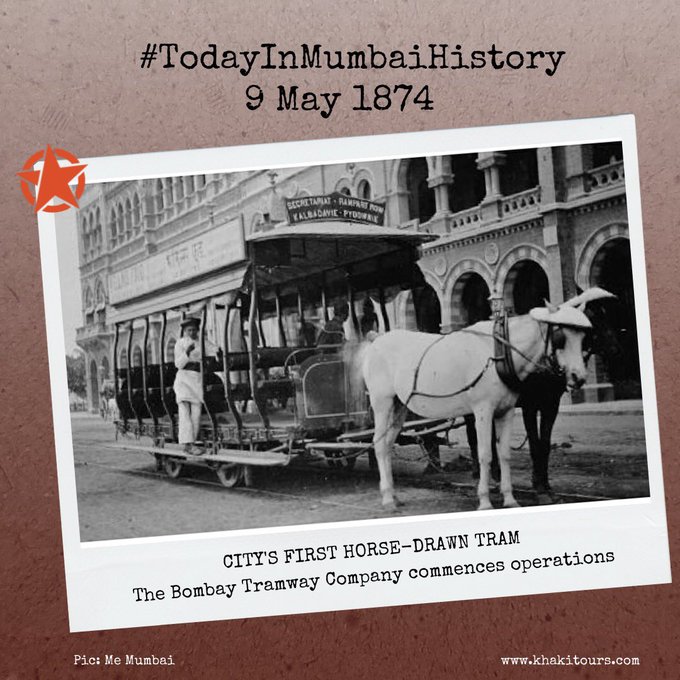
This day, 147 years ago, the Bombay Tramway Company run by the American firm of Stearns Hobart & Co., started #Mumbai’s first horse-drawn #tram service. The first route was between #Colaba and #Pydhonie via #CrawfordMarket. The fare was 3 annas (15 paise).


MARINE DRIVE 1950
VT STATION 1985 SHOWING HORSE TRAMS(BEFORE ARRIVAL OF CARS)
Bhendy Bazaar, Mumbai (1880)
Reversing Stations and Catch sidings
BOMBAY B.E.S.T. TRAMS
B.E.S.T[ BOMBAY ELECTRIC SUPPY AND TRANSPORT]. BUS BOMBAY 1926
SINGLE DECKER SKODA -TROLLEY BUS
BEST VESTIBULE BUS
VESTIBULE BUS
SINGLE DECKER ELECTRIC TRAM IN FRONT OF VT STATION BOMBAY
DOUBLE DECKER TRAM ;B.E.S.T. COMPANY;BOMBAY
BEST TOURIST BUS 1926
Limited Bus Service
BEST TROLLEY BUS
BEST TRAILER BUS
BEST TRAIN TYPE[ONE PULLING SECOND] BUS

B.E.S.T. Company and BOMBAY{mumbai}-history-- Electricity/Tram/bus arrives in Mumbai
|


| |||||||||||||||||||||
|


TRAMS WERE POPULAR IN BOMBAY CALCUTTA AND KARACHI
Bombay single deck Tram

BOMBAY DOUBLE DECKER TRAM

CALCUTTA TRAM

CALCUTTA TRAM

CALCUTTA TRAM

DELHI TRAM
![[Tram+in+Delhi.jpg]](https://blogger.googleusercontent.com/img/b/R29vZ2xl/AVvXsEhL9P-1rbbF1Xh3y7J9is4b5mBIKD5ZrE-n5exHahXUunVaaDBw156gAOwW6yNjuNFLDyORXmLaucyda9zj5ecBS8udolWeojtI_so7lw9tAcGjfVgR6-tDM2HqdQWkEws0JSP1djUZkjAT/s1600-rw/Tram+in+Delhi.jpg)

DELHI TRAM

KARACHI TRAM


BOMBAY DOUBLE DECKER TRAM
CALCUTTA TRAM
CALCUTTA TRAM
CALCUTTA TRAM
DELHI TRAM
DELHI TRAM

KARACHI TRAM


