
SS Gairsoppa: The British cargo ship SS Gairsoppa, which sailed from Calcutta (Kolkata), India, in December 1940, was torpedoed by a German U-boat on February 17, 1941, after breaking away from its convoy due to low fuel. The ship was carrying a large cargo of silver, estimated at up to 7 million ounces (approximately 240 tons), along with tea, pig iron, and other goods. The silver was intended to support Britain’s war effort during World War II.
The wreck was discovered in 2011 about 300 miles southwest of Ireland, at a depth of nearly 4,700 meters (15,400 feet). Recovery operations were conducted by the U.S. salvage company Odyssey Marine Exploration, under contract with the UK government. Over two summers, more than 3 million troy ounces of silver were recovered—mostly in bars.
In 2013, the Royal Mint began producing commemorative 50p coins from the salvaged silver, marking the ship’s history and honoring the 84 crew members lost. The project was a record-breaking deep-sea salvage operation, with Odyssey retaining 80% of the recovered silver’s value and the UK Treasury receiving the remaining 20%.


London A shipwreck holding silver worth £150million has been discovered in the Atlantic — the largest amount of precious metal ever found at sea. About 200 tons of the bullion sank off Ireland with British cargo steamer the SS Gairsoppa when it was hit by a German torpedo in 1941. But it has now been found by US treasure hunters hired by UK Department for Transport.They will now attempt to salvage the silver and will have to hand 20% of its value to the British Treasury.  Treasure hunter: The RV Odyssey Explorer, bristling with high-tech equipment, which went looking for and found the wreck of the Gairsoppa The US team lowered a robot 2.9 miles to the seabed and it found a gaping hole in the side of the ship where the torpedo had struck 70 years ago. Greg Stemm, chief executive of underwater archaeology and salvage firm Odyssey Marine Exploration, said: “We were fortunate to find the shipwreck sitting upright, with the holds open and easily accessible. “This should enable to us to unload cargo through the hatches, as would happen with a ship alongside a cargo terminal.” Valued then at 600,000 pounds, the silver today is worth about £150million, which would make it history's largest recovery of precious metals lost at sea, Odyssey said. After a competitive tender process the British government awarded Odyssey an exclusive salvage contract for the cargo, and under the agreement Odyssey will retain 80 percent of the silver bullion salvaged from the wreck. In May 2007, Odyssey announced it had found half a million silver coins and hundreds of gold objects from a ship they code-named the "Black Swan," which went down in 1804 off the Strait of Gibraltar. The find is being contested by Spain, which claims the trove. Sunken Treasure  Hoard: The ship, which was torpedoed after breaking away from a convoy, was carrying silver • The 125-metre Gairsoppa had been sailing from India back to Liverpool in February 1941 bearing a cargo of silver, pig iron and tea, and was in a convoy of ships when a storm struck. • Running low on fuel, the Gairsoppa broke off from the convoy and set a course for Galway, Ireland.  • It was hit by a German torpedo in the contested waters of the North Atlantic • Of the 85 people on board, only one survived • The Gairsoppa came to rest nearly 4,700 m below the surface. A previous effort to locate the shipwreck failed.  Finders Keepers. -------------------------------------------------------------------------------------------------------------------------------------- As late as the 1750s, India had an export surplus; its favourable trade balance was matched by bullion import, as the world had nothing else to offer India in return for its fine textiles. British colonialism reversed this process, first by monopolising trade and then — in the early 19th century — by demolishing Indian industry. During the period when British trade established supremacy, goods were exported by India but the bullion never reached the country. British merchants purchased goods in rupee receipts in India, and exchanged them abroad for bullion. Much before Dadabhai Naoroji and the so-called ‘modern nationalist’ school came up with a figure for India’s drain of wealth, Mughal chroniclers had put it at more than 100,000 million pound sterling per annum. Dadabhai NAVROJIproved that the average annual income of an Indian was barely Rs 20. Examining the import and export figures for 37 years, he proved that India's exports exceeded its imports by Rs 50 crores (approximately $135 million) annually. In fact, bullion owed to India helped finance England’s Industrial Revolution. Then, in order to flood Indian markets with European goods, India was de-industrialised. From being a supplier of luxury goods, it was turned into an exporter of raw material. Between 1820 and 1840, de-industrialisation closed down more than 12,000 markets, controlled and operated by peasants and small entrepreneurs in northern India The ideological moorings of imperialism have been many. From liberal
tradition of orientalism to that of not so good utilitarianism. All
these affected the political as well as the economic fabric. The
imperial powers started as trading organisations and later developed
into full fledged political powers. This transformation was to a large
extent based on the control over resources. In India's context, this had
meant things like:
# Use of territorial revenue by British trading company as 'investment',
whereby during the eighteenth century, it would use the territorial
revenue of Bengal to buy goods from Bengal and export that to Europe,
and would show that this money was their 'investment' in India!
#Trade imbalance that had gradually transformed India from an exporting
country in goods like Cotton to that of an importing country of cotton.
#Transfer of wealth in form of invisibles eg. transfer of profit,
pensions, cost of maintenance of Office of Secy etc all these coming
from Indian revenue.
Destruction of handicraft industries (during the later eighteenth
century), when the industrial revolution had only just started~ and
perhaps the societies were poised in a balanced way. This is also
related to an important phenomena of "proto-industrialisation" and
"deindustrialisation".
# Destruction of technological industries like shipping in the early nineteenth century. Here it is interesting to note that shipping of India was not outdone by any Western technology, but by the non-technological political policies made in Britain. Scholars like Gunder Frank also puts the western superiority in areas like shipping only by 1840s. All these meant technological impoverishment in the long run Churchill's legacy leaves Indians questioning his hero status ...www.bbc.com › news › world-asia-india-53405121 Jul 20, 2020 — A cyclone and flooding in Bengal in 1942 triggered the famine. But the policies of Sir Winston Churchill and his cabinet are blamed for making ... Sep 8, 2017 — 5. Famines in India. Between 12 and 29 million Indians died of starvation while it was under the control of the British Empire, as millions of tons of ... Bengal famine of 1943 - Wikipediaen.wikipedia.org › wiki › Bengal_famine_of_1943 The Bengal famine of 1943 was a famine in the Bengal province of British India during World ... Aid increased significantly when the British Indian Army took control of ... given provincial governments in November 1941 under the Defence of India Act, 1939. ... Poverty and Famines: An Essay on Entitlement and Deprivation. Famine had been a recurrent feature of life the Indian sub-continental countries of India, ... The first major famine that took place under British rule was the Bengal Famine of 1770. ... place in the historiography of famine due to Sen's classic work of 1981 titled Poverty and Famines: An Essay on Entitlement and Deprivation. Apr 16, 2019 — PDF | During British rule India and other colonial coutries were visited by devastating and recurrent famines.During ... poverty, chronic hunger and starvation. Over nine ... 1918-19, 1920-21, 1936-38, 1939-40, 1941-43 and 1946- WHEN INDIA WAS STARVING AND DYING BRITISH COLONIAL RULERS WERE TAKING SILVER OUT OF THE COUNTRY IN A HURRY FOR 2ND WORLD WAR! =================================== The Silver ShipUnder a mile and a half of water, three million silver Saudi riyals lay for 50 years on the seafloor off Oman, sunk with the rest of the cargo of a World War II Liberty ship bound for Dhahran. Was the John Barry also carrying $26 million worth of silver bullion when she went down? A high-tech salvage effort has recovered about half the coins, but the mystery remains.This article appeared on pages 20-27 of the March/April 1997 print edition of Saudi Aramco World. A sunken treasure of silver coins, recovered after more than 50 years beneath the sea, is still looking for a home on dry land. Minted in Philadelphia at Saudi Arabia’s request, a cargo of three million silver Saudi one-riyal coins was shipped to the oil port of Dhahran, in Saudi Arabia’s Eastern Province, late in World War II. But the Liberty ship that was transporting them, the S. S. John Barry, never arrived. Torpedoed by a German U-boat in the Arabian Sea more than 185 kilometers (100 nautical miles) off Oman in August 1944, the John Barry sank in waters so deep that no one thought she could ever be reached. Among the debris that marked her grave swirled rumors that, in addition to the coins, she was carrying a huge cargo of silver bullion. Gerald Richards, now in his mid-70’s, vividly recalls the night the John Barry sank. He was a Merchant Marine purser aboard the US cargo ship. “We were two days and eight hours out from Aden,” he says. “I was just getting around to going to bed at 9:55 p.m. when the first torpedo hit. It rocked us, I’ll say that.” Richards was thrown into oil-covered, wreckage-strewn seas when one of the davits holding his lifeboat snapped before the boat could be lowered. After an endless 15 minutes in the water, he was picked up by another lifeboat. Later that night he and his shipmates watched as another torpedo slammed into the John Barry, breaking her in two and sinking her in 2600 meters (8500′) of water. One of the few remaining survivors of the Liberty ship’s last voyage, Richards knew there was something special about the John Barry’s cargo when he saw guards with machine-guns on board as the ship loaded in Philadelphia in July 1944. That kind of security was “very, very unusual,” he recalls. 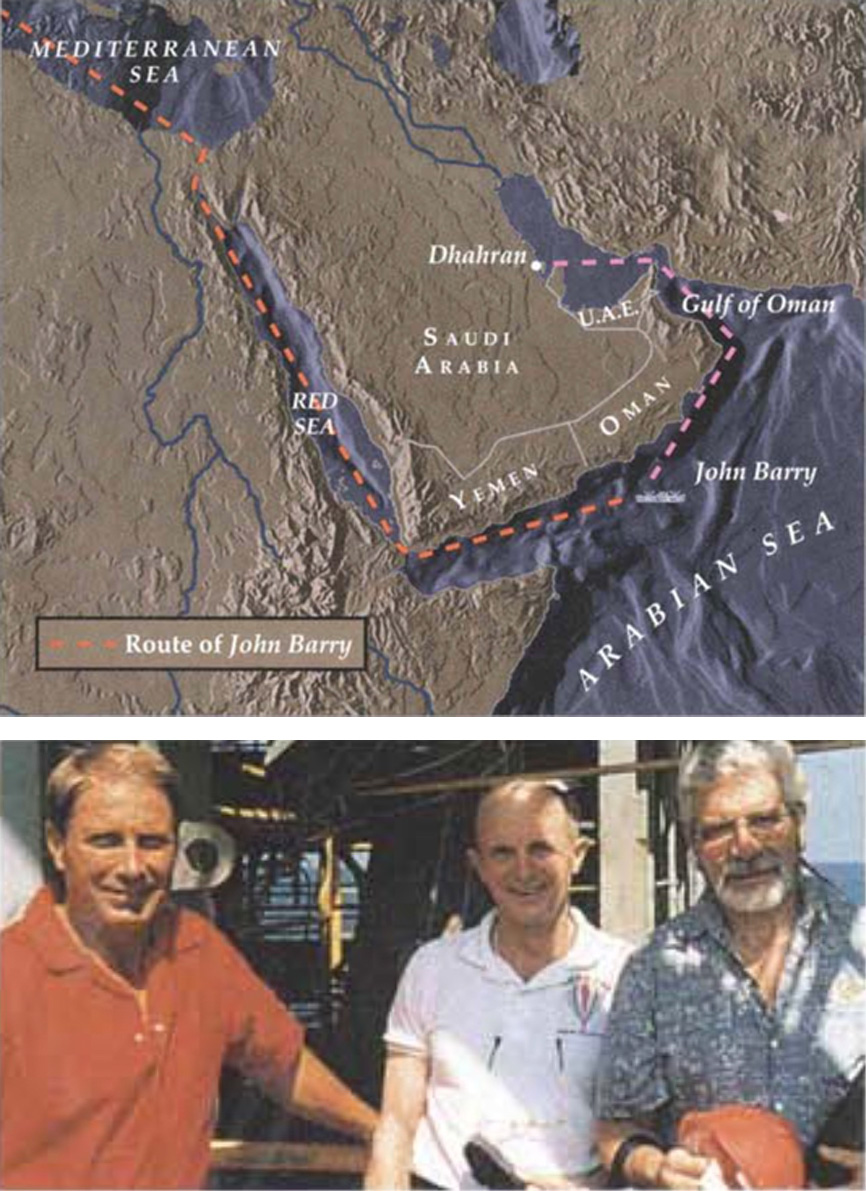 Aboard the Flex LD recovery ship, after five years of planning and preparation: British salvage expert Robert Hudson, left, who commanded the overall effort, and retired us Navy captain Brian Shoemaker, whose early curiosity about the S.S. John Barry led him to form a salvage group in 1989 with California restauranteur and marine salvor Jay Fiondella, right. (Photo courtesy Jay Fiondella) Amid a torrent of cargo that included refinery equipment, lengths of pipe, military trucks and a Caterpillar tractor, Richards didn’t see 750 wooden boxes go into the heavily guarded No. 2 hold. Stencilled on each box was the word “Dhahran,” the name of a new Middle East oil outpost. Secrecy was the watchword in wartime, and the John Barry’s crew should have known nothing about her secret cargo. But, says Richards, “I always figured there was silver bullion aboard because of the security they put on until we sailed.” After the war, he says, he forgot about the matter until 1994, when he was shown a 50-year-old letter from the superintendent of the United States Mint in Philadelphia stating that three million silver coins had actually been on board. The John Barry crossed the Atlantic in a convoy and proceeded south through the Suez Canal to Aden. Then, mysteriously, she was ordered to sail through the Arabian Sea—alone, on a zigzag course, and in radio silence. When a German submarine picked up her trail, the John Barry didn’t stand a chance. Astonishingly, only two crewmen were lost in the sinking. The next day, ships picked up the survivors and ferried them to shore. According to published accounts of the sinking, both Richards and the Barry’s captain, Joseph Ellerwald, stated that the ship had been carrying $26 million worth of silver bullion. Since silver was then worth 48 cents per troy ounce, that reckoning—never corroborated by the US government—would mean that the vessel’s cargo had included more than 1688 metric tons (1857 US tons) of silver. “I’ve asked myself how I knew: Everything was confidential then,” says Richards, who now lives in Independence, Missouri. “Up till I saw the letter from the mint, I just figured there was silver bullion.” Richards might also have asked himself why the silver, whether bullion or coins, was headed for Dhahran.
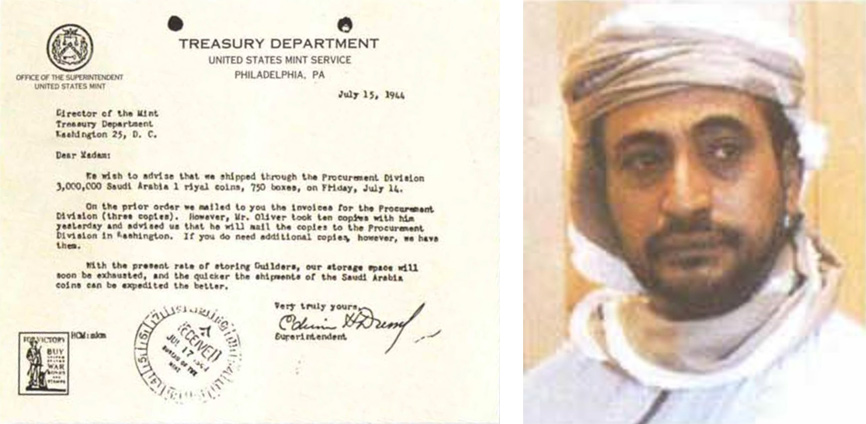 Left: The minting and shipment of the coins, paid for by Saudi Arabia under the terms of America’s 1941 Lend-Lease Act, was not secret, but their purpose was not declassified until 1984: The coins increased the amount of money circulating in the Saudi economy, making it possible to pay the workers who were building Aramco’s new refinery at Ras Tanura. Other shipments of silver riyals, totaling 49 million by war’s end, reached Saudi Arabia safely. Right: Oman-based entrepreneur Shaykh Ahmed Farid al-Aulaqi, head of Ocean Group, bought salvage rights to the John Barry from Shoemaker and Fiondella. (Sid Jordan) The small town on Saudi Arabia’s east coast was the regional headquarters of what was then the Arabian American Oil Company, known as Aramco, now the Saudi Arabian Oil Company (Saudi Aramco). It was also the site of a new US consulate. Oil had been discovered there just six years before (See Aramco World, May/June 1988), and Dhahran’s population was only a few hundred men. But it was becoming clear that there were considerable oil deposits under Saudi Arabia’s soil, certainly in commercially interesting quantities, and oil was the lifeblood of the war effort. Though Germany was reeling under Allied attacks, the war in Europe was not over; in Asia and the Pacific, Japan looked far from finished. In Washington, there was mounting worry about the adequacy of American oil reserves. Securing additional supplies was crucial to winning the war. Late in 1943, the US government—which controlled such commodities in wartime—allocated steel and other materials for sale to Aramco for the construction of a new refinery, tank farm and marine terminal at Ras Tanura, 25 kilometers (15 miles) north of Dhahran. But there was a further problem: Workers building the new refinery had to be paid; paper money was not yet in use in Saudi Arabia; and by 1943 the kingdom—and Aramco—had run short of riyal coins. The world economy was so unsettled that the riyals in circulation were valued more for their silver content than as a medium of exchange. Les Snyder, who was an Aramco employee in Dhahran in 1944, recalled that the company had to “scrounge for local supplies of riyals,” even sending him to Riyadh to buy coins from merchants there. The currency shortage was finally resolved when the Saudi government, under the terms of the 1941 Lend-Lease Act, arranged to buy silver in the United States to be minted into riyals in Philadelphia. The first American minted coins arrived in Saudi Arabia in the autumn of 1943, marking the beginning of a new relationship between Washington and Riyadh, and by the end of the war a total of 49 million riyals had been shipped unscathed from the United States to Saudi Arabia. The only consignment lost was on the John Barry. Snyder doesn’t recall the loss of the coins on the John Barry; he was upset that the loss of the ship’s general cargo set back refinery construction. But Parker Hart, then the United States consul-general in Dhahran, was furious that Britain, which was supposed to guard the sea lanes off the Arabian Peninsula, hadn’t provided adequate protection for the John Barry. Hart was to have collected the shipment of riyals for delivery to Riyadh. When the Barry went down, the riyal was worth 30 US cents. The ship’s three-million-riyal cargo therefore had a face value of $900,000. The silver in each coin, about 10 grams (3/8 of an ounce), was worth 18 cents, so the coins’ silver value was $540,000. Neither figure is anywhere near the $26 million that the Barry’s captain and purser were quoted as saying the cargo was worth. Hart’s cables about the sinking, secret when they were sent, don’t mention any uncoined silver, but with time the rumor of sunken bullion became accepted as colorful fact. 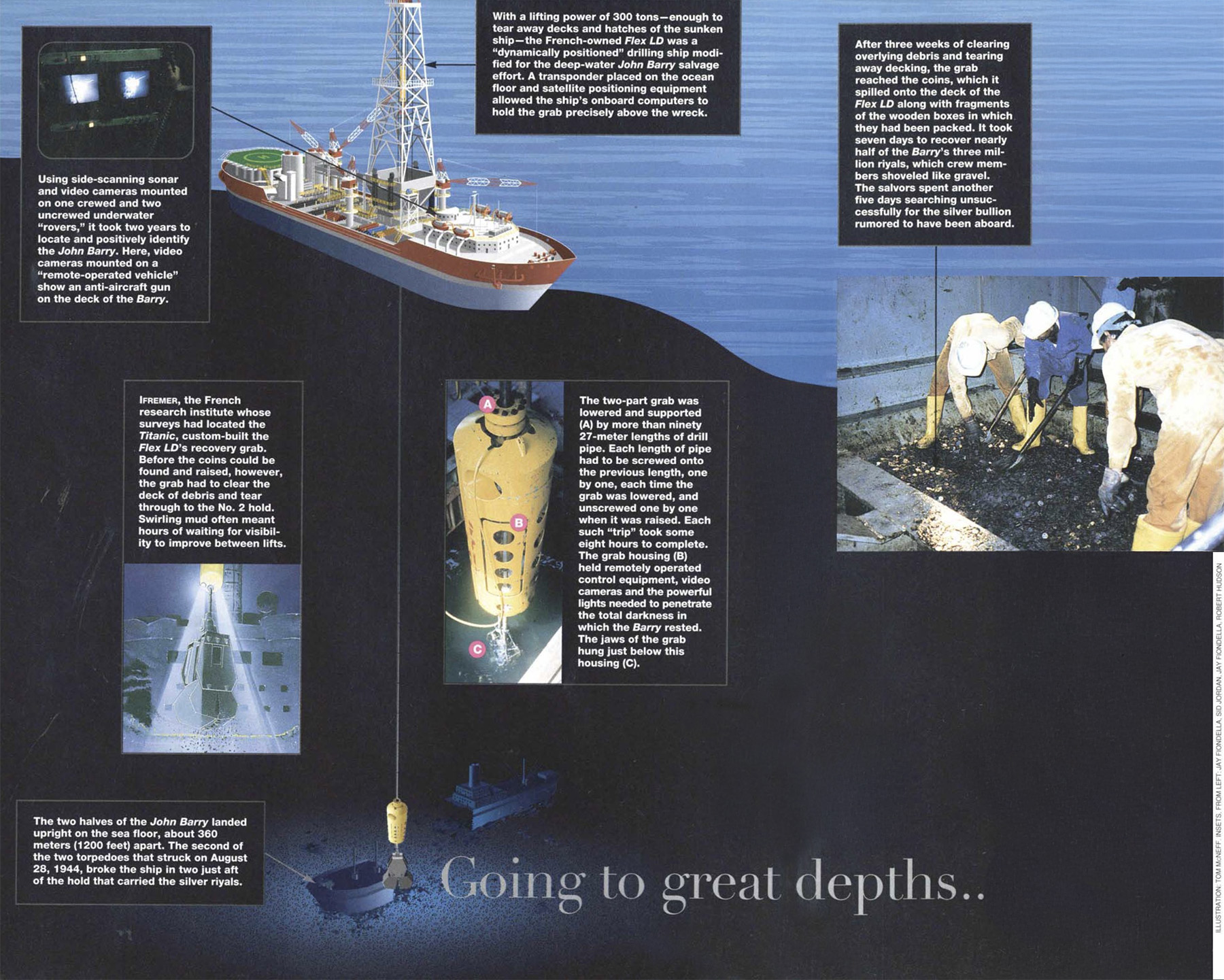 (Illustration: Tom McNeff. Insets, from Left: Jay Fiondella, Sid Jordan, Jay Fiondella, Robert Hudson) Thus, in his 1972 book Liberty Ships: The Ugly Ducklings of World War II, John Gorley Bunker writes, “The John Barry [was] a most unlikely treasure ship,…but securely crated and locked in her holds was a fortune more fabulous than even Ali Baba and his forty thieves could have hoped for—$26 million in silver bullion…. Somewhere in the Arabian Sea one of the richest treasures of all time waits, well protected by a mile of seawater, for the future technique that may enable a salvage crew to bring it up.” After aborting a scheduled auction of salvage rights to the ship in 1978, the US government re-advertised the rights in 1989. It reported that the Barry had been carrying a cargo of assorted vehicles and an unspecified amount of “silver bullion.” That caught the attention of Brian Shoemaker and Jay Fiondella, who were undaunted by the fact that no commercial salvage had ever been attempted at 2600-meter depths. But they weren’t after the riyal coins: By themselves, the coins probably wouldn’t pay for a recovery effort. They were interested in the bullion. Silver valued at $26 million in 1944 would have been worth about $380 million in 1987, when the metal was priced at just over seven dollars an ounce. That much treasure, they calculated, might attract the kind of investors who could finance a pioneering deep-sea salvage mission. So Shoemaker, then a Navy captain, turned all his spare time to finding evidence that the John Barry had been carrying silver ingots. Though he couldn’t prove that the bullion had been aboard, he did turn up tantalizing tidbits of information that pointed that way. He discovered official wartime papers showing that the United States had signed an agreement in June 1944 to send some 100 million ounces of Lend-Lease silver to India—just a month before the John Barry docked in Philadelphia. Later, he found proof that 90 million ounces of silver destined for India had been delivered to the port of New York at the same time the John Barry was docked there, just before she sailed—supposedly in ballast—to Philadelphia to collect the riyals. In November 1989, with a bid of $50,010, Shoemaker, Fiondella and two Washington lawyers won the right to salvage the Liberty ship, if they could. But before the newly named John Barry Group could launch its project, it had to deal with an immovable provision of international law. The wreck lay off the coast of Oman, not in Omani territorial waters but certainly in the sultanate’s declared economic zone. The project couldn’t proceed without Omani participation. Fortunately, Omani participants were ready. The mission to raise the Barry’s cargo had captured the imagination of British salvage expert Robert Hudson and of Shaykh Ahmed Farid al-Aulaqi, a wealthy Yemeni-born businessman who lives in Oman. Hudson, now managing director of Blue Water Recoveries of Surrey, England, was a member of Ocean Group, an organization set up by al-Aulaqi. Ocean Group would represent Oman in a bid to solve the John Barry mystery once and for all. 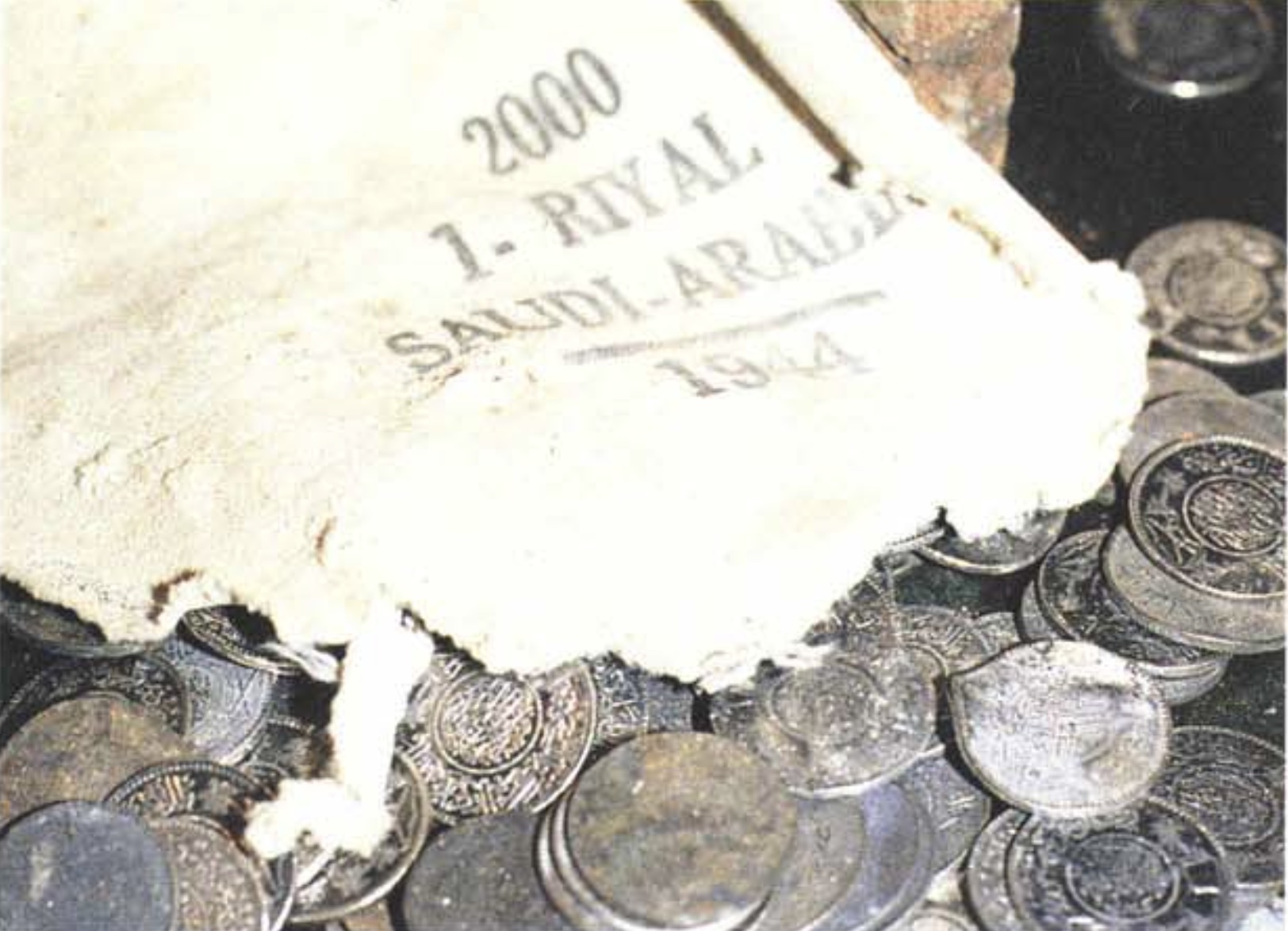 The S.S. John Barry‘s cargo of three million riyals was packed in 1500 canvas bags, some of which were recovered substantially intact. The bags were packed two by two in wooden boxes; the entire cargo weighed 37 us tons. In a deal reportedly worth $750,000, Ocean Group bought the salvage rights from the John Barry Group in 1990. The deal “was a bitter pill to swallow” despite its profitability, notes Fiondella, who had been as interested in the adventure as the money. But there was a sugar coating, in the form of a provision that, if Ocean Group recovered the bullion, “it would make me a millionaire.” Ocean Group moved quickly. A side-scan sonar survey at the coordinates shown in American and German war records promptly located a hulk in March 1990, says Hudson, whose Blue Water Recoveries was offshore project manager. In early 1991, a video-equipped remote-operated vehicle (ROV) sent back images of a wreck in two pieces. It was a Liberty ship, but it could not be positively identified as the John Barry. Still, those first images made it almost certain the mission was on target. In his book Stalin’s Silver, Ocean Group spokesman John Beasant quotes a technician on the scene as saying that the ROV showed the ship’s deck covered with “American World War II military vehicles…together with gun turrets and stacked drill pipes.” Early in 1992 a more detailed video survey showed the John Barry’s nameplate and ended any doubt. It also showed that the No. 2 hold was intact, though its hatch was blocked by debris. Views of the seafloor between the two halves of the ship—where silver bullion might have spilled when the ship broke in two—showed no sign of any ingots. Salvage contractors from Houston, Texas handled the first two stages of the operation. In 1992, the French government marine-research organization, the Toulon-based Institut Français de Recherche pour l’Exploitation de la Mer (IFREMER), joined the search. IFREMER had located the wreck of the Titanic in 1985; their task here was to send down a minisub with a crew to examine the wreck and pick the right spot to place explosives that would tear it open. The prow of the ship, where the salvors thought bullion might have been stored in deep tanks, had angled into the seabed and lay partly buried in mud. The experts chose the more accessible No. 2 hold, with its documented cargo of coins, as their target. The underwater charges went off, but they proved so weak at that depth that they did little damage. IFREMER got the green light to develop riskier “smash-and-grab” technology that would allow the team to break into the John Barry by main force. Taking such chances wasn’t unusual for Ahmed Farid al-Aulaqi. “The element of chance, the element of risk, is part of Shaykh Ahmed Farid’s character,” says Beasant. In Stalin’s Silver, Beasant states that al-Aulaqi had, in fact, risked “some $10 million” to make the mission possible. In October 1994, a modified drilling ship, Flex LD, carrying a 50-ton video-equipped grab designed by IFREMER and resembling the jaws of a giant steam shovel, sailed to the location of the John Barry’s grave. With its satellite positioning system holding it on station to within a few meters, the ship’s crew fitted together section after 27-meter (90′) section of pipe, building a “string” that lowered the grab toward the target. In early November, after the grab had stripped away the deck over the No. 2 hold and cleared away obstructing cargo, Hudson spotted the first glimmer of silver on the video screen. Over the next five days, the grab brought up 1.3 million Saudi riyals weighing 17 tons and showered them onto the drill-ship’s deck. One mighty lift alone brought up 60,000 coins. Even after the grab had harvested all the coins it could—the rest were abandoned as irrecoverable—the salvors continued to ransack the No. 2 hold. Hoping to find a safe containing the ship’s loading plan, they even peeled open the captain’s cabin. “We were still trying to prove the silver-bullion theory,” Hudson says, “but we failed.” Today, Hudson is convinced that there never were silver ingots aboard the John Barry. “It was all hearsay,” he says. “The crew of the Barry sat around and talked every night after watch…and eventually put a value on the [imaginary] silver.” The idea that the ship was carrying bullion to India on Britain’s Lend-Lease account doesn’t hold water, Hudson says; his own research shows that almost all the silver shipped there was actually delivered. 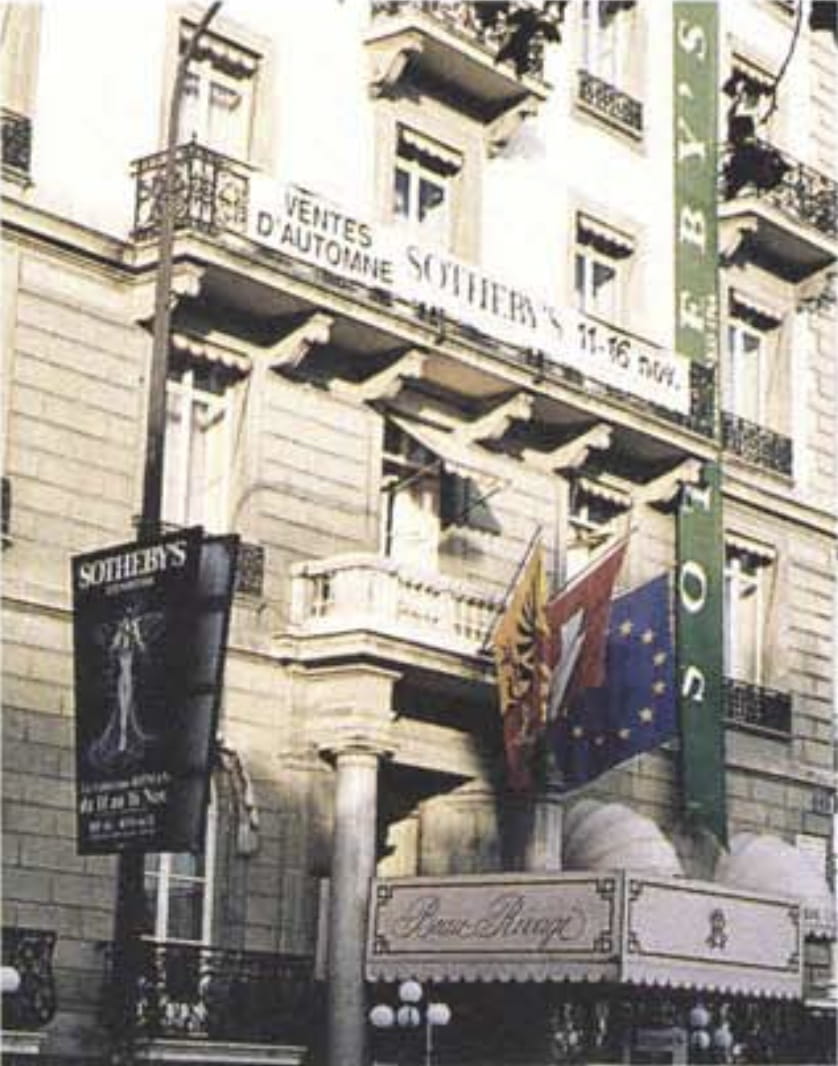 Offered as a single lot by Sotheby’s at a 1995 auction at the Beau Rivage hotel in Geneva, the John Barry‘s treasure failed to attract bids above the sellers’ reserve figure. Blue Water thus began to offer the coins singly to collectors. In the United States, they are available from Dakota International of Jacksonville, Florida. Beasant, on the other hand, argues that there could have been bullion aboard that was bound for the Soviet Union. His idea is based on wartime records from the Kremlin, which he received from the Russian Embassy in Muscat in 1995, that show that Washington agreed to supply Moscow with a “special” unnamed cargo worth $25 million in 1943. The near match between the value of that cargo and the $26-million value of the rumored silver on the John Barry “is beyond the bounds of credible coincidence,” Beasant writes. He theorizes that the Barry had a secret itinerary, and was scheduled to sail on from Ras Tanura to an Iranian port from which the USSR, an American ally in World War II, was being supplied with materiel. In fact, the Allies had developed the ports of Khorramshahr and Bandar Shahpur, at the head of the Arabian Gulf, for just this purpose, and completed both a highway and a rail line from there to the Caspian Sea in January of 1943. Al-Aulaqi is a believer in the silver bullion too, says Beasant, and in fact still hopes to find it. There is a “distinct possibility” that he might return to the site in the future, he says. Hudson says that building the recovery equipment and raising the coins from such unprecedented depths was a victory in itself. “It was a great relief that we found the riyals. It gave us all a buzz,” he says. “It was rewarding to see such an effort prove itself.” Financial rewards were harder to come by, however. Almost exactly a year after the recovery, on a rainy November night in Geneva, the coins were put up for auction by Sotheby’s as a single lot. In spite of heavy advance publicity, they failed to attract a bid at a starting price of about eight million dollars. Coin reference books list the value of uncirculated 1944 riyals as about $12 each, so the entire hoard, if each coin could be restored to mint condition, might be valued at $15.6 million. Sotheby’s representatives, in pre-auction interviews, described the coins as representing a unique “slice of history—more valuable than just the coins themselves.” A spokesman for Blue Water Recoveries said in Geneva that the company had been approached by individuals, including some Saudi citizens, about buying smaller lots of the coins, but had opted for a one-lot sale in the hope of finding a collector who might give the coins to a museum. In a bid to share some of the drama and history surrounding the recovered treasure—and to recoup expenses—Blue Water began a campaign in 1996 to sell the coins, initially in the United States. Success in that phase of the operation would, in effect, bring the riyals—perhaps the John Barry’s only real sunken treasure—back full circle to America, where the coins were minted to assist an important new ally more than 50 years ago. |

.jpg?cx=0.5&cy=0.5&cw=480&ch=360)
