Society painters – the Indian artists who worked for the East India Company
Society painters – the Indian artists who worked for the East India Company
‘Empire follows Art & Not Vice Versa as Englishmen suppose.’ So claimed William Blake in his well-known annotation to Joshua Reynolds’ Discourses on Art of 1778. If an exhibition was calculated to challenge Blake’s counterintuitive statement, it is ‘Forgotten Masters: Indian Painting for the East India Company’, currently at the Wallace Collection, coincidentally at the same moment as the major Blake exhibition on show a couple of miles south, at Tate Britain (and where empire, by contrast, is decidedly understated). The Wallace’s show brings to public attention, largely for the first time, the paintings and drawings of Indian artists working in the violently transformative era, from the 1760s to the 1850s, when the Indian subcontinent was shifting increasingly from Mughal to British imperial control. It has been guest-curated by William Dalrymple, the leading historian of British India, who has brought together a rich array of works on loan from a wide range of public and private collections, much of which has not been on display in the UK before, and certainly not in the environment of an art institution such as the Wallace.
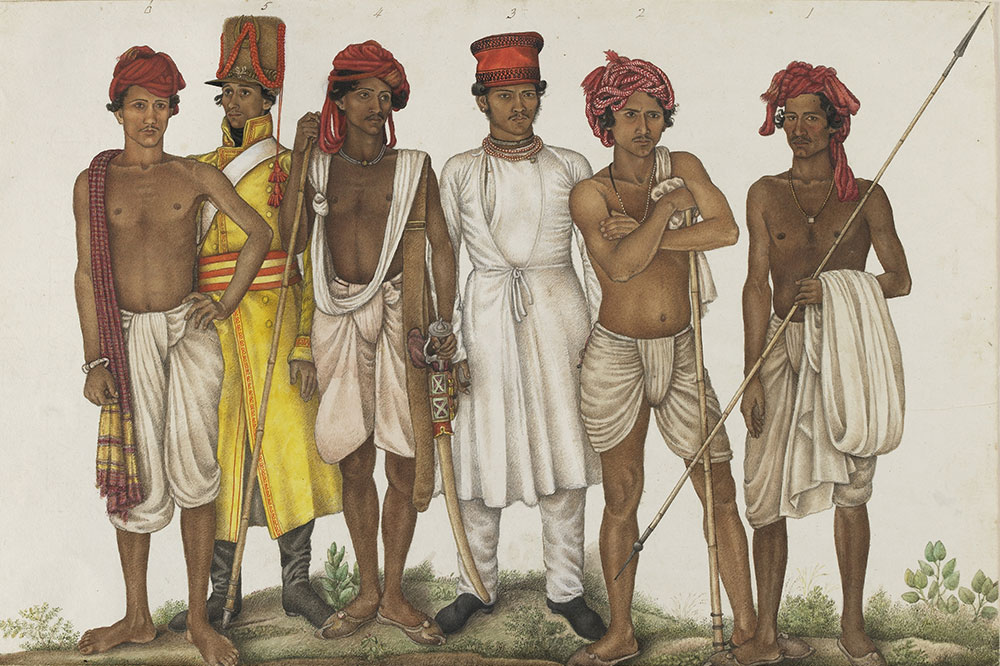
The exhibition’s main aims are two-fold: firstly, to recover and reevaluate the art of these ‘forgotten masters’ (no female artists are included), hitherto unjustly dismissed as ‘Company School’ painters, merely jobbing servants of a colonial regime; and secondly, to demonstrate how these artists adapted their techniques, subject matter and painterly practice, inherited from Mughal traditions, to meet the demands of East India Company patrons across a variety of geographical cultural centres and social and professional contexts. Accordingly, artistic innovation is to be understood as a consequence of imperial conquest, and (pace Blake) not the other way round. The exhibition is laid out clearly and logically, with each room more or less devoted to an individual artist or artistic circle, a particular cultural centre such as Lucknow or Delhi, and a specific genre such as natural history painting, or representations of everyday Indian society and culture, through its castes, professions, buildings and so on.
