


Search Results


Page Navigation


Premchand Roychand
Premchand Roychand | |
|---|---|
 | |
| Born | March 1832 Surat, Gujarat, India |
| Died | March 1906 (aged 74–75) |
| Occupations | Stockbroker and businessman |
| Notable work | Donor of Rajabai Clock Tower and establishment and founder of Bombay Stock Exchange |
| Mother | Rajabai |
Premchand Roychand (1832–1906) was an Indian Śvetāmbara Jain businessman known as the "Cotton King" and "Bullion King" from Bombay.[1] He is most well-known for the establishment of Bombay Stock Exchange and for his donation in the construction of the Rajabai Clock Tower.
Life
[edit]Premchand Roychand was born in 1832 i
ANALYSIS
Cuddalore and the American Revolution
The Anglo-French rivalry connected India and US
)
Updated : Nov 12, 2017, 07:23 AM IST
 "HISTORIES")
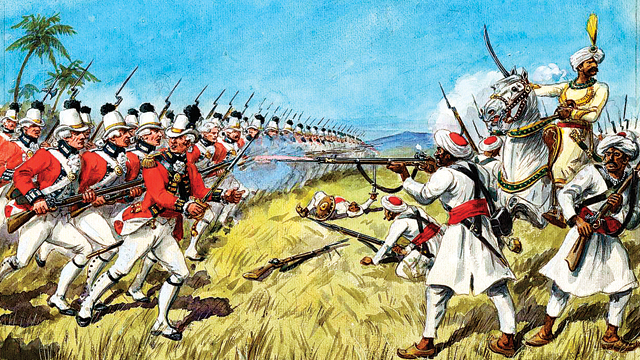
On July the fourth, 1776, a group of people in today’s America signed the Declaration of Independence. The United States celebrates that day as Independence Day, but at the time, it was viewed by England as a revolt against their authority. The East India Company was in no mood to let go of a cash cow with hundreds of acres of land and priceless cotton. But along with the British, another European power was making its presence felt in colonies across the world — the French. And in 1778, they threw their lot in with the Americans. They were also smarting over the loss of Canada to the British — although Voltaire described it as ‘losing a few acres of snow’. So the French opened up battlefronts against the British in the Caribbean Islands (especially Jamaica), in Gibraltar, of the Cape of Good Hope and also in India.
The French had been in India for quite some time and, in fact, had fought the British in the previous decade. But this time, they allied with the ruler of Mysore — Hyder Ali. The latter had been smarting over treatment given to him by the British and readily joined the French to settle scores with the East India company. Mysore allied with the French to battle and take several places in south India such as Cuddalore, ostensibly to help America attain independence. We are more familiar with these activities of Hyder Ali as the ‘Second Anglo-Mysore War’. Marquis De Bussy, who had played a central role in south India’s politics in the 1760s, arrived at Cuddalore and took over its command. In the beginning of 1782, Hyder Ali died and Tipu Sultan took his place. The Americans must have had some hint of the Anglo-Mysore Wars for there was an American ship named Hyder Ally plying the waters at the time.
The British were not going to sit idle. There was a lot at stake. Not just the United States, but also their newly formed rich colonies in India. Maj General James Stuart began the British siege of Cuddalore on June 7, 1783. His army consisted of not just East India Company soldiers, but also those from the regular British Army — the 73rd and 78th Highlanders. The British also had help from the German principality of Hanover in this battle — led by Christoph Von Wagenheim. The Germans were majorly involved in other battles related to the American Revolution, too, and were generally referred to as ‘Hessians’. But a curious thing had happened almost six months earlier
From 1778 to 1782, the French and the British had fought more than 40 battles against each other. Even Spain had joined the fray and to make matters more complex, the British had also fought the Dutch in battles related to the American Revolution. The British were finding it difficult to hold on to their American colonies, and so a truce had been signed between England and France in 1782. A ship left for India carrying the good news soon after.
Meanwhile, at Cuddalore, a French Admiral named Andre Du Suffren had arrived and he opened a naval front in what was till then a land-based war. He had fought a series of battles against the British Admiral Edward Hughes all over the Indian Ocean and now the British and French faced off against each other off the coast of Tamil Nadu.Major General James Stuart had repeatedly asked for reinforcements but to no avail. He, of course, did not know that a truce had been signed.
Du Suffren’s attacks on Cuddalore meant that the British could not hold on to the siege and Stuart soon retreated to Madras. Admiral Du Suffren was able to land around twenty-five hundred troops, once the British threat had reduced at the naval front, further compounding their problems.
But even so, the French and their soldiers drawn from Mysore’s army were not able to fully break the siege. It was hard work for both sides in the sweltering heat and humidity of south eastern India. Many people died of heatstroke, dehydration and dysentery. The naval contingents, as was often the case, were afflicted with scurvy — a disease of the gums. This was over and above the ones lost to the actual warfare.
Finally, at the end of June, the ship from England arrived. It had taken seven months to complete its journey — a time in which the Battle of Cuddalore took place and hundreds died. But there was no faster way for news to reach in those days. An unnecessary battle had taken place, and what’s more, the terms of the truce granted Cuddalore back to the British. Pondicherry and Mahe went to the French. And thus ended the last battle linked to the American Revolution — halfway around the globe. A year more of negotiations and a new country was born: the United States.
The writer is the author of Brahmaputra — Story of Lachit Barphukan and Sahyadris to Hindukush — Maratha Conquest of Lahore and Attock
|

'/%3E%3Cpath d='M16.0001 7.9996c0 4.418-3.5815 7.9996-7.9995 7.9996S.001 12.4176.001 7.9996 3.5825 0 8.0006 0C12.4186 0 16 3.5815 16 7.9996Z' fill='url(%23paint1_radial_15251_63610)'/%3E%3Cpath d='M16.0001 7.9996c0 4.418-3.5815 7.9996-7.9995 7.9996S.001 12.4176.001 7.9996 3.5825 0 8.0006 0C12.4186 0 16 3.5815 16 7.9996Z' fill='url(%23paint2_radial_15251_63610)' fill-opacity='.5'/%3E%3Cpath d='M7.3014 3.8662a.6974.6974 0 0 1 .6974-.6977c.6742 0 1.2207.5465 1.2207 1.2206v1.7464a.101.101 0 0 0 .101.101h1.7953c.992 0 1.7232.9273 1.4917 1.892l-.4572 1.9047a2.301 2.301 0 0 1-2.2374 1.764H6.9185a.5752.5752 0 0 1-.5752-.5752V7.7384c0-.4168.097-.8278.2834-1.2005l.2856-.5712a3.6878 3.6878 0 0 0 .3893-1.6509l-.0002-.4496ZM4.367 7a.767.767 0 0 0-.7669.767v3.2598a.767.767 0 0 0 .767.767h.767a.3835.3835 0 0 0 .3835-.3835V7.3835A.3835.3835 0 0 0 5.134 7h-.767Z' fill='%23fff'/%3E%3Cdefs%3E%3CradialGradient id='paint1_radial_15251_63610' cx='0' cy='0' r='1' gradientUnits='userSpaceOnUse' gradientTransform='rotate(90 .0005 8) scale(7.99958)'%3E%3Cstop offset='.5618' stop-color='%230866FF' stop-opacity='0'/%3E%3Cstop offset='1' stop-color='%230866FF' stop-opacity='.1'/%3E%3C/radialGradient%3E%3CradialGradient id='paint2_radial_15251_63610' cx='0' cy='0' r='1' gradientUnits='userSpaceOnUse' gradientTransform='rotate(45 -4.5257 10.9237) scale(10.1818)'%3E%3Cstop offset='.3143' stop-color='%2302ADFC'/%3E%3Cstop offset='1' stop-color='%2302ADFC' stop-opacity='0'/%3E%3C/radialGradient%3E%3ClinearGradient id='paint0_linear_15251_63610' x1='2.3989' y1='2.3999' x2='13.5983' y2='13.5993' gradientUnits='userSpaceOnUse'%3E%3Cstop stop-color='%2302ADFC'/%3E%3Cstop offset='.5' stop-color='%230866FF'/%3E%3Cstop offset='1' stop-color='%232B7EFF'/%3E%3C/linearGradient%3E%3C/defs%3E%3C/svg%3E)
 The Star-Spangled was born... on a Bombay-built ship.
 In 1814, during the War of 1812, American lawyer Francis Scott Key was held aboard this very ship.
 Want to know more about the Wadias and their legendary shipbuilding?

|


|


No comments:
Post a Comment