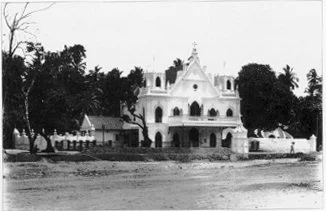
Portuguese Church - The Church of Our Lady of Salvation was originally built by the Portuguese Outside the Church's main entrance, on what is now the footpath or sidewalk, is a mortuary memorial to a Baretto, built about 200-300 years ago, and which names the location as "Mahim". Indeed, at that time, the Church was one of two Catholic Churches on the then Island of Mahim, with a shallow sea separating it on the east and south sides from other islands of the Bombay Archipelag
The name "Dadar" signifies a small stairway built on the eastern edge of Mahim Island; when the British built the Bombay, Baroda & Central India Railways (B.B.&C.I.
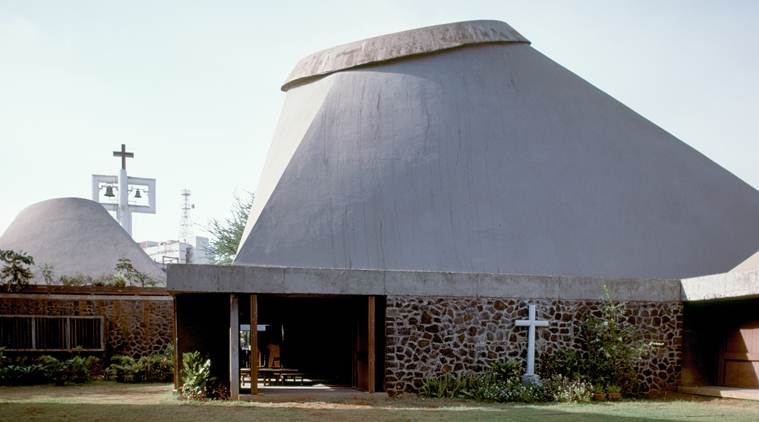
Dadar, Mumbai’s first planned suburb, is in popular imagination a place where culture and politics meet. When the Salvacao Portuguese Church, also called Our Lady of Salvation Church, was renovated in 1977, it was the first-of-its-kind makeover the city had seen. Gone were the steeples, the choir loft, the ascending roof and ornate facade, to be replaced by conical domes connecting the sanctuary (altar), the nave (central aisle), the baptistery (baptismal font), and the oratory (shrine). Charles Correa, by then, was already a Padma Vibhushan awardee, and had held the position of chief architect for Navi Mumbai.
The church was originally built by Portuguese Franciscans in the late 1500s and went through three renovations as it expanded. Correa was commissioned the revamp
in 1974. In an essay in his book A Place in the Shade, Correa writes of how architecture unites us, despite differences in religious beliefs.
How the axis mundi (the column of the universe connecting the earth to the sky) is fundamental to the architectonic symbolism in universal places of worship.
This “open to sky” motif appears in almost every Correa project. In this church, he attempts that with the conical flues, while the interconnected walkways and central courtyard become as much a congregational space as the interiors.
Correa’s other tradition-defying act was to invite MF Husain to do a fresco on glass for the central dome.
It was his idea of externalising the “social aspect of religion”.
Husain divided the glass into several segments for a stained-glass effect and painted the story of the five loaves and two fish, and the death and resurrection of Christ. On sunny days, it’s ethereal to see the light stream through the painting.
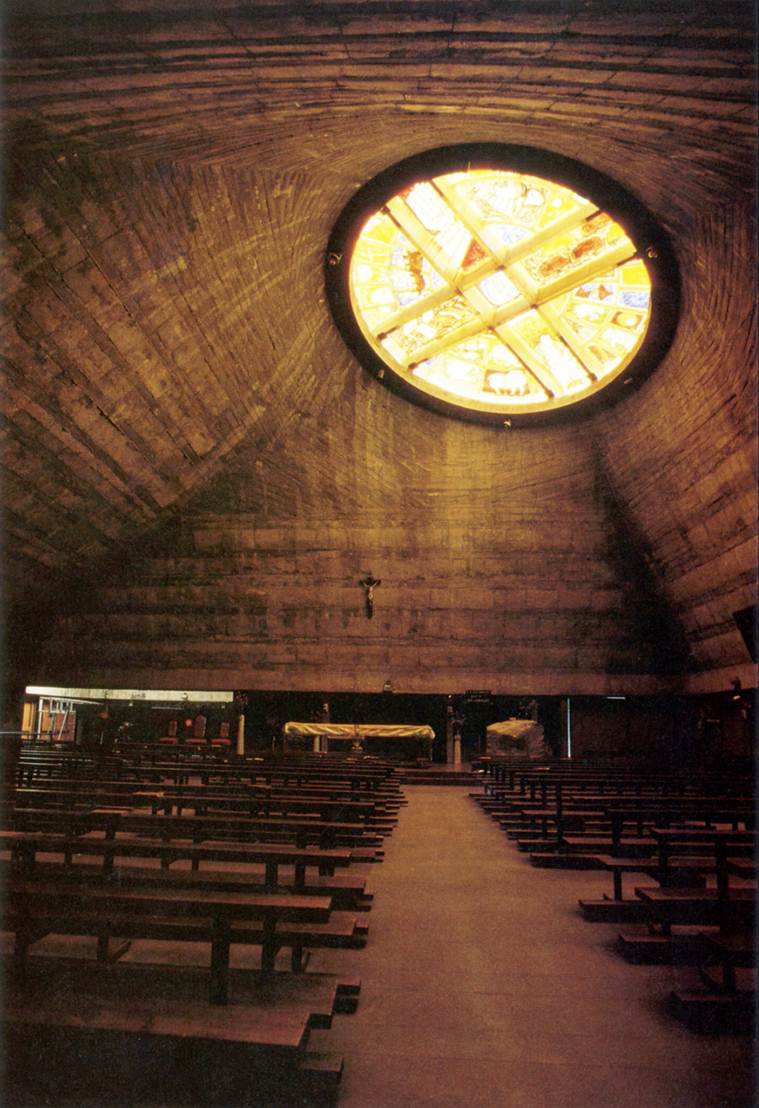 God’s grace: The fresco on glass painted by MF Husain.
“I experienced what a space is for the first time with this building,” says Smita Dalvi, a professor at the Pillai College of Architecture, Navi Mumbai, as she recalls her days as a student architect. “A church is traditionally about the architecture of the interior spaces, and here Correa moves from the inward space to the outward form.”
ACCORDING TO HISTORY:- THE OLDER CHURCH IN DADAR WAS DESTROYED BY SOME MEMBERS OF THE CHURCH AROUND 1950'S -TO MAKE NEW CHURCH WITH SHAPE OF AN OVERTURNED WASTE PAPER BIN-SAYING THAT IS NEW FASHION !!!
.png&imgrefurl=https%3A%2F%2Fwww.architecturaldigest.in%2Fgallery%2F12-most-spectacular-modern-churches-around-the-world%2F&docid=GDn5qjINzz8doM&tbnid=MKtPPBpHZkgCmM&vet=12ahUKEwjdzvmngIiUAxUrT2wGHb7ECwAQnPAOegQIExAB..i&w=720&h=1080&hcb=2&ved=2ahUKEwjdzvmngIiUAxUrT2wGHb7ECwAQnPAOegQIExAB)

First built in 1596, the church was rebuilt later in 1651 and 1914. When the church came up for the first time in Dadar, which was then known as lower Mahim in the sixteenth century. The present structure is the fourth on the original site.
 |
| Portuguese Church, Dadar. Mumbai.Nestopia |
The Portuguese Franciscans carried on their work until 1720 and later they left Mahim and Mumbai.


An important heritage feature of historical value is the cross that was built in the in the 19th century, in the late Baroque Portuguese style. A Portuguese inscription at its base reads, Fabricada por Jacinta Barretto de Vadalla, A. D. 1885. It was installed inside the church compound,and now it is outside the walls of the Church because a part of the church was given to the municipality for road expansion work. The graveyard is on the northwest corner of the site.
https://en.wikipedia.org/wiki/Portuguese_Church_(Mumbai)
 |
| Portuguese curch, Dadar, Mumbai, India. mid-day.com |
==================================================
portuguese church-Girgaum

St Theresa's Church (Girgaon Portuguese Church) - Mumbai
Girgaon - Wikipedia, the free encyclopedia

3 comments:
Thanks for sharing the photo!!
It is an amazing feeling to be in such a space.
Nice!! I feel the old church looks much better than the new one and should have been preserved. Ditto for St Michaels in Mahim.
The origin of the word 'Dadar' is difficult to trace. However, Molesworth's Marathi-English Dictionary, printed in 1831, has this word and it is explained - among other meanings - as '3.A bridge. 4.A Bombay word. A ladder-like and movable staircase.
The word is thus clearly pre-railway and existed as a Bombay word prior to 1831.
Sheppard, in his book 'Bombay Place Names and Street names' (1911) considers this as possibly a Koli word meaning 'a locality lying on the outskirt of a village'. He also mentions another locality called 'Dadar' which lay on the outskirt of the village Kelwe in Thana Distict.
Post a Comment