
Lord Curzon Viceroy of India (1899–1905)
In January 1899 he was appointed Viceroy of India. As such he was ex officio Grand Master of the Order of the Indian Empire and Order of the Star of India. This peerage was created in the Peerage of Ireland (the last so created) so that he would be free, until his father’s death, to re-enter the House of Commons on his return to Britain.
![Bombay Photo Images[ Mumbai]: History of Government House in Bombay {official residence of the Governor} 1700 - 2016](https://blogger.googleusercontent.com/img/b/R29vZ2xl/AVvXsEj_4xigOpcsHOF0SzC7NUwKSSW7uMWkHZYNuYMqnDm6WChYPOxnXNqv8ws7hPm68BuEBOMq2NsA8soJRz-_SOh5_bygXyKj07WpcZI0djyaGGdDvFfnW40RWl3jPH_EQXmM9N2aRcF4TB6m/s1600-rw/1_Image6.jpg)


Monday, May 23, 2016
History of Government House in Bombay {official residence of the Governor} 1700 - 2016

'Parell. The Government House, Bombay'. Lithograph by Day & Son from Sir Harry Darrell's China, India and the Cape London, 1852. Proof.
Image courtesy of the British Library | All Rights Reserved

'Parell. The Government House, Bombay'

Lithograph of the Government House in the Fort in Bombay by Jose M. Gonsalves (fl. 1826-c.1842). Plate 2 from his 'Lithographic Views of Bombay' published in Bombay in 1826. Gonsalves, thought to be of Goan origin, was one of the first artists to practice lithography in Bombay and specialised in topographical views of the city.
The location of the Government House in Bombay changed several times. Originally, the Government House was located in Bombay Castle.

The second Government House, shown in this view, was situated in the fort area on Apollo Street and functioned as the official residence of the Governor until 1829.
below:- Apollo street of Bombay fort

Scotch Church, Court-House, and entrance to the Dock-Yard [Bombay].--Photographer: Scott, Charles Medium: Photographic print Date: 1850--
THE ICE HOUSE NEXT TO THE CHURCH (DOMED STRUCTURE);WHERE ICE IMPORTED BY SHIP WAS STORED;TILL ICE MAKING WAS DISCOVERED ;NEXT BUILDING IS LAW COURT
Photograph from 'Views in the island of Bombay' by Charles Scott,1850s. This is a view looking north along Apollo Street from the Apollo Gate towards the dockyards entrance on the right. The Scotch Church stands in the left foreground, with Hornby House beyond. The classic Georgian style Saint Andrew's or Scotch Kirk was completed in 1819. Hornby House, which initially began as a residence to the Governor Hornby, served as the Law Court until the late 1870s when it became the Great Western Hotel. Between this building and the church, stands the domed Ice-House, erected by subscription in 1843 for the consignments of ice which were imported regularly and sold to the public. When ice began to be manufactured in Bombay the Ice-House lost its purpose and was used as a godown until it was demolished years later.
A PALKHI WALA (PALANQUIN CARRIER)CAN BE SEEN SITTING NEXT TO THE PALKHI ;NEAR CHURCH STEPS.THE ROAD LEADS TO THE 'CHURCH GATE' OF THE BOMBAY FORT WALL
 | ||
| Apollo Gate, Bombay. 1833 below:- The third Government House at Parel had already been used as a Country retreat for the Governor from 1719. |

The third Government House at Parel had already been used as a Country retreat for the Governor from 1719. Day & Son from Sir Harry Darrell's China, India and the Cape London, 1852. Proof. >
'Parell. The Government House, Bombay'. Lithograph by Day & Son from Sir Harry Darrell's China, India and the Cape London, 1852. Proof.
'Parell. The Government House, Bombay'. Lithograph by Day & Son from Sir Harry Darrell's China, India and the Cape London, 1852. Proof.
Image courtesy of the British Library | All Rights Reserved

'Parell. The Government House, Bombay'
'Parell. The Government House, Bombay'. Lithograph by Day & Son from Sir Harry Darrell's China, India and the Cape London, 1852. Proof.
Image courtesy of the British Library | All Rights Reserved
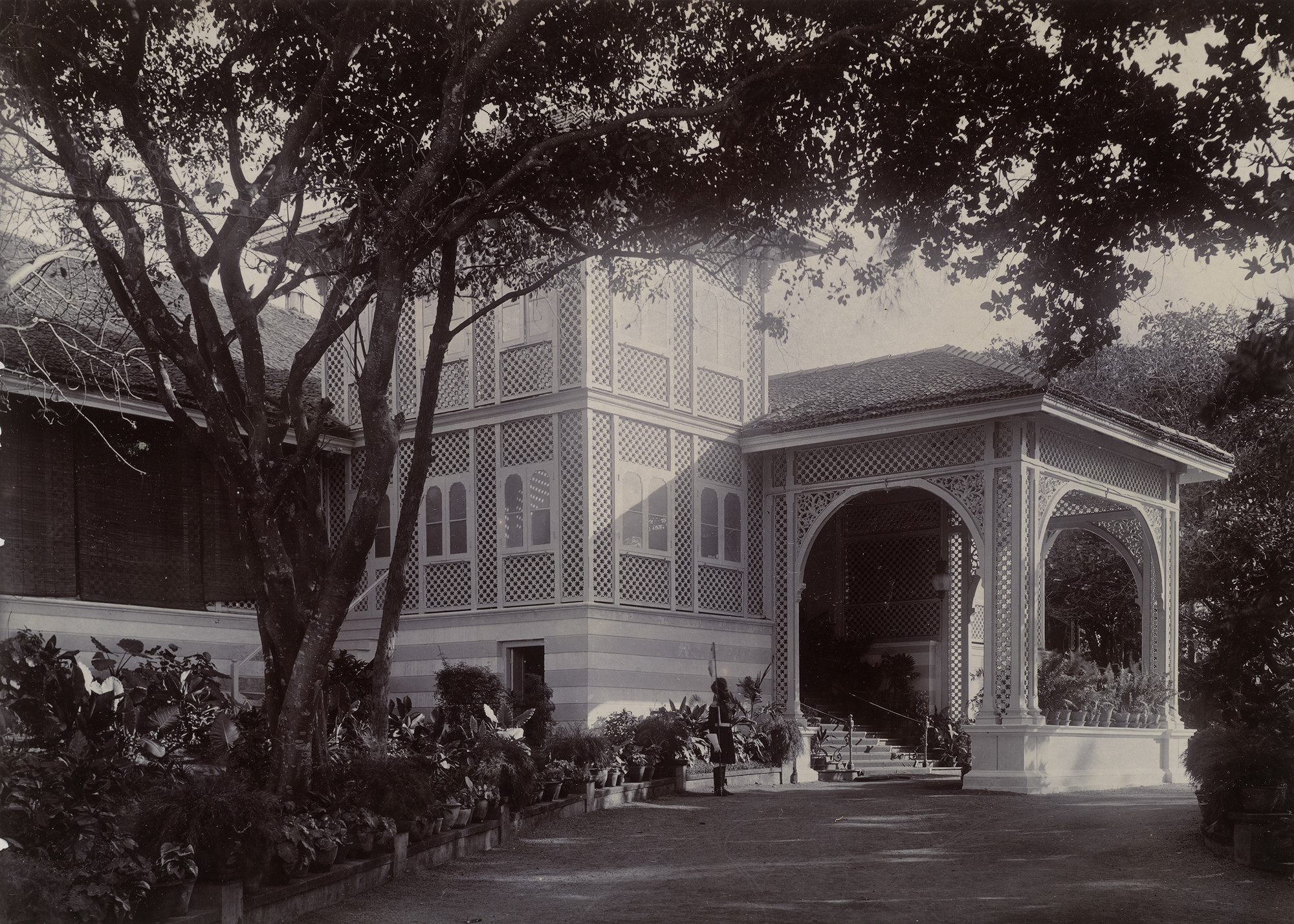
In the 1880s, the location of the Government House was moved once again to Malabar Point.
Below:- government house at malabar hill 1850's

No comments:
Post a Comment