
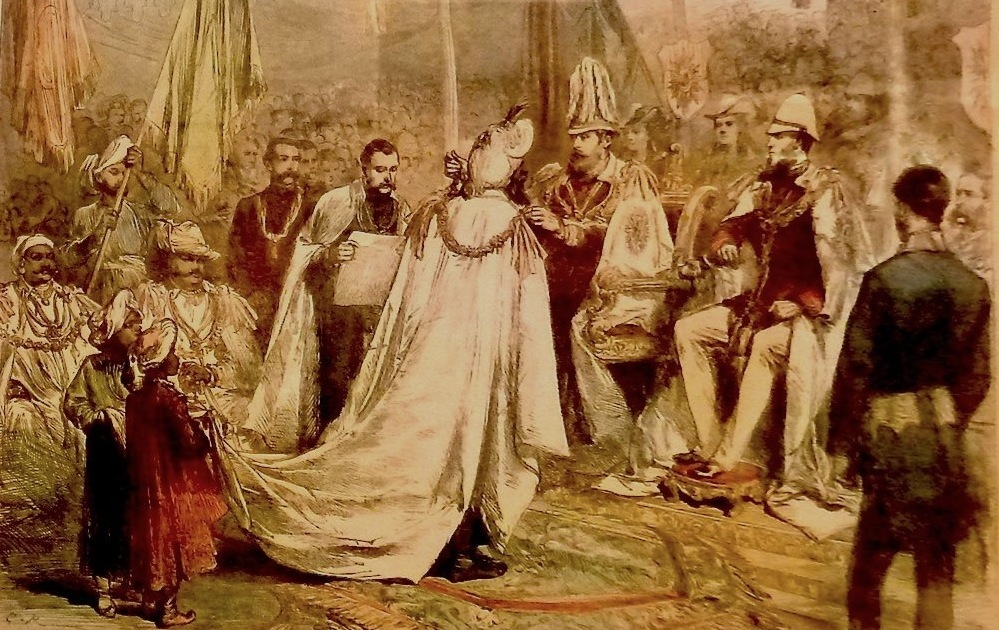
Grand Chapter of the Star of India at Calcutta, 1 January 1876. The Prince of Wales investing the Maharajah of Joodphore [Jodhpur] with the Order. Source: Tinted engraving from the collection of the Imperial Hotel, Janpath, New Delhi, reproduced by kind permission of the hotel. This was one of the many highlights of the trip, and perhaps the picture that has been reproduced most often.
Bombay and Environs
Prince Albert Edward (Bertie), Queen Victoria's eldest son, set sail from London on 11 October 1875 on the royal ship HMS Serapis, and arrived at Bombay in India just under a month later, on 8 November. There were altogether fifty men in the party, the next highest ranking to the Prince being the Duke of Sutherland, followed by Sir Bartle Frere. Chosen to record the visit were the Prince's Honorary Private Secretary, William Howard Russell (1820-1907), who reported on it for the Times, and the artist Sydney P. Hall (1842-1922), who was responsible for the illustrations in Russell's subsequent book about it. During the next seventeen weeks the Prince made an extensive tour of the country, meeting the colonial elite, being entertained in style by the native princes, bestowing honours, attending functions of all kinds, receiving costly gifts, participating in animal shoots and sporting events, dallying with one or two English belles, and so on. As Russell would note later, by the time he left, the Prince knew "more Chiefs than all the Viceroys and Governors together and [had] seen more of the country ... than any living man" (521). The tour was as extensively covered at home as it was extensive, but it is not much discussed now. Yet it demonstrated the surprising strengths of the future Edward VII, and had very significant repercussions for the Raj.


Left to right: (a) Sketch Map to Illustrate the Tour of HRH The Prince of Wales. Source: Russell, facing p. 1. (b) The First Step on Indian Soil: Landing at Bombay. Source: Russell, facing p. 115. (c) Shamzadan [Crown Prince] Passes! Native Band at Poonah. Source: Russell, facing p. 180.
Having acquitted himself well at his first royal audience in Bombay, the Prince then made it his base for some side trips into the neighbouring areas. First, he went eastwards by train for Poona, almost 120 miles away, making the scenic ascent of the Bhore Ghat, that had been such a massive feat of railway engineering, on the way. Poona (present-day Pune) was a cantonment area and the summer residency of the Governor of Bombay. Then, having been very handsomely received, presented with many gifts from rajahs and heads of state, and taken his first elephant ride, the prince returned to Bombay briefly before setting again on another scenic train trip, several times further and towards the north this time, across various bridges over rivers and estuaries, to the princely state of Baroda. On 18 November the special train was met at Baroda station by the thirteen-year-old Gaekwor of Baroda, who had already gone to greet the Prince in Bombay. Two days later, the Prince was off for his first shooting event or shikar. It was the beginning of a veritable orgy of such big-game hunting expeditions. This particular visit included a form of entertainment that the young Gaekwor particularly enjoyed: animal fights, between elephants, rhinos, and rams, and this caused some comment at home. The Aberdeen Journal perhaps struck the right note, acknowledging their brutality, but pointing out that the Prince was "not there to run amuck at anything that offends his more humane sensibilities," adding (surely correctly) that his hosts "were doing their best, from the highest to the lowest, to welcome him after their fashion." There is no hint, however, that the Prince's sensibilities were affected!
South to Ceylon, and up to Madras

Ceylon — The Dead Elephant. Source: Russell, facing p. 283.
On his return to Bombay, the Prince set off by the royal ship Serapis again, on a voyage to South India, first along the western coast, stopping on the way at Goa and the historic port of Beypore in Kerala. From there the Serapis sailed to Ceylon (present-day Sri Lanka), where the Duke of Sutherland surprised their hosts with his engineering skills, driving the royal train "round that dizzy promontory the 'Sensation Rock.'" At some point he also tightened up a coupling "with all the skill and proper application of strength" (Wheeler 12). The Prince proved himself in a more predictable and indeed expected way, by performing well in a particularly bloody and triumphalist elephant shoot. This again provoked controversy in the British press, understandably so, because elephant-hunting had only recently been banned by the colonial government (see "Elephants in Ceylon"). But it served to confirm his princely status: "Shooting an elephant was a public act, a performance where the prince was a principal actor: he must be seen to kill the great beast" (Ridley 177-78).
This great loop of the subcontinent was less than halfway through. Returning to India, the Prince and his party set off again by train to Madurai in Tamil Nadu, at the start of a rail journey that took them up 82 miles up the eastern coast to Trichinoploy (Tiruchchirapalli), and a further 198 miles to Madras, their main stop on the way to the seat of the Raj, at Calcutta. Their reception at Madras was again phenomenal:
As they packed themselves together to await the coming of the Prince, the women grouped by hundreds, the men in similar numbers, the front rank seated on the ground, those behind kneeling, while the rearmost of all stood up and peered over the heads of the others, they formed a vast and far-extending mass, to see which a journey of even eleven thousand miles was not too much. Every now and then carriages containing Bajahs and Maharajahs is picturesque costumes, escorted by the Governor's bodyguard in bright scarlet and gold uniforms, and followed by parties of their own wild-looking horsemen, drove past; and at last the Prince himself came, cheered vociferously by the crowd. [Gay 162]
The days in Madras were crammed with sight-seeing, and included a spectacular late night entertainment — one so late, in fact, the the prince himself only arrived at midnight.
Calcutta to Benares, via Bankipur
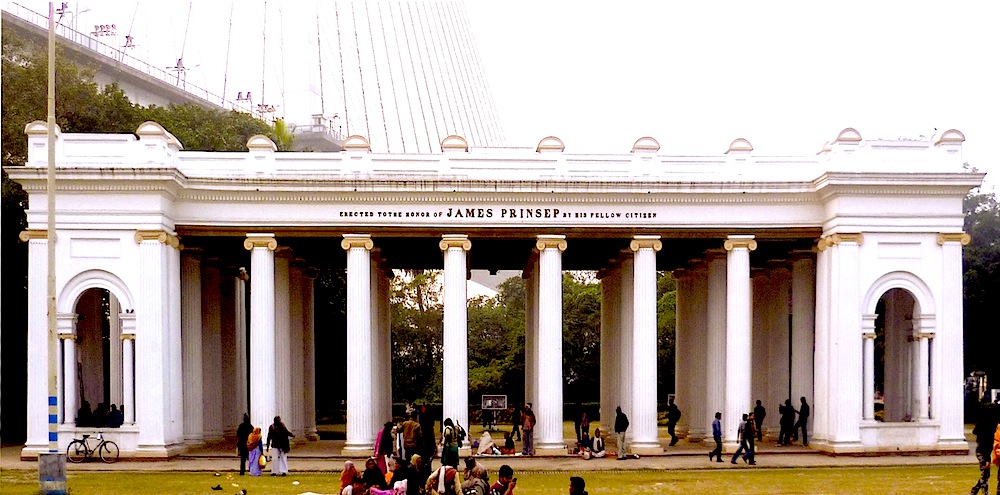

Left: Prinsep Ghat. Designed by W. Fitzgerald, this striking ionic landing stage on the Hooghly River at Calcutta was built in memory of James Prinsep (1799-1840), the eminent Oriental scholar, in 1843. It has recently been restored. Right: Benares. Illustration by Mortimer Menpes. Source: Finnemore, facing p.48.
The Prince of Wales finally arrived in Calcutta, the seat of the Raj, on 23 December. Here he stayed at the Raj Bhavan, and was able to attend the Christmas Day service at St Paul's Cathedral, before being conveyed to Prinsep Ghat, where huge crowds had gathered to see the flag-bedecked Serapis and catch a glimpse of the Prince himself. Thence the royal party went by river on the short trip to the French settlement of Chandernagore (present-day Chanannagar, just north of Kolkata) before the Serapis docked at Prinsep Ghat again. After the next few busy days in Calcutta, the Chapter of the Order of the Star of India was held on New Year's Day, with the prince dispensing honours, including knighthoods, to various Maharajas and high ranking officials. On 3 January, the prince received an honour himself: he was made honorary Doctor of Laws at Calcutta University (Wheeler 218).
Then he was off again, on the next leg of a tour which took him by train and boat along the Ganges. At the next stop, Bankipoor (now Bankipur) in Patna, Bihar, on the southern bank of the Ganges, he was met by Sir Richard Temple, and all the officials of the district, along with troops, police and crowds of onlookers. Although this was no princely state, again, the reception was extravagant:
Sir Richard Temple had made preparations to show what a Lieutenant-Governor of Bengal could do. His Court, if not equal in splendour to that of the Viceroy, satisfied the spectator that he was a satrap [ruler] of no ordinary magnitude and magnificence.... Considering that there are, it is said, less than 100,000 Europeans in India, it was surprising to see what an assembly of ladies, in the most charming bonnets and most correct costumes, were waiting to welcome him. The avenue to the Durbar tent was lined by nearly four hundred elephants, caparisoned with great richness, the howdahs filled with people in gala dresses. The great multitude Europeans on one side of the way and natives on the other was loyal and picturesque; the loyalty of the Europeans expressed by cheers, waving of handkerchiefs, playing of bands, and discharges of cannon; the picturesqueness afforded by Rajas, Nawabs, and natives of inferior dignity. [Russell 382]
All this, however, just for a three-hour break, after which the Prince returned to the railway station, and then travelled on to the holy city of Benares, with its spectacular ghat and its unforgettably palatial background. Another lavish reception awaited him from the Maharajah there. The Daily Telegraph correspondent realised how much this place would mean to "a believer in Shiva, a red-turbaned, shuffling, white-petticoated, olive-coloured native of Hindostan, with his heart set upon visiting the sacred city of India," and knew that such a one "would leap for joy; would forget the mist and the dimness, the chilly wind and clammy air, the chance of having no bed, and possibly no board either, and rejoice with exceeding joy at the prospect of plunging in the Ganges next morning, and washing away what peccadilloes and worse might cling to his soul" (Gay 218). But from his own description, it is clear that this observer did not quite share the enthusiasm, and had no intention whatsoever of dipping into a river which "might, were it not so sacred, be called very dirty" (220). It is remarkable that the Prince and his party not only kept up the pace set for them by the India Office at home, but also managed (apart from some knocks in a pig-sticking event and the Prince's catching a cold in Calcutta) to avoid its health hazards.
Lucknow and Kanpur


Left to right: (a) Veterans at Lucknow. Source: Russell, facing p. 393. (b) Visit to the Cawnpore Memorial. Source: Russell, facing p. 401.
The stop at Lucknow was special. Here, the element of gorgeous and spectacular entertainment gave way to poignant and stirring memories of the famous siege and its relief, during the 1857 Mutiny. A Celtic cross had long since been raised in the Residency garden in memory of Sir Henry Lawrence and the European officers and men who died then; now the Prince laid the first stone of a monument outside the garden, to the Indians who also died with them. It was surely the most emotional ceremony in which the Prince took part in India. In the presence of the assembled troops, the English flag was raised outside the battle-scarred ruins of the old Residency. Trumpets sounded, salutes were made, drums rolled and cannon fired.
The salute over, the Prince desired that all the survivors of the defence might be presented to him. The picture... was touching in the extreme. Some two hundred old warriors filed past. First came the officers.... They were followed by sixteen native officers and non-commissioned officers who had taken part.... and lastly, and on which all eyes turned, was a mixed band of decrepit warriors, and young men who, as mere boys, had done their duty nobly within the walls.... In some cases their bodies were supported by friends, and their palsied arms were with difficulty made to give a last salute.... Several veterans came forward in the old stiff uniforms of the East India Company's service, and having swords covered with the rust of twenty years. During the scene, many ladies, some of whom had lost sons in the relief, were in tears. Every one was affected. [Wheeler 227-28]
The Chief Commissioner for the region of Oude (present-day Awadh) declared, in the speech that followed, that the behaviour of the sepoys at Lucknow, who voluntarily stood by the British during the siege, "was simply without a parallel in the annals of the world" (qtd. in Wheeler 228). Amongst the other sights that the Prince was shown in Lucknow was the "square grey tomb, with a shelving stone on the top" of Major Hodson, whose elaborately carved monument can be seen in Lichfield Cathedral.
The royal party then set off for Delhi, with a couple of hours' pause in the evening at Cawnpoor (now Kanpur), where the Prince paid his respects at the spot of perhaps the most notorious of the atrocities committed during 1857 on both sides, when two hundred or so British women and children were butchered and thrown into a well (for an objective assessment, see Keay 442). Here stood Baron Marochetti's The Angel of Pity memorial. Marochetti loved to design and sculpt angels, and this is one of his finest. "I cannot describe the effect of the bright moon's rays on the white marble work — or how the whole memorial stood out in its lonely grandeur on that delightful night," wrote a member of the party (Gay 237-38). The Prince also inspected the Memorial Gardens and the only recently completed church there, now called the Kanpur Memorial Church, to which the monument has since been moved.
Delhi

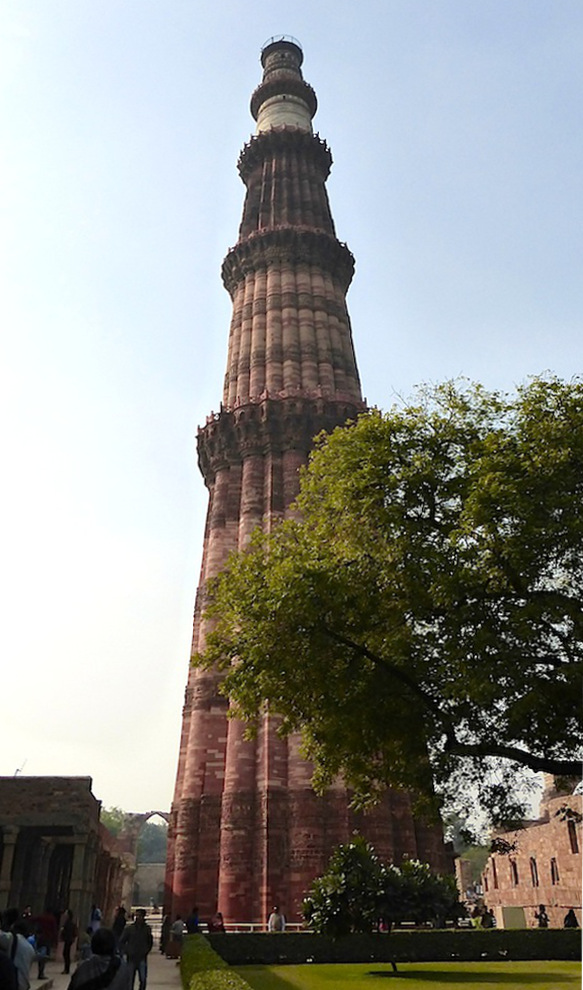

Left to Right: (a) Interior of the Royal Drawing Room Tent in Delhi. Source: black & white film copy neg. Library of Congress Digital Image, reproduction no. LC-USZ62-67684. (b) The Qtab Minar, a victory tower with twelfth-century origins, leans slightly now, and it is no longer possible to climb up it, as the Prince did. (c) Ruins of the Quwwat-ul-Islam Masjid in the complex, also of twelfth-century origin.
Travelling overnight by train, the royal party reached Delhi on 11 January, where they spent six days. There was the usual tremendous welcome, and again the visit was imbued with memories of 1857: most of the activities during the stay were of a military nature. As they had done at Benares, the guests stayed under canvas, and again in considerable luxury. The Prince's tents in particular were splendidly appointed: "The camp was a more luxurious bivouac than any monarch sleeping in the tented field has ever enjoyed" (Wheeler 235). There was a levee, followed by a glittering review of both British and Indian regiments, with the Prince sporting the uniform of a Field Marshal, and extensive military manoeuvres, with the Prince himself taking part on a charger. But amid all this there was still time for entertainment of a gentler kind, and some sightseeing:
At the Kootab there was a small camp pitched for the occasion. There was a military band, and lunch was laid in a large marquee. Many ladies were invited from Delhi. The Prince mounted to the summit of the Kootab, said to be the highest pillar in the world (it measures 238 feet in height), and viewed the wide-spread ruins of forts, tombs, mosques, and cities. [Russell 414]
It is easy to see, from the various accounts of the Prince's stay here, how Delhi, with its long and fascinating history, more recent associations for the British, and excellent railway connections, later came to be chosen as the capital of the Raj.
It is equally easy to see how the glowing reports of Bertie's triumphal progress up to this point played on the Queen's desire to be called Empress of India. As for the Prince himself, indefatigable, keen to engage in the pageantry of every occasion, appreciative of and sympathetic towards the Indian princes and colonial representatives alike, responsive to the common people as well, he was proving to be a wonderful ambassador for the British crown. The Queen's next move was not something he himself foresaw or wanted: "I could never consent to the word 'Imperial' being added to my name," he told Disraeli (qtd. in Ridley 181). Nor was he even consulted about it (see Ridley 181). But exactly a month after the royal party left Delhi on the next leg of their tour, Disraeli was putting forward to Parliament the Royal Titles Bill.
Related Material
- Part II: From Delhi to Bombay
- The Qtub Minar and the Victorians
- The 1857 Indian Mutiny (also known as the Sepoy Rebellion, the Great Mutiny, and the Revolt of 1857)
- Royal Titles Bill (Second reading)
- New Crowns for Old Ones (John Tenniel's cartoon lampooning the Royal Titles Bill)
Sources
Bisht, B. M. S., ed. "Titbits from my Archives: The Prince of Wales' Railway Journeys in India, 1875-1876" (edited and clearly dated excerpts from Russell, giving a good idea of the tour in brief). IRFCA (Indian Railways Fanclub). Web. 30 March 2014.

[Victorian Web Home —> Political History —> Victoria and Victorianism —> The Empire —> British India —> Next]
Photographs and image scans by the author. [You may use any of these images, apart from the last one, without prior permission for any scholarly or educational purpose as long as you (1) credit the source and (2) link your document to this URL or credit the Victorian Web in a print one. Click on the images to enlarge them.]

Nagas Dancing before the Prince of Wales's Elephant in the Torchlight Procession at Jeypore. Source: Tinted engraving from the collection of the Imperial Hotel, Janpath, New Delhi, reproduced by kind permission of the hotel. The Prince, in a red jacket, sits in the leading elephant's howdah behind a swirling flame.
Prince Albert Edward (Bertie), Queen Victoria's eldest son, was now over halfway through his highly successful seventeen-week tour of India. He had disembarked from the royal ship HMS Serapis on 8 November 1875, and he was leaving Delhi late on 17 January 1876. Still to come were more triumphal entries, more banquets, balls and hunting expeditions, and some of the most spectacular sights of the trip, including the Himalayas and the Taj Mahal. At home, the Prince, like his mother, was "sufficiently great to brush aside on occasions the hard-and-fast rules of Court customs and observances" (The Private Life, 12); but as the weeks passed by, any doubts about his readiness to behave with due formality and respect to the Crown were dispelled. His strengths became still more apparent, as did the general warmth of his reception in India, and the wholeheartedness with which he responded to it. This not only improved his own image, but encouraged Queen Victoria to present herself as the Empress of India, and helped to foster the "extraordinary attachment and even reverence for the Queen's person which littered Indian cities with her statues and certainly strengthened Anglo-Indian ties" (Spear 148).
Amritsar and Lahore


Three illustrations by Mortimer Menpes. Left to right: (a) A Distinguished Maharajah. Source: Finnemore, facing p. 9. (b) A Sikh Warrior. Source: Finnemore, facing p. 16. (c) The Golden Temple, Amritsar. Source: Finnemore, facing p. 25.
The royal party breakfasted at Amritsar, where the Prince admired the famous Golden Temple of the Sikhs, though he declined to discard his footwear and inspect its interior. According to the Court Circular in the Times of 31 January 1876, it was "considered inexpedient" for him to do so. More to his taste, no doubt, was the fort-like station of Lahore about thirty miles further on (now, of course, in Pakistan), where he was greeted with the usual rousing and extravagant welcome. But there was a difference. Its military flavour was spiced with a new exoticism: "The roll of drums, blare of trumpets, and clang and outburst of strange instruments saluted the Prince. Lance and sword, morion and cuirass [helmet and breastplate], flashed, and all was light and beautiful. The very spirit of chivalry hovered over these martial faces and noble forms," wrote the Times special correspondent, William Howard Russell, who also served as the Prince's Honorary Private Secretary. Russell noted too the "flat roofs and carved lattices" here, and "an Orientalism which is not altogether Indian" (421). The party was conveyed to Government House by a procession of carriages, including that of the Lieutenant-Governor himself, drawn by six tall camels. One triumphal arch was festooned with costly Cashmere shawls, "not one of which was valued at less than 50/- sterling," commented another correspondent, this time for the Central News, wonderingly (Wheeler 254).


Left: Arrival of the Prince of Wales at Lahore (detail, showing his "friendly salutation"). Source: Tinted engraving from the collection of the Imperial Hotel, Janpath, New Delhi, reproduced by kind permission of the hotel. Right: Hill-people from the Himalayan foothills today, still wearing the silver amulets, beads, and "nose, finger, and toe-rings" customary at that time (Russell 473).
The Prince was unfailingly gracious. For example, when the chiefs at Lahore found themselves unable to lower their fixed ensigns as his own sepoys had done, he soon "smoothed down [their] ruffles ... by his smile and friendly salutation" (Wheeler 255). One of the events laid on for the royal party this time was a "Soldiers' Industrial Exhibition," just the sort of display to please the visitors in these years of regular exhibitions at the re-sited Crystal Palace at home. Merchants from the Himalayan foothills laid out their wares here too, selling everything from falcons to Tibetan mastiffs. To everyone's satisfaction, the Prince played his part by buying many curious and precious goods. He was already well-informed, but remained "insatiable in the acquisition of knowledge" (The Private Life, 145). Never aloof or superficial in his attention to what was laid before him, he showed a genuine interest in it, and took an obvious pleasure in it too.
They were now on their way to Kashmir itself, where their stop was at the frontier town of Jummo, which they entered on 20 January. This was the furthest point of their journey north, and their reception by the Maharajah of Cashmere was, by all accounts, the most splendid yet. After the last uncomfortable fifty miles by lurching carriages, this is where they first set eyes on the Himalayas:
we passed the last British outposts, took short cuts over ploughed fields, and at last arrived in sight of Jummoo needs not to be described. It was at the moment of sunset when the town was seen. Behind it were the everlasting hills, on one, indeed, of which it is seated. All round was dense jungle. For hours the sky had been beclouded; we had not seen a bright ray all the afternoon, till at this moment the sun burst out and lit up the landscape with its marvellous light. Pink, orange, dark, purple fell upon the snow-capped ridge, threw the three-peaked Tri-couta into bold relief, glittered upon the dome and minarets, the golden spires and white stone buildings of Jummoo.... [Gay 263-64]
After the now usual round of festivities, including a fabulous firework display, the party returned to Lahore Station. But there was still one more entertainment, one of the many on the tour of a martial nature: at the station Sir Charles Reid showed how to load up a train with artillery, troops and horses (ninety-four of the latter) in double-quick time. When they arrived at Amritsar again, the contingent poured out onto the platform in a flash, to the unsuspecting crowd's astonishment. Such "games" must have served not merely as amusements for the visiting Prince, but as spectacles to evoke awe and respect from the populace.
Via Rajpura to Agra

The Taj Mahal, ethereal in any light, seen slightly off-centre here.
The Prince's special train arrived at Rajpura, back in the Punjab, in the middle of the night, to be met at a fantastically garlanded station by the Maharaja of Patiala, and his civil and military retinue. Again there were bands, cannon and flaring lights, and a banquet ordered in from Calcutta and held in a palatial marquee, followed by fireworks, before the train moved off again on its way to Agra. When they arrived around teatime the next day, the Commissioner and all the top army officers were assembled to greet them, although a sandstorm swept up out of nowhere and partially obliterated the scene. They were then accompanied to the camp on elephant. Here a whole assembly of maharajahs had gathered, and later that afternoon "troops of the Nawabs and Rajas passed before the Prince — a strange mélange of elephants, camels, horses, bullocks, men such as Alexander might have led into captivity, knights in armour, artillery drawn by oxen, for an hour and half" (Russell 442). The Central News correspondent found the town itself "rather disappointing' (Wheeler 281), but disappointment was banished late the next day, when the Prince was driven see the Taj illuminated, with 7000 spectators looking on. "Nothing on earth equals it," breathed the Telegraph correspondent, who had been out earlier to look his fill in daylight, and was glad to have done so.
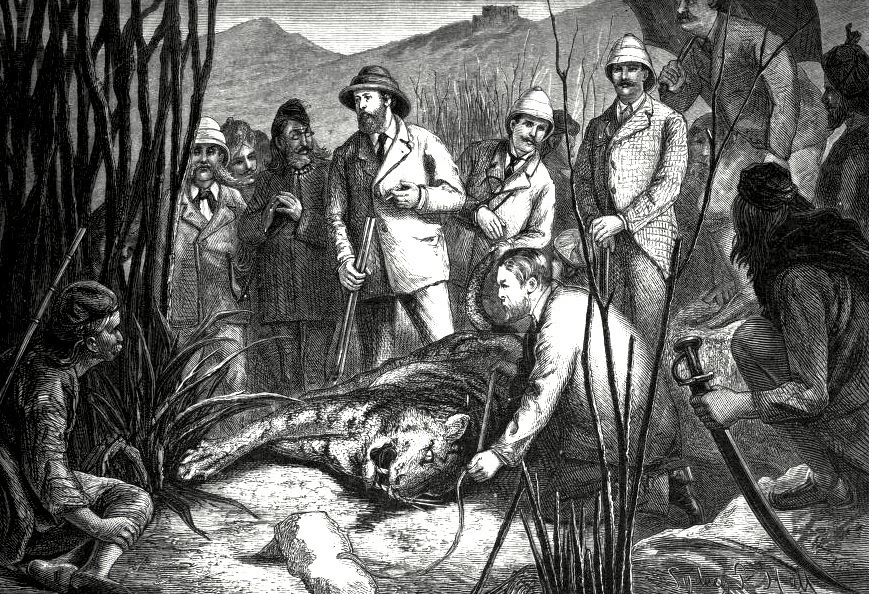
The Prince's First Tiger. Source: Russell, facing p. 458. This and subsequent illustrations from Russell are by Sydney P. Hall (1842-1922), the official artist on the tour. The Prince stands in the centre, cigarette in one hand, rifle in the other. His hunting gear in India consisted of "a khaki jacket and knickerbockers and a solar topee with a very wide brim," sometimes with the addition of "leech gaiters" (The Private Life, 253). Even in this wild rocky area, it included a tie as well. He was particular as to dress.
Shooting expeditions, balls and visits to Maharajahs punctuated the rest of the stay here, which also included a trip to Jaipur, where the Prince shot his first tiger, or, rather, tigress. "That the tigress on being skinned is found to have been the prospective mother of three cubs, is considered a matter for farther rejoicing," says one commentator, without intimating (except perhaps in the distance implied by "is considered") his own feeling on the matter (Gay 320). In fine fettle, the Prince later smoked a hookah at the Maharajah's banquet. Whilst based at Agra, too, the Prince "saw a great deal," and probably a great deal too much, of his host Lord Strachey's young sister-in-law, Mabel Batten, who was only nineteen and just recently married. It was the kind of thing the Queen, and no doubt his wife, the future Queen Alexandra, had feared, but it did not become a scandal. On the other hand, it was widely noted in his favour that the Prince had shown his displeasure when a rajah was treated discourteously by one of the officials (see Ridley 179-80). Here was another example of his good nature and the genuine appreciation he showed his hosts.
The Terai
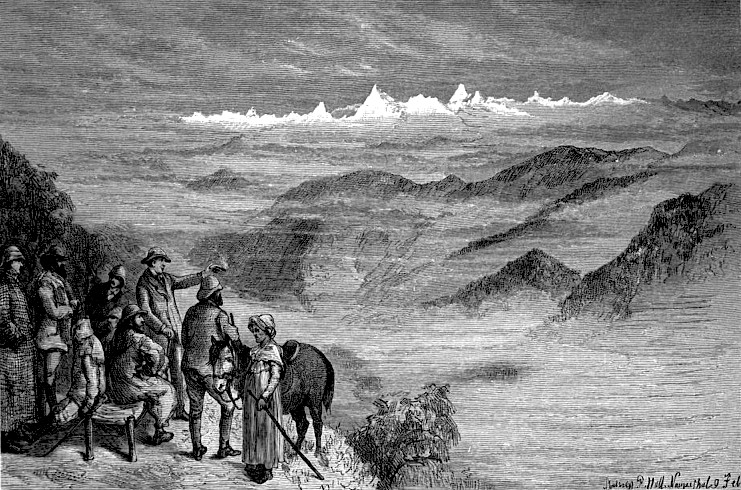

Left: The Himalayas at Sunrise. Source: Russell, facing p. 466. Right: The Pleasures of the Chase. — Pad Elephant. Source: Russell, facing p. 490. Hall himself had captioned this one, "A Wild Elephant Chase in Nepal." Russell explains that the hot and weary elephants were cooling themselves with showers from their trunks, and that the Prince himself came in for a sudden soaking.
The last part of the Prince's tour was spent in the Terai, in the Kumaon Hills, famous for their man-eating tigers. While the Serapis sailed for Bombay in readiness for the voyage home, the Prince took one last view of the Taj Mahal by moonlight, and left Agra by his special train for Moradabad, at the end of its line in that area. "Dreaming possibly of the Taj, or of the pleasant camp and the hospitalities of Sir John and Lady Strachey at Agra, stretched at length on the comfortable cushions of our railway carriages, and snugly wrapped in resais [quilts]" (Russell 463), a select party was wafted away further north, to spend the middle of February at the vast hill-camp of Sir Henry Ramsay, and engage in big-game hunting. After a visit to the pretty hill-station of Nainital, where the Prince and some members of the party went to a well-known vantage point to see the snowy range at sunset, came a longer one to Nepal:
The Nepaul Terai is a vast land of jungle interspersed with woods of great trees, and broken by hills, ravines, nullahs, and sluggish streams. It is the rearing home for wild beasts, and birds of every known and unknown kind. The streams which flow from the watershed of the Gundra ridge on the south, and from the snows of the Himalayas, here the highest peaks in the world, enter into the beautiful valley of Nepaul,and form three great tributaries of the Ganges. [Wheeler 319]
Here the sport was excellent and the Prince soon bagged the first of many more tigers, including a tigress pregnant with six cubs (see Russell 458). This makes difficult reading now, and even at the time the Graphic made a point of devoting some lines to the Prince's affection for his elephant, to which he would give "bread, cakes, fruit &c" in the morning, and which, in return, would salute him with its trunk (202). But, on the whole, it would be a mistake to denigrate the Prince's sporting pursuits in India: attitudes were very different then. "There can be no doubt," wrote one biographer with a special interest in the Prince's prowess in this area, that "the skill and adroitness with which His Royal Highness adapted himself to entirely new surroundings, particularly in the Terai, and the success which happily attended his efforts, had their effect on all classes of the Indian community" (Watson 341-42). This biographer noted the Prince's courage, too. It might be added that his entourage included a naturalist (Mr Bartlett) as well as a botanist (improbably named Mr Mudd), for whom the Prince's various trophies were specimens for a future collection.
Then the homeward journey began. Although there were more grand receptions en route, particularly at Allahabad where another investiture was held, and at Lalbagh, where a durbar was held, there was a clear feeling of winding up a fabulous stay. On 11 March they reached Bombay again, and were received on board the waiting and freshly painted Serapis with all due formalities, and expressions of appreciation for all that had been done, and regret at the departure, on every side. "The Prince has travelled nearly 7600 miles by land and 2300 miles by sea, knows more Chiefs than all the Viceroys and Governors together, and seen more of the country in the time than any living man," noted Russell (520-21).
Consequences


Left: The Prince of Wales in the frontispiece to Russell's book. Right: Sir William Howard Russell (1820-1907) from the Times, who had exclusive reporting rights for the trip (see Ridley 174), and, as the Prince's private secretary on the tour, was the best able to convey every aspect of it. © The National Portrait Gallery.
The second Times leader of 6 March 1876 pointed out the cumulative effect of all the reports that had poured out of India in the last few months. Previously, the British press had been apt to focus on the "troublesome financial problems" that the country presented. But the Prince's tour had now brought out for the British public the "dazzling accumulation of natural marvels, great traditions, wealth, and historic influence" of the sub-continent. For his part, the Prince of Wales had, it seems, impressed upon the Indian Princes the fact that they were now "members of an organised Empire," and had had "the tact, or rather the generosity and the good feeling, to bring this reality home to them." In this respect, "the pomps and shows of a Royal progress, the grace of a Royal visit" had had "permanent value in what they [implied]." They formed, as Russell said on one occasion in his published book on the tour, a "tangible, visible representation of royalty" (341).
Partly thanks to Russell's own literally glowing reports, during the Royal progress the Prince had emerged convincingly, to the public at home as well as to the people of India, as "the future Suzerain of ancient dynasties." It had all been a resounding diplomatic triumph, one upon which the leader-writer himself (whether Russell or the editor taking his cue from him) urged the government to capitalise. Indeed, in pushing for the title of Empress of India, Queen Victoria was already doing her utmost in this regard — perhaps partly out of a desire to steal a march on her son (see Ridley 181). There was, however, a clear note of warning in the leader as well. "If we continue to regard the heirs of that vast civilisation as conquered dependents, a feeling of alienation will slowly but surely deepen." With evident relish, Bertie had done his best for relations between Britain and India. Now it was up to his successors to build on the close ties he had created, or ultimately to destroy them.
Related Material
- Bertie's Progress: Part I
- The Prince of Wales's Saloon Carriage
- Royal Titles Bill (Second reading)
- New Crowns for Old Ones (John Tenniel's cartoon lampooning the Royal Titles Bill)
Sources
Bisht, B. M. S., ed. "Titbits from my Archives: The Prince of Wales' Railway Journeys in India, 1875-1876" (clearly dated excerpts from Russell, giving a good idea of the tour in brief). IRFCA (Indian Railways Fanclub). Web. 3 April 2014.
"Court Circular." Times. 14 February 1876: 8. The Times Digital Archive. Web. 3 April 2014.
