Sunday, October 1, 2017

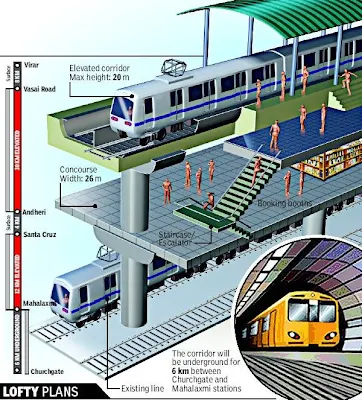
ELEVATED TRACK plan from virar to church gate station cancelled.underground metro MAY get flooded

Image result for ELEVATED   railway TRACK VIRAR TO CHURCH GATE

CANCELLED
Image result for ELEVATED   railway TRACK VIRAR TO CHURCH GATE
CHEAPER THAN METRO UNDERGROUND FROM COLABA TO ANDHERI
THE  PLAN FOR ELEVATED TRACK FROM CHURCH GATE TO VIRAR STOPPED
THEN A PLAN FOR ELEVATED TRACK FROM BANDRA TO VIRAR ALSO STOPPED
 https://qph.ec.quoracdn.net/main-qimg-cad0768de28940f499aa7bb3c6766237-c
CANCELLED
Image result for ELEVATED   railway TRACK VIRAR TO CHURCH GATECANCELLED

Image result for ELEVATED   railway TRACK VIRAR TO CHURCH GATETwenty22-India on the move: Mumbai elevated rail corridor snippets
Twenty22-India on the moveCANCELLED
The technical feasibility study of the ambitious elevated rail corridor between Churchgate and Virar shows that the entire 60 kmstretch will not be above ...

NOW UNDERGROUND METRO FROM COLABA TO ANDHERI EAST IS GETTING READY 
ALL CHANCES OF IT GETTING FLOODED DURING RAIN.HIGH TIDE,ETC ETCImage result for MUMBAI TRAINS IN WATERROM COLABA TO ANDHERIImage result for MUMBAI TRAINS IN WATERImage result for MUMBAI TRAINS IN WATERImage result for MUMBAI TRAINS IN WATERImage result for MUMBAI TRAINS IN WATER
 
Image result for NEW UNDERGROUND METRO FROM COLABA TO ANDHERI

About 4,22,000 results (0.70 seconds) 

Map from Colaba, Mumbai, Maharashtra to Andheri, Maharashtra 400047


Image result for ONE TRACK OVER ANOTHER  railway TRACK VIRAR TO CHURCH GATECANCELLED


HOPE THE METRO WILL NOT GET AFFECTED BY RAINS,FLOODS,HIGH TIDE ,CYCLONE

.

Wednesday, September 6, 2017

Now, one can detect cancer in just 10 seconds

Now, one can detect cancer in just 10 seconds

ANI
Published Sep 7, 2017, 8:01 am IST
Updated Sep 7, 2017, 8:01 am IST
Researchers from University of Texas, Austin invent powerful tool that rapidly and accurately identifies cancerous tissue during surgery.
The current method for diagnosing cancers, called Frozen Section Analysis, is slow and sometimes inaccurate. (Photo: Pixabay)
 The current method for diagnosing cancers, called Frozen Section Analysis, is slow and sometimes inaccurate. (Photo: Pixabay)
Washington DC: A new device can detect whether or not a tumour is cancerous in just 10 seconds.
The researchers from University of Texas, Austin invented a powerful tool that rapidly and accurately identifies cancerous tissue during surgery, delivering results in about 10 seconds-- more than 150 times as fast as existing technology.
The MasSpec Pen is an innovative handheld instrument that gives surgeons precise diagnostic information about what tissue to cut or preserve, helping improve treatment and reduce the chances of cancer recurrence.
"If you talk to cancer patients after surgery, one of the first things many will say is 'I hope the surgeon got all the cancer out,' " said team leader Livia Schiavinato Eberlin. "It's just heartbreaking when that's not the case. But our technology could vastly improve the odds that surgeons really do remove every last trace of cancer during surgery."
The current state-of-the-art method for diagnosing cancers and determining the boundary between cancer and normal tissue during surgery, called Frozen Section Analysis, is slow and sometimes inaccurate. Each sample can take 30 minutes or more to prepare and interpret by a pathologist, which increases the risk to the patient of infection and negative effects of anesthesia. And for some types of cancers, frozen section interpretation can be difficult, yielding unreliable results in as many as 10 to 20 percent of cases.
However, in tests on tissues removed from 253 human cancer patients, the MasSpec Pen took about 10 seconds to provide a diagnosis and was more than 96 percent accurate. The technology was also able to detect cancer in marginal regions between normal and cancer tissues that presented mixed cellular composition. The team expects to start testing this new technology during oncologic surgeries in 2018.
"Any time we can offer the patient a more precise surgery, a quicker surgery or a safer surgery, that's something we want to do," says James Suliburk. "This technology does all three. It allows us to be much more precise in what tissue we remove and what we leave behind."
Although maximizing cancer removal is critical to improve patient survival, removing too much healthy tissue can also have profound negative consequences for patients: For example, breast cancer patients could experience higher risk of painful side effects and nerve damage, in addition to aesthetic impacts. Thyroid cancer patients could lose speech ability or the ability to regulate the body's calcium levels in ways that are important for muscle and nerve function.
In tests performed on human samples, the device was more than 96 percent accurate for cancer diagnosis. The team has also demonstrated that it accurately diagnoses cancer in live, tumor-bearing mice during surgery without causing any observable tissue harm or stress to the animals.
Physicians can operate the disposable handheld device easily. It requires simply holding the pen against the patient's tissue, triggering the automated analysis using a foot pedal, and waiting a few seconds for a result. Meanwhile, the pen releases a drop of water onto the tissue, and small molecules migrate into the water. Then the device drives the water sample into an instrument called a mass spectrometer, which detects thousands of molecules as a molecular fingerprint.
The process is also low-impact for patients.
"When designing the MasSpec Pen, we made sure the tissue remains intact by coming into contact only with water and the plastic tip of the MasSpec Pen during the procedure," noted Zhang. "The result is a biocompatible and automated medical device that we are so excited to translate to the clinic very soon."
The research appears in the journal Science Translational Medicine.

Saturday, July 29, 2017

Hundreds of people have become allergic to red meat[now no need for lynching road side mobs to stop meat eating

Hundreds of people on the East End have become allergic to red meat in recent years after being bitten by the Lone Star tick, with scattered cases cropping up elsewhere across Long Island, medical experts say.
Patients are subject to hives, rapid heart palpitations, pervasive itching and, in the worst and rarest of cases, life-threatening anaphylactic shock.
newsday.com

now no need for lynching road side mobs to stop meat eating

Mob lynching India's shocking war within, a challenge Narendra Modi ...

indiatoday.intoday.in › Magazine › Cover Story
Jul 13, 2017 - "With the new issue of beef and cattle trade, lynching is becoming ubiquitous. ... cattle to slaughter on motorbikes or set up road obstructions.

one more of my blog deleted today by Google?

Inbox
x

Blogger <no-reply@google.com>

Jul 18 (10 days ago)


to me

http://newsaroundnewssss.blogspot.com/ has been deleted

Hello, Your blog at http://newsaroundnewssss.blogspot.com/ has been reviewed and confirmed as in violation of our Terms of Service for: SPAM. In accordance to these terms, we've removed the blog and the URL is no longer accessible. For more information, please review the following resources: Terms of Service: https://www.blogger.com/go/terms Blogger Content Policy: https://blogger.com/go/contentpolicy -The Blogger Team


because it is a news blog i suspect Google and others

India supreme court strikes down internet censorship law | World news ...

https://www.theguardian.com › World › India
Mar 24, 2015 - India's supreme court has struck down a controversial law that made posting ... Other cases include a university professor detained for posting a cartoon ... to have some means to regulate offensive material on the internet.

Friday, July 28, 2017

B.E.S.T. -Brihanmumbai Electric Supply and Transport-

Brihanmumbai Electric Supply and Transport - Wikipedia

https://en.wikipedia.org/wiki/Brihanmumbai_Electric_Supply_and_Transport
The Brihanmumbai Electricity Supply and Transport (BEST) Undertaking is the civic transport and electricity provider public body based in Mumbai, Maharashtra, India. It was originally set up in 1873 as a tramway company called "Bombay Tramway Company Limited".
m
Image may contain: outdoor

Friday, July 21, 2017

Mrigank Warrier, asian


Trainspotting at Dockyard Road

THE ASIAN AGE. | MRIGANK WARRIER
Published : Jul 22, 2017, 12:52 am IST
Updated : Jul 22, 2017, 12:52 am IST
Listen to the clang of trains being shunted and an engine’s call. Watch the sun set over colonial Bombay.

 The rail system in Mumbai is the city’s lifeline. It ferries millions of people across the city on three lines – Western, Central, and Harbour. Trains begin to run at 4 am and run until past midnight.
Beside the railway is a hill and on the hill is a garden. To admire the railway, climb the hill and enter the garden.
Dockyard Road railway station abuts Bhandarwada Hill, which is crowned by a garden named after Joseph Baptista, Tilak associate, Bombay mayor and local Mazagaon boy. This arboretum boasts of old trees, vast lawns, lovers in gazebos, swotting students, jogging aunties, blink-and-you-miss-them exit staircases, and a vantage point to view Mumbai’s three main modes of transport: road, ship, and rail.
In the foreground is the conveyor belt of the Eastern Freeway. Behind it looms the mammoth yellow arch of Mazagon Dock Ltd. – Shipbuilders to the Nation. Beyond is the harbour that gives the city its name: “Bom Bahia” (meaning “good bay”). I have eyes only for the eponymous railway that adorns the city’s “other” coast like a less ostentatious necklace: the humble, plodding Harbour Line.
a
Leap onto the parapet. Hop over the railing. Trample past some shrubs and lo! – an ancient nine-coach rake trundles out of unseen Dockyard Road, curves eastwards over an expansive train yard, and reaches Sandhurst Road seconds after the guard’s cabin has cleared Dockyard. From your height, it looks like a toy train. If only you had a remote.
Listen to the clang of trains being shunted and an engine’s call. Watch the sun set over colonial Bombay.
Clamber down the seldom used stairs of Sandhurst Road’s Platform Number 4. Walk past the baby-blue staircase leading up to the office of the Senior Sectional Engineer (Electric) and find yourself in a station area like no other.
Fourteen cavernous godowns are separated by cobblestone plazas. The walls consist of 15 or 20-foot high stone arches joined by brick. The roof is corrugated metal. Each godaam shelters an island platform that was once flanked by two side lines; most of these have been stripped away. In its 20th century heyday, Wadi Bunder was the city’s premier hub for goods transport, employing thousands of labourers. Today, a few men load white parcels into a single windowless luggage van stabled at one of the few godowns still in use. The nearby offices of Raj and Co. (Clearing, Forwarding & Transport Agents) consist of three chairs, a table, and a solitary clerk flipping desultorily through a yellowed register. No one else is in sight.
a
The abandoned platforms are strewn with spools of thick cables, cannibalised machines, and obsolete wooden sleepers arranged in a pyre. Faded orange bunting harks of a union function. One godown has been commandeered by a shantytown. Clothes dry on a wire strung between mighty pillars that support this once buzzing yard.
Wadi Bunder is an old age home/graveyard for derelict compartments. Mismatched rakes of the old and new Rajdhanis, pantry cars, sleeper coaches, bio-toilets, and generator vans reach the end of the line – and life – here. Grass grows between rails, and vegetables are grown between tracks. This is where Miss Havisham would park her personal train. Come evening, spotlights are switched on. Someone alert Sanjay Gupta about this readymade film set.
Walk back towards, under, and past the station. Climb a concrete ramp between stationary trains and watch 11093 Down CST-Varanasi Mahanagari Express being prepped for tonight’s journey. Young men in rolled-up trousers hose the exterior while ragpickers scamper through the inside, cleaning the train before its 1,500 kilometre journey to the north.
“And he stood upon the foot overbridge, Lord of all he surveyed.” – Gospel of Mrigank.
At Sandhurst Road, the two tracks of the Harbour Line part from the four tracks of the Central Line, meeting once at Kurla, ne’er to meet again. The clickety-clack of trains hurtling on the ground over concrete sleepers is replaced by the thunder of Harbour Line trains ascending the ramp over metal ones; Sandhurst Road is the only station to have platforms at two levels. The unlit coaches of a train crawl out of Wadi Bunder towards CST, soon to burst with light and people.
The foot overbridge shudders as a local enters the station, the rails gleaming in its headlamp. Southbound services overflow with light; the doors of ’burb-bound locals are darkened by clinging, straining bodies. I count the coaches of every outstation train – a childhood obsession. The Duronto to Nagpur – and my parents – passes by. So do the Howrah Mail to Calcutta and the Devagiri Express to Secunderabad. So will the Konkan Kanya to Ratnagiri and Sindhudurg and Goa, and our old friend the Mahanagari, to Khandwa and Itarsi and Jabalpur and Satna and…
— By arrangement with TheCityStory.com

Thursday, July 20, 2017

Mumbai school art, antique print, 1875

alamy is a british company formed a few years ago to claim all photos and sell for a profit
Alamy is a British privately owned stock photography agency launched in September 1999. Its headquarters are in Milton Park, near Abingdon, Oxfordshire, United Kingdom.