Friday, May 28, 2010

1875-BOMBAY-MODES OF TRAVEL[1] HACKERRY CARRIAGE[2] ELEPHANTS


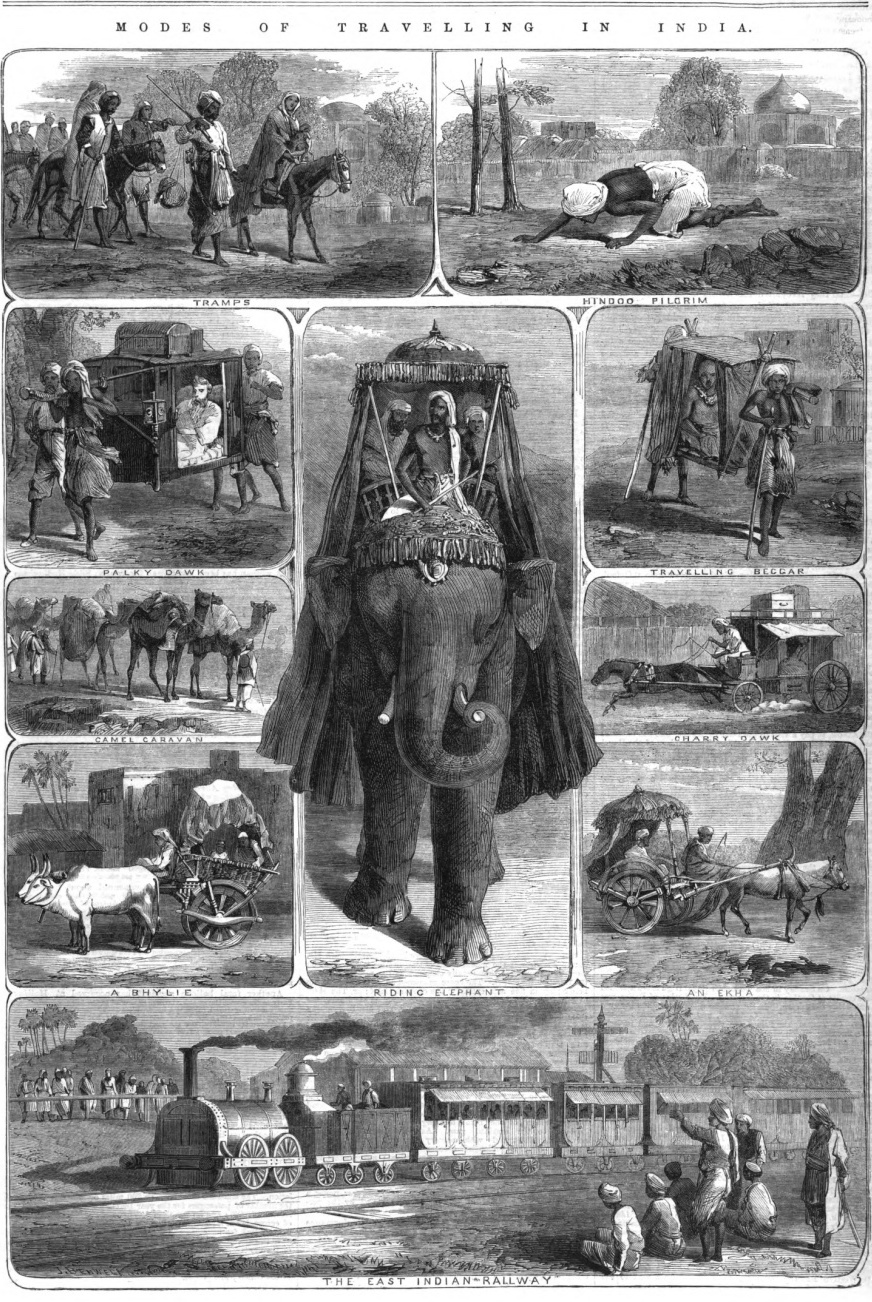
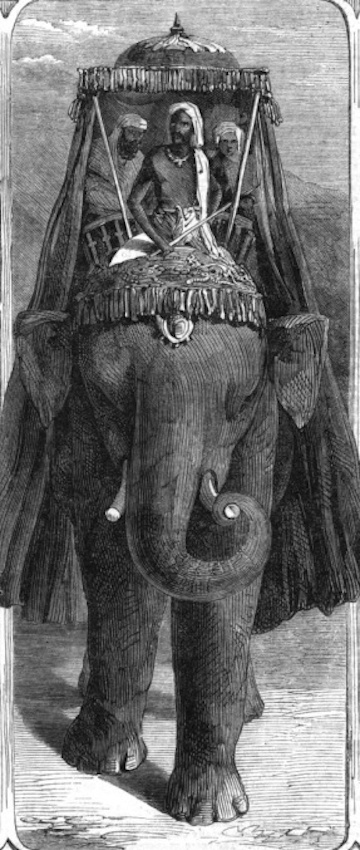
Modes of Travelling in India. From top left corner clockwise: Tramps; Hindoo Pilgrim; Travelling Beggar; Charry Gawk; An Ekha; The East Indian Railway; A Bhylie; Camel Caravan; Palky Gawk. Image from The Illustrated London News, 19 September 1863, p. 284. Pride of place is, of course, given to the elephant, which continues to be used on ceremonial occasions and for dragging heavy loads. Here, the mahout or elephant-driver conducts two passengers in the howdah behind him.
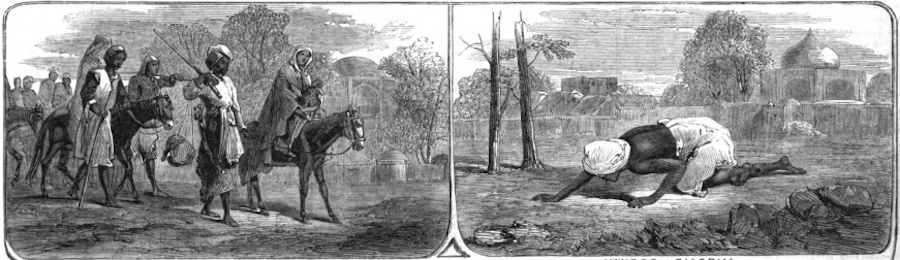
Left: "Tramps." Right: "A Hindoo Pilgrim." The former are probably itinerant nomadic or tribal people. There are still several hundred tribes which are nomadic in origin, if not in practice. The latter is a devout worshipper at a holy place, abasing himself in the presence or proximity of his goal, though he may adopt this mode of transport much earlier in his journey. He is not going as far as continually prostrating himself, but the idea is the same, i.e. not to touch the ground with the soles of the feet.
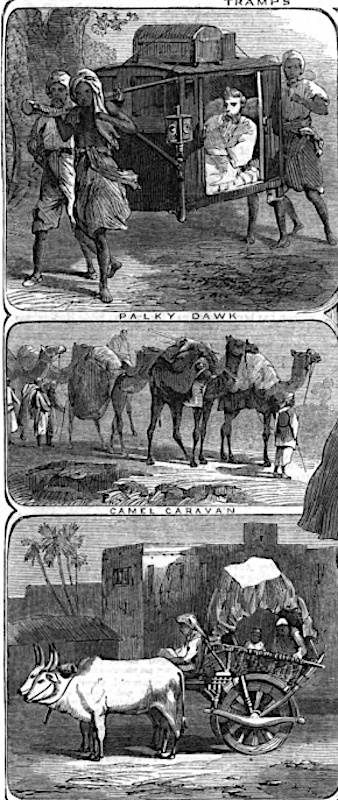
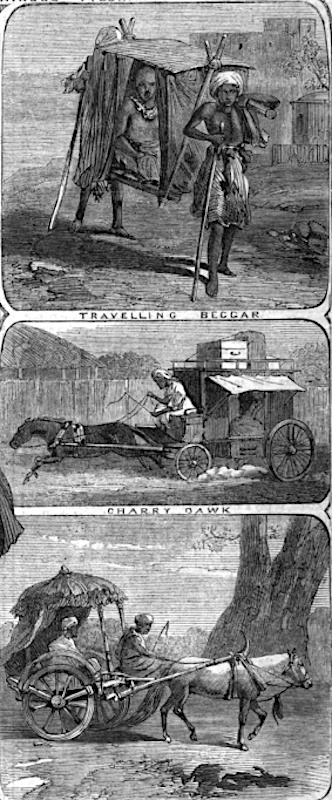
 

Left (top to bottom): "Palky Gawk"; "Camel Caravan"; "A Bhylie." Right (top to bottom): "Travelling Beggar": "Charry Gawk"; "An Ekha." These are mostly defined in their illustrations, except the "Travelling Beggar." A beggar was not someone begging for money, but a menial labourer: "a person pressed to carry a load, or do other work really or professedly for public service" (Yule and Burnell 80). The passenger here looks very much like a local big-wig.
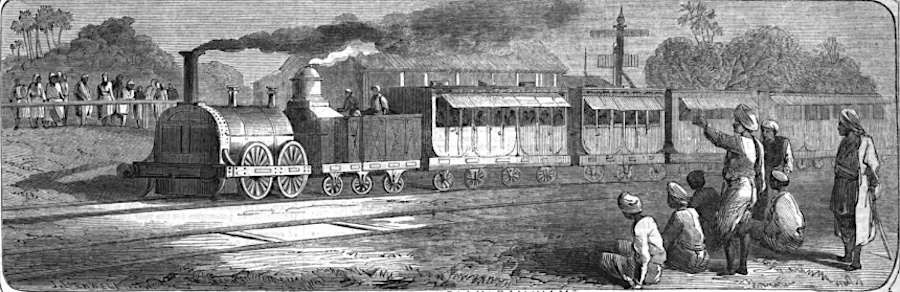
"The East Indian Railway." By the end of the 1850s, the East Indian railway had 77 engines, 228 coaches and 848 freight wagons, all of this having been shipped from Britain (see "East Indian Railway"). However, this was not a great number, considering the immensity of the area to be covered, and people seem to be greeting this train as something of a novelty.

Illustration downloaded and excerpted, text and formatting, by Jacqueline Banerjee. [You may use these images without prior permission for any scholarly or educational purpose as long as you (1) credit the source and (2) link your document to this URL or cite the Victorian Web in a print document. Click on the images to enlarge them.]



1870-BOMBAY-BROKERS AND TRADERS AND THEIR SECRET HAND LANGUAGE

Mumbaiwale: Can you crack this 150-year-old cloth merchants’ code?

Hindustan Times | By
Published on: Oct 26, 2018 10:41 pm IST

Fabric trading in 1800s Bombay was a complex affair, with towels, hand-signals and secret bids. See how one british newspaper described it

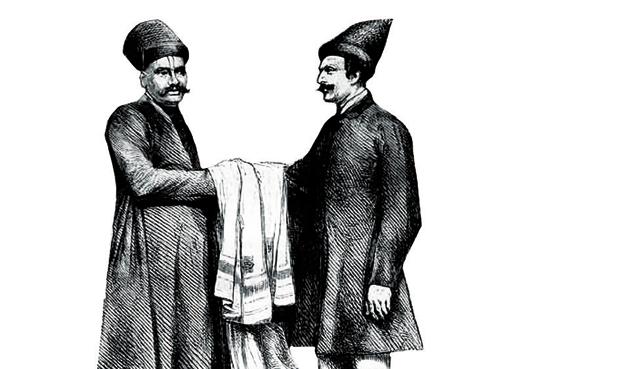
Would you have recognised the Bombay of 150 years ago? No suburbs. No traffic jams. No concrete jungle. No malls. Could you have done business there? This image, taken from an engraving reproduced in the illustrated weekly newspaper, Graphic, in 1870 depicts an interesting moment in the brokers’ rooms of an English merchant.

The man on the right is a Parsi, typically on the staff of a European cotton firm as a broker or clerk. His job would have been to show the goods, high-quality cotton fabric, to Hindu buyers like the man on the right, accept bids from each of them and submit it all in a book to his bosses.(The Graphic)

What’s going on? The two gentlemen are conducting a secret deal. The man on the right is a Parsi, typically on the staff of a European cotton firm as a broker or clerk. His job would have been to show the goods, high-quality cotton fabric, to Hindu buyers like the man on the right, accept bids from each of them and submit it all in a book to his bosses.

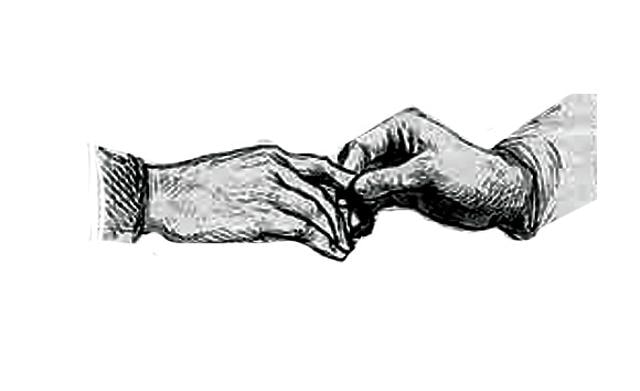
Of course, no Hindu merchant wanted to be outbid or seen to make a ridiculous offer. So, in the absence of sealed tenders and bidding apps, a special signaling system had been devised. “The native way of making and receiving offers is very peculiar,” The Graphic notes. “The offer is never made in words but always by squeezes of the fingers and strokes of the finger across the palm, the hands being covered with a towel or scarf so bystanders may not know the offer made.”

The offer is never made in words but always by squeezes of the fingers and strokes of the finger across the palm, the hands being covered with a towel or scarf so bystanders may not know the offer made. (The Graphic)

The covert communication served two purposes. “The seller, if beaten down in his price in one particular instance, does not find his goods generally depreciated. And the purchaser may charge any profit he likes without being found out.”

Take a good look at the two men. The Graphic describes the Parsis, as a Persian community that had settled in the province of “Juzerat”, and says its people were entrusted with being intermediaries for British businessmen, to make bargains and settle disputes in Bombay. Parsis, the report says, “by their energy, industry and intelligence have become the leading commercial class in Western India”. The community “combines some of the polish of the West with the courteous gravity of the educated Eastern.”

It also describes the Hindu dealers, who flock to Bombay in winter and re-sell to traders in central and northern India, Persia, Afghanistan, Arabian regions and Africa, in slightly unsavoury terms. “Hindoos … in their loud talk, coloured turbans, and legs and feet innocent of stockings, offer a striking contrast to the spruce Parsee, in his spotless white dress peeping from beneath a good brocade coat on cold days, with China silk trousers, white stockings and dainty shoes.”

The writer, however, couldn’t decide which side drove the harder bargain, “the suave Parsee or the slovenly Hindoo”. Because (and here comes the grudging praise) “the latter is a man of considerable wealth and can be trusted for thousands of pounds.”