Monday, September 17, 2012

1884 Pig Sticking India Horses Spear


Pig Sticking | Faithful Readers

Pig Sticking | Faithful Readers

Pig Sticking | Faithful Readers

Pig Sticking | Faithful Readers

Pig Sticking | Faithful Readers

Pig Sticking | Faithful Readers

Taste of Life: When pig-sticking hogged ...

Pig Sticking | Faithful Readers

Pig sticking india hi-res stock ...

First Spear', Pig sticking, India, 1889 ...

Pigsticking in india hi-res stock ...

Pig Sticking | Faithful Readers

Pig sticking, India, 1889 | Online ...

Pig sticking india hi-res stock ...

champion pig stickers in India

19th Century Indian pig-sticking spear with

Pig Sticking | Faithful Readers

Pig-Sticking and Tent Pegging in Poonah

Pigsticking in india hi-res stock ...

Pig sticking hi-res stock photography ...

PIG STICKING"TO EAT

Pig sticking india hi-res stock ...

Pig sticking india hi-res stock ...

HORSES - PIG-STICKING

File:Modern Pig-Sticking (1914) A. E ...

Pig sticking india hi-res stock ...

19th Century Indian pig-sticking spear with

Shall I?', Pig sticking, India, 1889 ...

Pigsticking in india hi-res stock ...

Nirvan Ahir Zamindars ...

Fine Art Finder Print of Pig Sticking ...

File:Modern Pig-Sticking (1914) A. E ...

Pig sticking india hi-res stock ...

19th Century Indian pig-sticking spear with

European Women Trying Equestrian Sports ...

Pig sticking india hi-res stock ...

Pigsticking in india hi-res stock ...

Pigsticking in india hi-res stock ...

Pigsticking in india hi-res stock ...

Pig-Sticking and Tent Pegging in Poonah

Pigsticking in india hi-res stock ...

19th Century Indian pig-sticking spear with

Pigsticking in india hi-res stock ...

SPORT ANTIQUES

Pig Sticking in India during the ...

Pig sticking, 1889 | Online Collection ...

Antique Print 1884 Pig-Sticking India ...

Nirvan Ahir Zamindars ...

Pigsticking in india hi-res stock ...

Nirvan Ahir Zamindars ...

Pigsticking in india hi-res stock ...

1936 Kadir Cup ...

PIG STICKING"TO EAT

Pig Sticking in India during the ...

Pigsticking in india hi-res stock ...

19th Century Indian pig-sticking spear with

Nirvan Ahir Zamindars ...

Pig Sticking in India during the ...

Button, Bihar Light Horse, 1884-1947 ...

SPORT ANTIQUES

File:Modern Pig-Sticking (1914) A. E ...

Pig Sticking | Faithful Readers

Pig Sticking | Faithful Readers

Indian Spear Horse Stock Illustrations ...

1859 The Indian Mutiny. 'Gallant attack ...

Spear Hunting Hogs on Horseback - YouTube

Pattern 1853 Enfield rifle cartridges ...

Hog-Hunting in Bengal. Wild boar of ...

Pigsticking in india hi-res stock ...

Illegal Spiked Bits Used to Harm Horses ...

SPORT ANTIQUES

Continuity of Terracotta Horse Making ...

Hog-Hunting in Bengal. Wild boar of ...

SPORT ANTIQUES

Cavalryman of the British Indian Army.

Cavalryman of the British Indian Army.

SPORT ANTIQUES

1st Horse (Skinner's Horse) - Wikipedia

PDF) Colonial Pig-Sticking, Imperial ...

Indian Spear Horse Stock Illustrations ...

Fine Art Finder Print of Pig Sticking ...

painting of Maharaja Takhat Singh ...

PIG STICKING"TO EAT

Indian Spear Horse Stock Illustrations ...

SPORT ANTIQUES

1859 The Indian Mutiny. 'Gallant attack ...

A Soldier From 1857, How This Unknown ...

SPORT ANTIQUES

India, Native Cavalry Tent-Pegging ...

trade in Gippsland bred horses ...

champion pig stickers in India

Nirvan Ahir Zamindars ...

champion pig stickers in India

Bear spear - Wikipedia

The many horse invaders of India

Five-pound history lesson: animal fat ...

Wild Boar " PIG STICKING " Victorian ...

Sikh Military History and the Defeat of ...

Button, Bihar Light Horse, 1884-1947 ...

Indian Spear Horse Stock Illustrations ...

trade in Gippsland bred horses ...

Pig Sticking, British Raj, Antique ...

Hog-Hunting in Bengal. Wild boar of ...

painting of Maharaja Takhat Singh ...

legal validity up by a strong pigtail

Imperial Hunting ...

PORUS: HYDASPES, ELEPHANTS, TACTICS ...

Pattern 1853 Enfield rifle cartridges ...

Late 19th Century Pig Sticking Spear ...

Late 19th Century Pig Sticking Spear ...

14th Horse (Scinde Horse) - Wikiwand

Antique Print 1884 Pig-Sticking India ...

Neanderthal horse-hunting ...

Troopers of the 20th Deccan Horse ...

14th Horse (Scinde Horse) - Bharatpedia

Oldest Wooden Spears To Hunt Horses ...

Continuity of Terracotta Horse Making ...

Pig Sticking in India during the ...

trade in Gippsland bred horses ...

15th Bengal Lancers tent pegging ...

trade in Gippsland bred horses ...

Indian Spear Horse Stock Illustrations ...

Imperial Hunting ...

Pig Sticking in India during the ...

Hog Sticking Raj Style ...

PORUS: HYDASPES, ELEPHANTS, TACTICS ...

Hog-Hunting in Bengal. Wild boar of ...

1st Horse (Skinner's Horse) - Wikipedia

15th Bengal Lancers tent pegging ...

India – Abhijit Majumder ...

Imperial Hunting ...

PORUS: HYDASPES, ELEPHANTS, TACTICS ...

What horses in a Harappan site and the ...

Imperial Hunting ...

Hog-Hunting in Bengal. Wild boar of ...

List of big-game hunters - Wikipedia

trade in Gippsland bred horses ...

9th Horse (Deccan Horse) | Military ...

First Anglo-Sikh War - Wikipedia

Imperial Hunting ...

Troopers of the 20th Deccan Horse ...

Galloping Horse ...

9 Of The Most Famous War Horses In ...

Indian Spear Horse Stock Illustrations ...

Imperial Hunting ...

9 Of The Most Famous War Horses In ...

European Women Trying Equestrian Sports ...

Adolescent Literature ...

Hog Sticking Raj Style ...

9 Of The Most Famous War Horses In ...

cartridges greased with pig and cow fat ...

Deep History of Cheshire

Pattern 1853 Enfield rifles ...

The many horse invaders of India

Equestrian Statue Ridden By Man Raising ...

Series Editor: Crispin Bates | PDF ...

Dominic Winter Auctioneers by Jamm ...

14th Horse (Scinde Horse) - Wikiwand

cartridges greased with pig and cow fat ...

Bear spear - Wikipedia

Pig Sticking in India during the ...

European Women Trying Equestrian Sports ...

mysterious horse-hunting spears ...

Reminiscences of Sport in India | PDF ...

Dariusz caballeros: April 2012

Fine Art Finder Print of Pig Sticking ...

675 Indian Pig Stock Photos, High-Res ...

What horses in a Harappan site and the ...

European Women Trying Equestrian Sports ...

675 Indian Pig Stock Photos, High-Res ...

PDF) Cavalry Warfare from Ancient Times ...

Ancient Stone Implements, Weapons ...

Madras Horse Artillery Gun ...

wild horse - NamuWiki

Boar Spear with Double Barrel Wheellock ...

John French, 1st Earl of Ypres - Wikipedia

Horses in the Boer War

Imperial Hunting ...

675 Indian Pig Stock Photos, High-Res ...

Hog Sticking Raj Style ...

The Thirteenth Hussars in the Great War ...

Ruskin Bond - THE MANTHAN SCHOOL - Page ...

The Missing Horse Of Baghpat - Devdutt ...

disappearing horse statue

Illegal Spiked Bits Used to Harm Horses ...

South African War, 1899–1902 ...

Pig sticking, India, 1889 | Online ...

A Texas Cowboy, by Chas. A. Siringo - A ...

Billy" Dixon of Adobe Walls ...

Eternal Mewar | Mewar Dynasty | Lineage ...

The Sepoy Heart (Part III) - India ...

Sikhs and the 1857 Mutiny – Musings

coracles | Early Tourists in Wales

banner_research.jpg

675 Indian Pig Stock Photos, High-Res ...

The Sepoy Heart (Part III) - India ...

How horses saved besieged Ladysmith ...

Bounty and story of Pitcairn Island ...

9 Of The Most Famous War Horses In ...

South India in the Freedom Movement ...

Madras Horse Artillery Gun ...

Papua New Guinea ...

1884 Pig Sticking India Horses Spear

1877 India Poonah Boat Club


1858 India-dangers of Palanquin travel-- Wolves Hyenas Jackals Tiger

1854 Indian Railway Station Platform People Waiting

Yachting Ceylon Bombay India 1882


Queen's Birthday India-- Hindu Celebration Bombay 1899

- Motor Cars in India-- Napier Oakland Talbot Sunbeam Vauxhall

Viceroy travelling to Government House Bombay 1899 .

Jamsetjee Jeejeebhoy Art Bombay School Print 1872 BOMBAY


WAR IN EGYPT-INDIAN TROOPS LEAVING BOMBAY DOCKS FOR EGYPT


1882 Anglo-Egyptian War:-n 1881, an Egyptian Army officer, Colonel Ahmad Urabi (see Ahmed Orabi), initiated a coup against the Ottoman Khedive in Egypt because of grievances over disparities in pay between Egyptian and European employees, as well as other concerns (see Urabi Revolt). In January 1882 the British and French governments sent the "Joint Note" to the Egyptian government, declaring their recognition of the Khedive's authority. On May 20, 1882, British and French warships arrived off the coast of Alexandria. On June 11, 1882, a riot occurred in Alexandria that killed 50 Europeans, though Colonel Urabi ordered his forces to put down the riot. On July 11, 1882, British warships began their bombardment of Alexandria.

The British army tried to reach Cairo through Alexandria but was stopped for five weeks at Kafr-el-Dawwar. In August, a British army of over 40,000, commanded by Garnet Wolseley, invaded the Suez Canal Zone. He was authorized to destroy Urabi's forces and clear the country of all other rebels.

Battle of Tel el-Kebir
This important battle was fought on September 13, 1882. The Urabi forces were routed and the capital was captured. Khedive power was then restored as the authority of Egypt.

British occupation

British troops then occupied Egypt until the Anglo-Egytpian Treaty of 1922 and Anglo-Egyptian Treaty of 1936, giving gradual control back to the government of Egypt.
Hopkins argues that the British continued its occupation of Egypt after 1882 in order to guarantee British investments, "Britain had important interests to defend in Egypt and she was prepared to withdraw only if conditions guaranteeing the security of those interests were met - and they never were

1889 Prince Albert Victor India Poonah{POONA/PUNE} Native Infantry

TROOP SHIP"SERAPIS" TO INDIA 1867

1856 STEAM MAIL SHIP TO BOMBAY

PROCLAMATION OF QUEEN VICTORIA AS THE EMPRESS OF INDIA 1877

THE "MOZOFER" STEAM SHIP BEING MADE IN BOMBAY DOCKS 1846

SIR MANCKJEE CURSETJEE OF BOMBAY AT SHEFFIELD 1854 SPEAKING ON EDUCATION IN INDIA

Ship Tory West India Docks 1845 BOMBAY

Prince'S 'Levee' AT BOMBAY 1876{ the simple act of getting up in the morning WHICH was raised to a ceremonial custom at the court} AND India'S Maharana Oudeypore 1876


KING'S 'LEVEE' =the simple act of getting up in the mornin WHICH was raised to a ceremonial custom at the court

Prince Wales Temple Parbuttee Poonah India Print 18769(POONA /PUNE)

PRINCE OF WALES IN INDIA 1876

Road Steamer Omnibus India 1871 BOMBAY

Sassoon Hospital Bombay India 1868 AT" POONAH"

LAUNCH OF THE SHIP "MEANEE" AT BOMBAY 1849

1877 Rajah Ram High-School Kolapore India -Bombay presidency

Arrival Of Indian & Australian Mails At Alexandria EgypT on the way to Bombay 1853

An Indian Money Changer 1895

SHIP FOR THE ROYAL VISIT AT BOMBAY 1875


LIFE ON THE SHIP 1875

CEREMONY PERFORMED BY NATIVE GIRLS FOR THE BRITISH PRINCE -BOMBAY 1875

photo shows the old Bombay Artillery Mess at Matoonga [Matunga].1830'S

Adelphi Hotel BOMBAY 1850

Bombay Esplanade in 1857

Note Colaba Railway Station on the left. And CUFFE PARADE is yet to be RECLAIMED.

Colaba Reclamation POST CARD by BOMBMAN.

COLABA RECLAMATION BOMBAY

[Mumbai_Hot_Spots_Pics___Old_Colaba_0.jpg]

The Anglo-Persian War 1856-1857

File:Kooshab.jpg
British-Indian forces attacking at the Battle of Kooshab
PERSIAN ARMY WAS DEFEATED

A havildar of Bombay Presidency Army Artillery, 1882

5th Bombay Cavalry (Sind Horse). ~1895

Bombay Cavalry AT ANGLO PERSIAN WAR 1856-1857 AT KOOSHAB


THE PERSIAN WAR .THE CHARGE OF THE BOMBAY CAVALRY AT THE BATTLE OF KOOSHAB

Origins

In the context of the Great Game — the Anglo-Russian contest for influence in Central Asia — the British wished for Afghanistan to remain an independent country friendly to Britain as a buffer against Russian expansion towards India. They opposed an extension of Persian influence in Afghanistan because of the perception that Persia was unduly influenced by the Russians. The Persians had repeatedly attempted to acquire Herat by force, most recently in 1838 and 1852; both times British opposition had convinced them to back down prior to war. They made a fresh attempt in 1856, and succeeded in taking the city on 25 October, with Russian encouragement and in violation of the existing Anglo-Persian treaty. In response, the British Governor-General in India, acting on orders from London, declared war on 1 November.

Koosh-Ab

After the arrival of the C-in-C, the force advanced inland and defeated the Persian field army at Koosh-Ab on 8 February 1857. The Poona Horse carries a Standard surmounted by a silver hand and bearing a Persian inscription captured at Koosh-Ab, in commemoration of the brilliant charge of the 3rd Bombay Light Cavalry which broke into enemy infantry and decided the fate of the day. The honour was awarded vide GOGG 1306 of 1858 and spelling changed from Kooshab vide Gazette of India No 1079 of 1910.


One of the earliest emu trainsets (4-car ) speeding over the Sandhurst Road flyover

The first electric train in India: circa 1925(the inaugural train at Bombay VT.)


Picture at left shows H.E. the Governor making a speech on the occasion, while the pic on the right shows the inaugural train at Bombay VT

The first emu cars for the erstwhile BB & CI Railway (now WR) being unloaded from a ship around 1925.


THE FIRST ELECTRIC RAILWAY ENGINE GETTING OFF LOADED FROM SHIP 1925

BOMBAY FOUNTAIN TAXI STAND 1950

See full size image

HMS Calcutta -SHIP MADE IN BOMBAY 1831

File:Tissot HMS Calcutta.jpg

HMS Calcutta was an 84-gun second-rate ship-of-the-line of the Royal Navy, built in teak to a draught by Sir Robert Seppings and launched on 14 March 1831 in Bombay. She was the only ship ever built to her draught. She carried her complement of smooth-bore, muzzle-loading guns on two gundecks. Her complement was 720 men (38 officers, 69 petty officers, 403 seamen, 60 boys and 150 marines).

In 1855 the ship had been in reserve, but was recommissioned for the war between Russia and Britain and sailed for the Baltic. After two months she was sent home again, as being useless for modern naval actions.

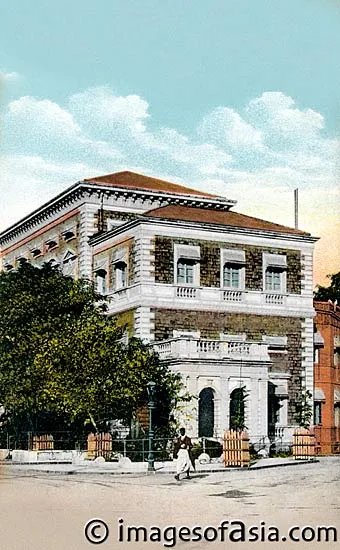
Malabarpoint governmenthouse bombay.1865

FREE MASONS HALL FORT AREA BOMBAY


freemasons hall bombayfreemasons hall bombay

KANHERI CAVES


The caves, which are more than 100 in number, are reached from the Bhandup station of the Central railway or the Borivli station of the Western Railway by a good black topped road emanating from the Western Express Highway and passing through the National Park at Borivli. From Bhandup, 24 km. (fifteen miles) north-east of Bombay, the Kanheri road runs north-west for about a mile, formerly across rice fields and grass uplands, till, at the foot of the Salsette hills, it joins the old Bombay-Thane road. It then climbs a pass in the hills, and winds about a mile across the rugged upland of Vihar, the gathering ground of the Vihar lake, which, starting on the left, stretches about 8 km. (five miles) to the south-west, its surface broken by wooded islets. Beyond the Vihar gathering ground, the path passes, for about a mile, through a thick belt of forest, over the slightly raised watershed that separates the Tulsi and the Vihar valleys. Near Tulsi the road swerves to the left, keeping to the south-west of Tulsi lake, a beautiful sheet of water surrounded by wild forest-clad hills. For the two remaining miles, from Tulsi to Kanheri, the road though formerly not fit for carts is now black-topped and motorable. The first mile lies along the Vihar-Borivli road, with rises and falls, down the wooded Tulsi or Tasu valley, surrounded by high forest-clad hills, through glades of withered grass, thick copsewood, and bright green clumps of bamboos. The last mile is along a footpath that strikes from the Borivli road north to Kanheri.

BORIVALI LION SAFARI PARK


This Lion Safari Park is the second of its kind in India, the first being in the Nehru Zoological Park, Hyderabad.

The Lion Safari Park in Borivli is a miniature Gir Forest. The 13 hectares site occupied by the park has a gentle slope from north to south. The green rolling hills of Kanheri seen prominently from the safari park remind the visitor of the Girnar hills of the Gir Forests. The Lion Park includes many species of trees characteristic of the Gir.
The 1200 m. long, 6 1/2m. high chain-like fence fitted to channel iron posts encloses the lion park area and is lion-escape-proof. On the northern boundary, the fence alignment goes up a hill, thus including in the Park one complete boulder-strewn face of the hill. This is a very attractive feature which lends beauty and grandeur to the safari park. The fence is painted green and merges with the surrounding greenery.
The visitors to the Safari Park are provided with mini-buses (each with 10 seats) from which they can view the animals roaming free in the Park. These minibuses are provided with safety measures to protect the visitors from lions. A rescue vehicle also with safety measures is always kept in readiness to counter unforeseen difficulties of the mini buses inside the Park. The 1.25 km long, asphalt internal road system within it is planned in such a manner that visitors could be taken rea sonably close to the lions, wherever the lions be within the park. To prevent lions from escaping from the park when the gate is opened to allow entry into and exit from the Lion Park by the safari, a double door arrangement is provided at the gate. The lion house hidden from the visitor's view is a weather shelter to lions into which they are taken daily in the evening for feeding. A natural looking pond provides drinking water to the animals.

imamwada mosque bombay

Ali Baba and his 400 hookahs-Bhendi Bazar's popular dealer, the iconic Ali Baba


He procures the hookahs from Iran, Dubai, China and Moradabad (Uttar Pradesh). "My prices are lower than elsewhere and it's genuine custom-made maal ranging from Rs 90 to several thousands

"Two apples (apple, saunf), mint (perfect for summers), Paan Rasna, Paan Fantastic and Al Araz Gum (chewing gum-like) are the most popular hookah flavours,"

Bhendi Bazar's popular dealer, the iconic Ali Baba

;3-in-one hookah has a holder for a cigarette, a hookah and smoked as a pipe


Not for sale: This hookah made from pure marble, is 103 years old and
displays designs in gold embossed paint and embedded genuine gemstones


REGAL TALKIES, COLABA..
The Regal Cinema was built during the cinema boom of the 1930s during which Plaza Central, New Empire, Broadway, Eros and Metro all opened in Mumbai. Opened in 1933, Regal was designed by Charles Stevens, the son of the famous 19th century architect, F. W. Stevens. Its interiors with extensive mirror-work were designed by the Czech artist Karl Schara. The main auditorium had a motif of sunrays in pale orange and jade green. Its interiors were designed to create an impression of airiness, coolness and size in harmony with the modern simplicity of the exteriors. The Regal was built completely in reinforced concrete cement (RCC), fully air conditioned, and had an underground parking lot for patrons. The elevator up from the parking area was a major innovation at the time.
The cinema was the third venue to host the Filmfare Awards night. Today, it is a multi-use building combining a cinema with shops at street level.

Tuesday, September 4, 2012

Tremors near mumbai Jawahar--Is Mumbai ready to face a devastating earth quake?

Tremors in Jawhar scare villagers -minor tremors between 1983 and 1996.

Tremors in Jawhar scare villagers Ram Parmar mirrorfeedback@indiatimes.com

Times of India Publications


Fresh tremors were again felt in Jawhar on Monday morning.Since August 26,villages in the tribal belt have been experiencing tremors.Scientists from the India Meteorological Department (IMD),Colaba,and National Disaster Response Force (NDRF),Pune were to arrive in Jawhar late Monday evening.The Thane District Disaster Management Squad are pacifying the terrified tribals and holding public awareness meetings.
Nitin Naik,Chief,District Disaster Management Squad,Thane,said his team is in Jawhar after Tehsildar Urmila Patil informed him about fresh shocks on Monday morning.Three tremors were recorded since 9.00 am,said Naik.
Some of the utensils fell from the racks and our huts also shook, said Harshad Patil,a resident of Kalidhond.
We panicked and ran out of our homes and stood in the open, said Mohammed Hussain,another resident of the same village.
We are quite surprised with these shocks as even the seismic apparatus kept at the IMD,Colaba has not recorded them.But we are not taking any chances and have informed the IMD and the NDRF,and scientists
are to arrive in Jawhar by late Monday.Only after they analyse the situation,we can arrive at a conclusion, said Naik.
When asked whether the incident could be due to stone quarrying in the jungle areas of Jawhar,Naik said the government has banned quarrying and other activities during the monsoons.The shocks could be due to the massive explosive activities being carried out by the Irrigation department,Thane to lay underground water pipelines.The pipes are being laid around 800 m underground.But this is an assumption, said Naik.


The Seismic Environment of Mumbai


Fault lines in Mumbai There have been claims that Mumbai is prone to moderate intensity earthquakes ranging up to about 6.5 on the Richter scale.
Mumbai lies over more than 10 seismic fault lines (black lines in the map). Major fault lines lie along the Thane creek, Ulhas river, the Manori and Malad creeks and the lakes. To the west, a fault line stretches from Colaba to Vasai, touching Malabar hill.
A major junction of three faults, the Thane, Panvel and Dharamtar creeks lies close to the Oil and Natural Gas Commission's oil plant in Uran in New Mumbai.
The coastal plain to the east of Mumbai is prone to earthquakes of even higher intensity, upto 7.5 on the Richter scale. In this region the black volcanic rocks of the Western Ghats have been eroded by the action of the sea. The resulting relief of pressure on the underlying rocks has created many fault lines along the coast.


 FEW YEARS AGO THERE WAS A SIMILAR EARTH QUAKE; IN JAWAHAR; WHICH WAS FELT ALLOVER MUMBAI .
THE CONCERNED GOVERNMENT DEPARTMENT MUST MAKE DEEPER STUDIES ABOUT THIS ;INSTEAD OF SAYING THAT IT MAY BE BECAUSE OF PIPE LINE ETC
Jawhar recording minor tremors between 1983 and 1996.
======================================================================

Home
Epaper
Letter to Editor
Feedback


 The writer is an ex-Professor of Geology, IIT Bombay at Powai and an earthquake geologist

RSS Feeds

When Kalyan trembled

By: 
discuss news article
print news article
email news article
share news article
  Movers and shakers

June 2005 has turned out to be an unusual month for the northern city of Kalyan, situated on the bank of Ulhas river, with two minor earthquake tremors, both of magnitude 3.0, shaking it and neighbouring Ambernath and Dombivli, on the evening of June 14 and again on the morning of June 18.

Though they did not cause any damage, they show that the eastern corridor beyond the Thane Creek is seismically quite active and this is significant.

Such low earthquake activity persisted in the northern part of Thane district earlier too, with Khardi, Bhatsa, and Jawhar recording minor tremors between 1983 and 1996. But, after 1998, the earthquake activity shifted southwards to the tract falling between Kalyan and Panvel except for one stray occurrence near Palghar in December, 2001.

Two of the most recent tremors May 31, 1998 of magnitude 3.6 and the other that occurred on November 16, 2001 of magnitude 3.0 were epicentred at Ambhe village, 10 km east of Taloja and Khairna, 10 km west of Taloja, close to the Thane Creek. Both shocks that occurred in June, 2005 were epicentred at Kalyan.

Why Kalyan rocks

The main reason for persistent seismic activity, even if it is of low magnitude, at the corners of a triangle connecting Kalyan, Khairna and Ambhe, is the major geological transition that has taken place in this terrain to the west of Kalyan in the north and Panvel in the south.

The rock in this region is a black basalt of volcanic origin, having been poured out of long and deep fissures in a hot, molten state in the geological past. This basalt rock occupies a staggering 5,00,000 sq km of Deccan Volcanic Province that covers major parts of Madhya Pradesh, Maharashtra and Gujarat.

The most important aspect is that this basalt lies in a perfectly horizontal position at all places located to the east of the Kalyan-Panvel line as seen clearly in the hill forms flat-topped plateaus and ridges like the ones at Khandala and Mahabaleshwar.

But immediately to the west of this line the geological scenario changes drastically and the same black rock occurs here with a distinct slant, called dip, in a westerly direction as observed in the hills around the Powai Lake.

Tension in Panvel too

Such a geological feature that imparts a tilt to horizontally laid rocks is called a monoclinal flexure and Dr J B Auden, a British geologist who was the first to recognise this feature in this region, christened it the Panvel Flexure since it starts from Panvel at its southern end and runs northward through Kalyan and turns northwest.

This important Panvel Flexure owes its origin to a tensional stretching of the rocks in a westerly direction.

It is well known that tension always leads to rupture and such a tensional pull of the rocks had consequently led to the formation of many geological faults (which are in fact rupture planes over which the rocks on either side have moved past each other) in the region; these faults had weakened the rocks of the terrain considerably and made them vulnerable to earthquakes.
Cost of staying safe

Important townships like Navi Mumbai, Belapur, Mumbra, Ambernath, Dombivli and Badlapur besides Kalyan are located in this active seismic belt.
Given that earthquakes can neither be predicted nor prevented, precautions are necessary. Following standard building codes for different civil engineering structures during construction is the only precaution.
Earthquake-resistant designs which include an additional safety factor in view of the seismic risk, are available for all types of buildings and these increase overall cost of construction only by about 10% which is well worth providing for.

How high can you go?

Buildings with 40-50 floors are problematic and may be avoided.
Seismologists are not able to ensure safety beyond a certain optimum height; a state-level committee had recommended restricting heights to 70 metres (about 22 floors) and this seems reasonable.

It is argued that high-rises can be built on raft foundations which will make them float like ships during earthquakes but recent research at Pennsylvania State University has shown that high-rises may not always come back to their original vertical positions after the earthquake vibrations pass off but, instead, remain tilted.

Likewise, existing buildings should also be reinforced to withstand earthquake vibrations.

California is preparing itself
Complacency should give way to caution considering the seismicity of the Kalyan-Panvel corridor.
It will be good to increase the level of awareness about earthquake possibilities and get into a mood of preparedness as the Americans are doing in California which is a highly seismic state; their calculations lead them to believe that a major earthquake is due on the San Andreas Fault in the San Francisco area sometime between 2010 and 2030 and they are already gearing themselves towards that possibility after nearly a century their last major earthquake occurred in 1906 at San Francisco.

As for Mumbai

Mumbai seems to be somewhat favourably located to the west of the Thane Creek in a terrain with fewer faults and so earthquakes have so far avoided the commercial capital of India. However, it still figures in Seismic Zone 3 and therefore can draw its lessons from the Kalyan tremors.

An earthquake of magnitude 6.5 occurring anywhere in the Kalyan-Panvel corridor will affect all the places in the Mumbai Island. One can only hope that the Thane Creek will continue to act like the Lakshman Rekha and hold the earthquakes at bay!

The writer is an ex-Professor of Geology, IIT Bombay at Powai and an earthquake geologist
Finding faults
Some of the important faults occurring in this region are: the Thane Creek Fault, the Panvel Creek Fault and the Ulhas River Faults.

These faults are responsible for the minor earthquakes in this eastern corridor by getting reactivated periodically. It will be seen that the Ulhas River west of Kalyan flows along many small unusual meandering loops all of which would appear to be faulted segments.

These tiny faults and the major fault along the Panvel Flexure itself surround Kalyan closely and make it a potential venue for earthquakes.

Likewise, the Thane Creek Fault (which is an established feature by now) had given rise to the Khairna tremor of 16-11-2001 while the Panvel Creek Fault had obviously triggered the Ambhe earthquake of 31-5-1998.

It needs to be noted that this major geological transition zone lying to the east of Thane Creek is a highly faulted tract and this makes it vulnerable to earthquakes.


Thursday, August 30, 2012

What would have Jinnah thought of Ajmal Kasab and gang, wonders SC-especially on Taj Mahal Hotel,

So Deep Is the Night 

NEW DELHI: In the wanton spilling of blood and mindless destruction during the 26/11 Mumbai attacks, Pakistani terrorists had scant regard to places, including the iconic Taj Hotel, which were once close to the heart of Pakistan's Quaid-e-Azam Mohd Ali Jinnah.

"One wonders what Quaid-e-Azam would have thought of the terrorist attack on his favourite city in the subcontinent and especially on Taj Mahal Hotel, which he had a personal relationship of a very intimate kind," the Supreme Court said in its judgment on Wednesday while upholding death penalty to the lone surviving Pakistani terrorist Ajmal Kasab.

The bench of Justices Aftab Alam and C K Prasad recalled, "At the Taj Mahal Hotel ballroom on February 20, 1918, at her 18th birthday party, Ruttie had accepted Jinnah's hand in marriage while the  

band was playing  Chopin tune 'So Deep is theNight'."


Ruttie - Jinnah(you tube)


Ruttie Jinnah: The Story, Told and Untold A - The Sunday Tribune .

 OFF THE SHELF
Jinnah’s tragic love
V.N. Datta

Ruttie Jinnah: The Story, Told and Untold
by Khwaja Razi Haider. Pakistan Study Centre, University of Karachi, Karachi. Pages 194. Price not stated.

Ruttie Jinnah: The Story, Told and UntoldA great deal has been written on Jinnah’s role in the making of Pakistan, but little is known of his private and personal life. This was because he wrote little, and what he wrote was formal and a matter of fact. Some of his letters read like telegrams. He wrote no autobiography or diary, as he had no literary flair. He was reserved, taciturn and secretive. He wrote his will in May, 1939, but it was after his death that Liaquat Ali Khan, his close associate, came to know that he was its trustee and executor.
The book under review focuses on Jinnah’s conjugal relationship with his wife, Rattenbai, popularly known as Ruttie. The author Khwaja Rai Haider, a researcher of the freedom movement in Pakistan, has reconstructed the Jinnah-Ruttie relationship not on the basis of what they wrote to each other, but what others have written about them.
Jinnah married his fabulously rich and renowned magnate Parsi friend Sir Dinshaw Petit’s daughter, Ruttie, when she was 18 and he was 42. Love has no logic. Sir Dinshaw opposed her daughter marrying Jinnah, but she stood firm and walked out of her parental home to which she was never to return.
Ruttie got converted to Islam. The marriage took place on April 19, 1918, under the Muslim Shiite doctrine at the Jamia mosque, Bomaby. Jinnah paid Rs120,000 as haq mehr to Ruttie. The couple spent their honeymoon in Naini Tal at the Raja of Mahmudabad’s mansion. Recollecting her meeting with Ruttie, the Raja wrote, "I felt a very charming and enchanting fragrance from her body which is still living in my soul." Dewan Chiman Lall, Jinnah’s friend and a prominent Congress leader of Punjab, while recalling his association with Ruttie wrote, "There is not a woman in the world today to handle a candle to her for beauty and charm." Chiman Lall, whom Ruttie addressed as ‘Chum’, sighed for her as a lover, which is confirmed by his nephew Manohar Lal Tandon, a resident of Amritsar.
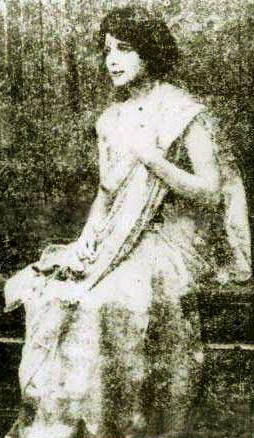
Ruttie was a dazzling beauty, vivacious and sprightly, full of life, with exquisite tastes and affable manners. With long hair decked in ever-fresh flowers, she was easily one of the most well-dressed women. Quick witted, she moved freely in the elitist circles of Bombay.
The author throws light on Ruttie’s life-style. Reading and horse-riding were her pleasures. She recited English poetry, and her favourite poet was Oscar Wilde. Besides law, Jinnah’s special interest lay in Shakespeare. While in London, he had acted in some of Shakespearean plays. He had thought of taking acting as his profession. Possibly, his interest in Shakespeare gave him insight into the intricacies of human character which he was to use for grasping the essentials of Indian politics.
After their marriage, the couple travelled a lot in India and abroad. Ruttie watched
with a great sense of pride the feverish political activity of her husband. She came closely in touch with Mahatma Gandhi who advised her to speak in Hindi or Gujarati. The author narrates Jinnah’s encounter with Lord Willingdon, Governor of Bombay, who had invited Jinnah and his wife for dinner in Government House. Ruttie’s unconventional and "low-cut dress" upset Lady Willington who asked her A.D.C. to bring in a wrap for her. At this remark, Jinnah said, "When Mrs Jinnah needs a wrap, she will ask for it." Thereafter, the couple walked out of the house.
According to the author, the relations between Jinnah and Ruttie became strained in January 1928. She fell ill and shifted to the Taj Mahal hotel. Accompanied by her mother, she went to Paris for medical treatment. Dewan Chiman Lall, who found her "delirious" in a Paris clinic, states that again both Jinnah and Ruttie quarreled. Ruttie returned to the Taj Mahal hotel on October 26, 1928, while Jinnah too reached Bombay. Ruttie’s condition deterioted, and finally, death struck her on her birthday, February 20, 1929.
What did she die of remains hidden—was it colic pain? No one knows. And what caused the ruination of Jinnah-Ruttie marriage? Was it incompatibility of temperaments—a cold, introvert and commanding personality of Jinnah on one side, and a young, extrovert, glamorous girl on the other` A line in her letter to Jinnah dated October, 1928, is significant: "Try to remember my beloved the flower you plucked, but not the flower you tread."
  She found it difficult to live with Jinnah and felt suffocated. She sought for solace in occultism, mysticism and sorcery, which were repellent to a rationalist like Jinnah. It was death that released her from her anguish and suffering. 

 It is a strange twist of fate that a love story that started like a fairy tale ended as a haunting tragedy to rival any of Shakespeare’s dramas.

  Ruttie’s love letter to Jinnahthis letter shows the depth of passion his wife had for him. 

Rutti Bai
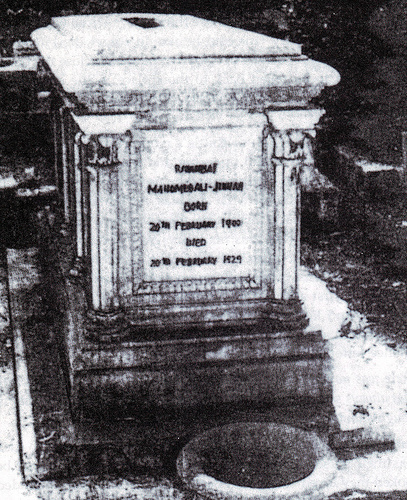
Ruttie's Grave
Ruttie's Grave
Ratti Shifted to Taj: Ratti, a Cancer Patient shifted to Bombay’s Taj Hotel where she was taken care of by the hotel staff. Kanji, here close friend, continued to be her constant companion. By February 18, 1929 she had become so weak that all she could manage to say to him was a request to look after her cats. Two days later, Ruttie Petit Jinnah died. It was her 29th birthday.

Mumbai Taj Mahal Hotel Attack