How did AIR get its name? The answer lies in what Lionel Fielden, the first Controller of Broadcasting said to Viceroy Linlithgow after a banquet. The name, Indian State Broadcasting Service (begun on an experimental basis for two years in 1930), suggested Fielden, was rather bureaucratic. The Viceroy, rising to the bait, agreed it was a mouthful. “All India Radio,” mumbled the Viceroy after serious prompting by the broadcaster. “The very thing!” exclaimed Fielden, “and what beautiful initials!”
India’s first Prime Minister was a regular visitor at the All India Radio office. Here, seen with AIR artistes after a programme. (Photo courtesy: AIR)
AIR was born on June 8, 1936. Urdu humourist Sir Syed Ahmed Shah Bokhari (before the formation of Pakistan in 1947) was the first director general. PC Chowdhuri was independent India’s first DG.
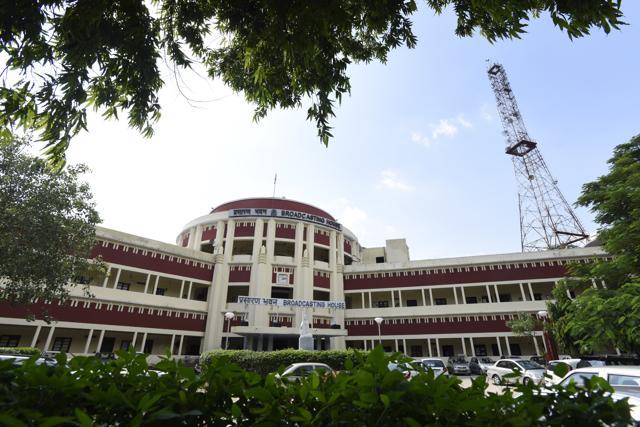
The Broadcasting House is the home of the All India Radio office in New Delhi. AIR was born on June 8, 1936. (Sanjeev Verma / HT Photo)
The AIR signature tune based on raag Shivaranjini was composed by Walter Kaufman, a director of music at AIR, a Czech Jew who had fled Europe fearing the Nazi onslaught.
AIR played a sterling role during Partition and the refugee influx, uniting families. Accessed by just 4,000 radio-sets in 1947, on June 3, AIR broadcasted Mountbatten, Jinnah and Nehru’s declarations on India’s partition. Gandhi visited AIR only once -- on November 12, 1947 -- to broadcast a message from Studio 3 to refugees arriving in Haryana from Pakistan.
Artiste Madhu Malti (85), then a 16-year-old who got paid Rs 15 per programme (at 17, she got her first three-month contract and was paid Rs 150), recalls the yeoman service AIR did at that time. By the ’50s, she was a star of its radio plays and a top announcer receiving fan-mail of 4,000-5,000 letters a week with three assistants for sorting them! Dadima Jaagi and Awaaz ki Dulhan were some of her best plays. “The latter was broadcast eight times in two years on request,” recalls the artiste.
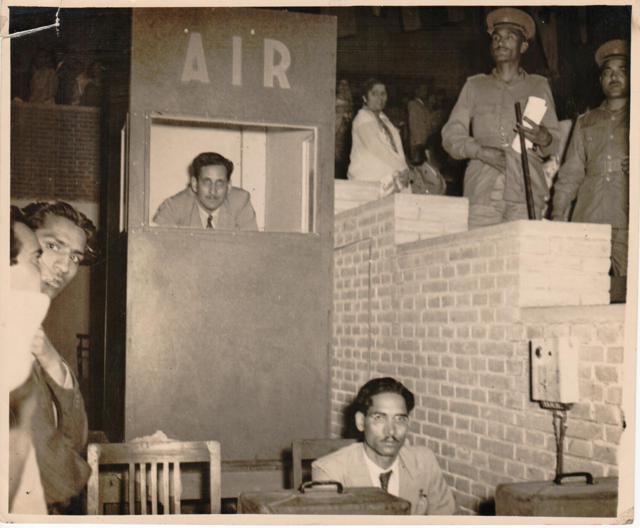
Melville de Mellow (inside the announcer’s booth), a former Armyman, was known as the Voice of AIR in the Fifties. Here, he is seen on an out-of-office assignment. He is remembered for a seven-hour running commentary during Mahatma Gandhi’s funeral. (Photo courtesy: AIR)
Melville de Mellow, a former Armyman, who turned out to be AIR’s iconic newsreader, did the seven-hour running commentary for Gandhi’s funeral.
Newsreader Surojit Sen was the first foreign correspondent to reach Dhaka after the Indo-Pak war in 1971 and interview the top leaders of newly-founded Bangladesh.Author Nirad C Chaudhuri was an AIR news editor in the late ’40s.
The News Divison people at AIR were always an independent bunch, writes KG Joglekar, a former director of the division, in Sakshi, an Aakashvani magazine. “We were neither burra sahibs nor babus but professionals who had strayed into government service…We dressed differently and were at times irreverent in our talk.”
After independence, AIR also played a vital role in bringing music, which used to be patronised by princes, to ordinary homes.
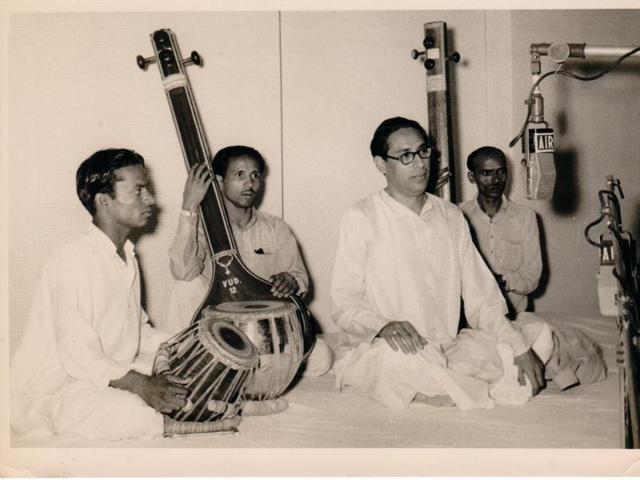
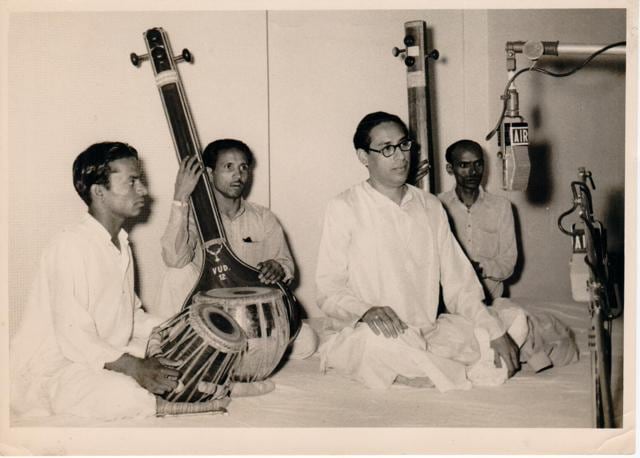
One of the most influential figures in Hindustani vocal music and the founder of the Indore Gharana, Ustad Amir Khan (second from right) at an AIR programme. (Photo courtesy: AIR)
In the ’50s, the AIR National Orchestra (Vadya Vrind) was set up. Pandit Ravi Shankar was its director from 1949-56. Vividh Bharati Service (VBS), AIR’s hit channel for Hindi film songs, started in 1957. Pandit Narendra Sharma was one of its stalwarts. Since 2008, VBS programmes have been available on DTH, making it a 24-hour music channel.
AIR’s unique youth service, Yuva Vani (YV), was set up on July 21, 1969. It was both a youth hang-out and training ground. In its glory years, the English section was managed by the trinity of Rita Mukherjee, Avik Ghosh and Noreen Naqvi. Naqvi, in fact, was the first woman director general of AIR. No longer a channel, YV now lives as a daily programme on AIR. Theatre artist Sunit Tandon, quizmaster Siddhartha Basu, politicians Sitaram Yechury and Anand Sharma and PSBT director Rajeev Mehrotra were active YV participants. Actress Lillete Dubey’s was a YV romance; she met her husband, Ravi, a fellow participant, on a YV programme. Author Amitav Ghosh was a campus reporter for its Roving Microphone programme.
“On Roving Microphone, we caught things of interest in town. We even interviewed children selling flowers at traffic lights. We asked them what they had to say about their life. They were scared to say and we were scared to ask, as, in a sense, what we were probing could reveal a critique of the government, but it opened up things,” says Rita Mukherjee. “In Firing Line, we put a person at the centre of a controversy on the mat and had young people question him/her. For example, if there was a medicine scam, we could have the health minister in the studio. The idea of journalism was to make the government function, so that those in power could be made accountable to the people.”
Usha Puri who started with YV in the ’80s, eventually moved to the English Talks section on Delhi station: “I inherited a staid schedule and decided to turn things around in content without touching basic format,” she says. In the Sunday programmes broadcast during vacations, there were, for instance, young students teaching other young people how to make Dutch omelettes over the radio or literally taking them for a walk in the Delhi zoo with background sounds of quacking ducks and orangutan grunts. “Or, we just took any newspaper subject and turned it around with any number of spins,” adds Puri. “At the time when artificial yellow colouring was found in ladoos, I told Sunit (Tandon) to talk of the colour yellow and he spun it really well -- ranging from yellow and black taxis to yellow stockings from Shakespeare’s Twelfth Night.” AIR, indeed, opened the gateway for people who wanted to be electronic broadcasters.
Now a staple of all television news channels, AIR was the first to introduce hourly news bulletins in the ’80s.
The ’90s was the time when Prasar Bharti Corporation took control of AIR and Doordarshan (DD). AIR also began to face competition from private radio stations.One FM station, however, is like any other, says Sunit Tandon. “Commercial broadcasting won’t go niche and do drama or high-quality literary shows or preserve classical and folk music the way AIR does. At the end of the day, it’s about civilisational values, not film songs.”
In the 2000s, AIR began to adapt itself to new technology. It launched digital satellite home service to cater to all of Indian subcontinent and South-east Asia. FM 2 channel (later called FM Gold) also started its broadcast.
AIR broadcasts in 23 languages and 146 dialects. It has 419 broadcast centres. AIR’s official app, All India Radio Live, offers 13 channels. Two lakh hours of AIR programmes are in the process of being digitised. The total Air budget is at present 1,700 crore of which 23% (400 crore) is spent on programming. Out of the programming budget, 8.25% is spent on news and 41.5% on entertainment. It’s big push now is for “complete FMisation” by 2017.
HTPOLL
below details of 2012 radio stations,were removed by unknown
All India Radio (Akashvani) and its popular entertainment network, Vividh Bharati, have featured legendary singers, classical maestros, and iconic radio personalities over the decades.
Golden Era & Bollywood Playback Icons on Radio
Lata Mangeshkar — Often hailed as the Nightingale of India, her songs have been a staple of AIR and Vividh Bharati broadcasts for generations.
Mohammed Rafi — Celebrated for his unmatched versatility across romantic, patriotic, and classical-leaning film tracks.
Kishore Kumar — The iconic yodelling genius whose energetic and melancholic hits ruled request shows like Bhoole Bisre Geet.
Asha Bhosle — Renowned for her expressive, adaptable voice spanning multiple genres and decades.
Classical & Top-Graded AIR Artists
Pandit Ravi Shankar — Master sitarist and former Director of Music at AIR Delhi (1949–1956).
Ustad Bade Ghulam Ali Khan — Celebrated Patiala gharana vocal maestro closely associated with classical broadcasts.
M. S. Subbulakshmi — The queen of Carnatic vocal music whose renderings became cultural touchstones on public radio.
Ustad Rashid Khan — A top-grade classical vocal artist frequently featured in national AIR sangeet sammelans.
Popular Radio Jockeys & Show Hosts
RJ Anurag — Famous for "Picture Pandey" on Fever 104FM, who got his start at All India Radio Indore.
RJ Naved — A prominent contemporary voice known for prank calls and social humor across metro radio networks.
Would you like to focus on classical Hindustani/Carnatic artists, retro Bollywood playback singers, or regional folk/light music featured on All India Radio?
Prasar Bharati
PRASAR BHARATI (INDIA’S PUBLIC SERVICE BROADCASTER) ALL INDIA RADIO: KOLKATA ANNUAL ARTISTE LIST OF AIR KOLKATA AS ON 01.01.20
1 Jan 2020 — Top-Grade Classical Vocal: Pt. Amiyo Ranjan Banerjee, Vidushi Suranjana Bose, Pt. Santanu Bhattacharyya, Pt. Ajay Chakraborty, Pt.
Instagram
Dear Papaji, congratulations for being awarded Top Grade Artist by ...
13 Jun 2024 — Dear Papaji, congratulations for being awarded Top Grade Artist by All India Radio - Akashvani! This life long achievement is a we...
Prasar Bharati
Vividh Bharati
12 Oct 2026 — The Prime Entertainer. Vividh Bharati Service of All India Radio is the largest entertainment network of the nation. Since its inc...
Animesh Deb Casual Folk Vocal TOP. Nil Good Satisfactory - Nazrulgeeti A … 2. Anusuya Mazumder Casual Nazrulgeeti. Abdul Kader Barbuiya Casual Folk Vocal BH 23 ...
Congratulation J A Jayant on becoming “A-Top Grade” from All India Radio. ; Gayathri Kumar. Congratulations ; Govardhanan A. Congratulations anna.Read more
List of top Radio Jockeys of Metro Cities in India 2025 · RJ Naved · RJ Raunac · RJ Sayema · RJ Sarthak · Top Radio Jockeys of Mumbai in 2025 · RJ Siddhartha Kannan.Read more
Burman, R.D. Burman, Madan Mohan, and Shankar-Jaikishan … singers like Lata Mangeshkar and Kishore Kumar dominated radio, record sales, and film success for ...