
"Koir Wig" (sometimes transcribed as "Koir Wig Company")
- Context: The phrase "Qui hi" comes from the Hindustani call "Koi hai?" ("Is anyone there?"), which British masters would shout to summon a servant. Over time, British expats living under the Bengal/Bombay presidencies became colloquially known as "Qui Hi-s". The story tracks his misadventures, eccentricities, and his ultimate death and cartoonish funeral. [1, 2, 3, 4]
- The "Go Down" Reference: In the print's title, it is sarcastically called "Padree Burrows's Go Down". Padree meant priest or chaplain, referring to the Reverend Arnold Burrowes, who oversaw the cemetery at the time. A Go Down (godown) is an Anglo-Indian word for a warehouse or storage shed—darkly joking that the cemetery was simply the priest's warehouse for dead bodies. [1]
- Location & Current Status: You are completely correct that it is no longer there! Mendon's Point cemetery was positioned at the southern edge of the old Bombay Fort area, near where the modern Cooperage Ground / Colaba area stands today. It was situated right by the sea looking across Back Bay toward Malabar Hill. It was closed and demolished later in the 18th century for military fortification adjustments, and the burials were shifted further inland to the Sonapur cemetery. [1]
&imgurl=https%3A%2F%2Farchive.org%2Fdownload%2Fdli.venugopal.480%2F__ia_thumb.jpg&imgrefurl=https%3A%2F%2Farchive.org%2Fdetails%2Fdli.venugopal.480&docid=m3KFJMEvlg9IdM&tbnid=YvM3DZAx-ig-5M&vet=12ahUKEwi5yueEwouXAxXWXGwGHX4-CKIQnPAOegQIZRAA..i&w=180&h=314&hcb=2&ved=2ahUKEwi5yueEwouXAxXWXGwGHX4-CKIQnPAOegQIZRAA)

&imgurl=https%3A%2F%2Fm.media-amazon.com%2Fimages%2FI%2F91tVekGJQLL._AC_UF1000%2C1000_QL80_.jpg&imgrefurl=https%3A%2F%2Fwww.amazon.com%2F-%2Fes%2FMaster-Adventures-Hindostan-Hudibrastic-Cantos%2Fdp%2F819245021X&docid=Oh3v3rsBtdLaEM&tbnid=_G3RSGNwh1bIAM&vet=12ahUKEwi5yueEwouXAxXWXGwGHX4-CKIQnPAOegQINxAA..i&w=673&h=1000&hcb=2&itg=1&ved=2ahUKEwi5yueEwouXAxXWXGwGHX4-CKIQnPAOegQINxAA)

Adventures of Qui Hi (British Rule in India)
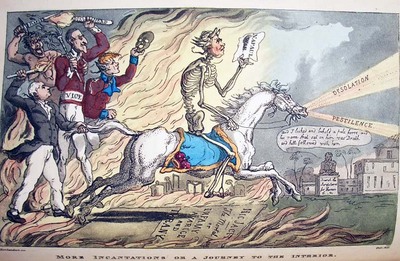
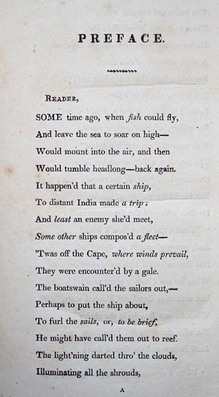
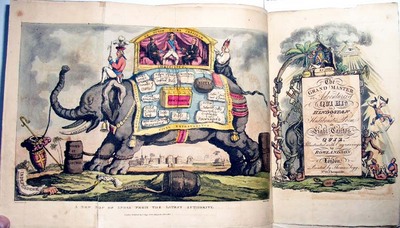
Attributed to William Combe (1742-1823), The Grand Master; or, Adventures of Qui Hi? in Hindostan. A Hudibrastic Poem in Eight Cantos by Quiz. Illustrated with engravings by Rowlandson (London: Printed by T. Tegg, 1816). Graphic Arts Collection (GA) Rowlandson 1816. Gift of Dickson Q. Brown, Class of 1895.
“Qui hi, or Kooee Hye, is the Bengalee phrase meaning Who’s there. As no bells are used in the houses of the gentry in India, the servants sit at the doors of the dining or drawing room, or study, and are called … by the phrase Qui hi, to which they instantly reply by appearing. Hence all the English in Bengal are called by the Europeans of other parts of India Qui his.” — Joachim Stocqueler, Familiar History of British India (1859)
This stinging satire of British imperial rule in India, punctuated with Rowlandson’s hand colored plates, features Francis Edward Rawdon-Hastings, 1st Marquess of Hastings (1754-1826), known as The Earl of Moira. Hastings served as Governor-General of India and led the British troops to victory when the Gurkhas declared war. The battles ended in 1816 and the book appeared shortly afterwards.
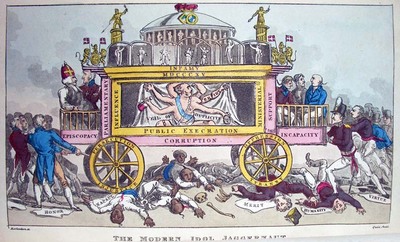
Pulled for ART 453 / ECS 453 Caricature and Modernity: 1776-1914
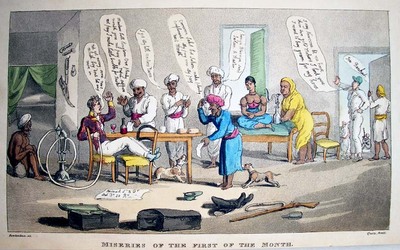
- The Artistic Collaboration: The book features 28 hand-colored aquatint engravings by Thomas Rowlandson, one of the most famous political caricaturists of the era. Rowlandson never actually visited India; he based his drawings entirely on the text, sketches from travelers, and popular descriptions. This explains why the "Mendon's Point" beach in the print looks somewhat romanticized, yet includes distinct local elements like a traditional palanquin (left) and a Hindu cremation taking place on the shore (right).
- The Target of Satire: The story follows "Qui Hi," a naive young Englishman who goes to India to make his fortune. Instead of finding glory, he encounters a system run by lazy officials, corrupt chaplains, and exploitative merchants. The book heavily criticized how the EIC treated local populations, its strict censorship of the press, and how quickly British expatriates succumbed to disease or excessive living. Qui Hi's death from "the liver" (likely hepatitis or malaria) and his unceremonious funeral were meant as a cautionary tale to young Englishmen dreaming of wealth in India.
       [ MALABAR HILL ] (Wooded, secluded bungalows & towers)
              |
              |  ~ ~ Back Bay ~ ~
              |
       [ MENDHAM'S POINT ] (Southeastern spit, early cemetery)
              |
       [ BOMBAY FORT ] (Walled city, Garrison, St. Thomas Church)
- The Visual Reality: Historical accounts describe it as a crowded, eerie place packed with elaborate, heavy stone tombs. It was positioned right on the water's edge, meaning high tides would frequently lap against its boundary walls.
- Why it disappeared: By the 1760s, military engineers argued that the tall stone monuments of the cemetery provided perfect strategic cover for an invading enemy army (such as the French) to launch an assault on the Bombay Fort. In 1763, the cemetery was demolished, the ground leveled for a military esplanade, and the graves moved further back to Sonapur.
- Then: In the 1700s and early 1800s, Malabar Hill was a dense, rocky jungle far outside the city limits. It was largely wild, inhabited by panthers and jackals, and visited mostly by pilgrims going to the ancient Walkeshwar Temple.
- The Transition: Around the time this book was published, the British Governor of Bombay began building a small summer cottage on the hill to escape the stifling heat and grime of the walled Fort. This sparked a trend; wealthy British officials and Parsi merchants began building large, breezy garden bungalows there, transforming it into the high-end residential district it remains today.
