Tuesday, May 25, 2010

Road Steamer Omnibus India 1871 BOMBAY

https://c7.alamy.com/comp/FFCRF1/india-omnibus-1871-nroad-steamer-and-omnibus-for-the-indian-government-FFCRF1.jpg 


m

Sassoon Hospital Bombay India 1868 AT" POONAH"


Sassoon Hospital, a Jewish merchant’s enduring gift to Pune which he didn’t live to see

Through Sassoon Hospital, David Sassoon wished “to relieve the wants of the poor of Poona” and contributed more than half of the money used to build it.

Jasoon hospital“I feel the least hesitation in expressing my belief that one of the most cherished schemes of my life will be fully realised,” said Sassoon during the foundation stone laying ceremony.
Listen to this article
00:00
1x1.5x1.8x

On October 8, 1863, the then Bombay Governor Henry Bartle Frere laid the foundation stone of Sassoon General Hospital in Pune in the presence of Baghdadi Jewish baron David Sassoon.

In his speech, Frere liberally praised then-71-year-old Sassoon’s philanthropy, who had donated Rs 1.88 lakh for the establishment of the public institution, and hoped that “providence should permit him to see the building suitably completed”.

“I feel the least hesitation in expressing my belief that one of the most cherished schemes of my life will be fully realised,” said Sassoon during the foundation stone laying ceremony. However, his wish did not come true during his life time.

Sassoon, the then Bombay-based owner of David Sassoon, Sons & Company, who had a summer residence in Pune, called Garden Reach, died in the city in November 1864 before the hospital became operational.

“The venerable David Sassoon, head of the Jewish community of Western India, and a merchant-prince of worldwide reputation, died in the city of Poona on the 5th instant after a day’s illness…Bombay has lost one of its most energetic, wealthy, public-spirited and benevolent citizens,” read an obituary in an English newspaper.

From Baghdad to Bombay

Born in 1793 in a family of official treasurers of the ruler of Baghdad, David ben Sassoon left the city with his family in the 1830s because of the mal-treatment of Jews under the reign of Daoud Pasha and reached Basra. In 1832, he visited Bombay for the first time, and, beguiled by the “beauty and promise” of the city, shifted his family to the city for good. Once here, since surnames were customary, he became David Sassoon.

When Sassoon made Bombay his home, it was a gateway to India from Europe and many traders from the West and Middle East made their way to the city to have a share in the trade pie and hoped to build a fortune. It was also a time when the British government had weakened the trading monopoly of the East India Company.

Sassoon started small in the Indo-Persian trade of English textiles and Oriental weaves. He deployed his knowledge and connections in Persia and Baghdad to expand the trade and soon became a big player in the market.

“It was a turning point in the history of his business, for it was this that gave him the clue of the boundless potentialities of his new place of residence. England knew it as the gateway that gave access to India, (Sassoon) realized that Bombay was not only the Gateway to India but a gateway to China. That was David Sassoon’s great discovery which was rewarded by a shower of gold,” Cecil Roth wrote in his history of the family, The Sassoon Dynasty, published in 1941.

Sassoon started trading with China and the Far East by dealing in yarn, gold, and, most importantly, opium which later played a large role in his immense financial success. “It was the China trade that raised the house to the very first rank in British India. By 1854, David Sassoon was considered a millionaire; he was far more than this by the time of his death,” according to Roth’s book.

His firm developed a practical monopoly in the trade of opium, fabrics, and cotton yarn with branches in Calcutta, Shanghai, Canton, Hong Kong, Yokohama, and Nagasaki. Considering the political support required for such large operations, including the contentious ones such as the opium trade in China, Sassoon aligned closely with the British government.

Most cherished scheme

Sassoon is known to have donated large sums of money towards building several institutions in Bombay, including the Sassoon Library and Reading Room, the Industrial and Reformatory Institution, the Clock Tower, and the Magen David Synagogue.

In Pune, he donated Rs 50,000 to build the Poona Infirm Asylum, now known as Niwara, and the Ohel David Synagogue, which is locally known as Laal Deval.

But his most significant, and also the most impactful, contribution came when he decided to spearhead the establishment of a public hospital in Pune in 1863 — the Sassoon General Hospital — which continues to be the largest public hospital in the region. Before the Sasson General’s establishment, the only hospital in Pune was the Civil Hospital with a capacity to accommodate only 50 patients.

The hospital was a special project for him. As per a report in The Illustrated London News in late 1862, Sassoon “wishing to relieve the wants of the poor of Poona” laid before the government an offer to contribute towards building a hospital.

The total cost of the construction was pegged at Rs 3,10,060, with Sassoon contributing Rs 1,88,000.

When it was opened in 1867, the hospital designed by Lieutenant Colonel Wilkins could accommodate 144 patients, each with 75 square feet of surface area and 1,400 cubic feet of space. In times of emergency, the verandas could house an additional 60 individuals.

“The building in the English Gothic style, has a very imposing appearance, with its massive clock tower. It consists of two floors, which have lofty roofs, perfect ventilation, and as an internal arrangement simple but admirable,” said The Illustrated London News about the hospital.

A polymath who didn’t know English

During the ceremony to lay the foundation stone of Sassoon Hospital, Governor Frere was full of praise for the Jewish patriarch, his philanthropy, and his decision to send some of his sons to Europe for higher education. Sassoon’s brief statement would have been hardly comprehensible to the governor as he delivered it in his native tongue: Arabic.

Historians of the Jewish diaspora say Sassoon received only religious education as a child and was fluent in Hebrew, Persian, and Turkish apart from his native language Arabic. After migrating to India, he had learnt to communicate in Hindustani to the extent that it helped him do his business communications. “But this multi-millionaire who rose to fame and fortune under the British flag never mastered English,” according to Roth’s book.

As a religious man, he devoted his time to the study of scriptures and the offices of his firm remained shut on Sabbath (Saturday) in addition to Sunday as per local custom. “Every Saturday, the heads of the Bombay Jewish community assembled in David Sassoon’s house, accompanied by such native and foreign scholars as were available. The afternoon would be occupied with study of the Zohar and Talmud,” says Roth’s book.

One of his contemporaries described Sassoon as having a particularly impressive appearance: He was extremely tall, standing head and shoulders above the average inhabitants of Bombay, wearing Oriental garments and head-dress that added to his dignity and his apparent height – he never abandoned the Baghdadi costume of his youth.

When he died in November 1864, he left a large family behind including six sons, four daughters, and his larger family – the Baghdadi Jewish community of Bombay. He was buried in the courtyard of Ohel David Synagogue in Pune which he had established in the city where he breathed his last.

‘2,000 patients reporting daily’

Sassoon’s grandson Jacob, from his younger son Elias David, donated Rs 2 lakh in 1906 for the expansion of the hospital by establishing a new wing exclusively meant for European patients and those from the Jewish community. The foundation stone of the building was laid by the then-Bombay Governor Lord Lamington.

In November 1878, a medical school was started on the campus which would later grow into the B J Medical College.

The hospital provided medical services to the people of Pune, especially during the plague pandemic that started in 1897. It was also the hospital where Mahatma Gandhi was repeatedly admitted during his imprisonment in the city’s Yerwada Prison and underwent surgery to remove an inflamed appendix in January 1924.

“Presently, at least 2,000 patients are reporting daily at the Out Patient Department apart from another 200-220 admissions,” says Dr Sanjiv Thakur, Dean, Sassoon General Hospital and B J Medical College. “It’s a tertiary care centre for Western Maharashtra where poor and needy patients get gold-standard treatment so that they are not deprived of better care,” adds Dr Thakur.

Financially weak and meritorious students come here for graduate and postgraduate studies.

Presently, both the heritage buildings – the David Sassoon and Jacob Sassoon buildings – are undergoing restoration. The work began in November 2022 and Rs 14.7 crore will be spent on the restoration work of the David Sassoon Hospital building and Rs 9 crore on the Jacob Sassoon building.

Archana Deshmukh Kulkarni, a conservation architect at Nasadeeya Architecture and Conservation appointed by the Public Works Department, Government of Maharashtra, for the restoration project, said that 50 per cent of the work has been completed.

“David Sassoon built a typical early English Gothic style with high walls and sloping roof, while the Jacob Sassoon building is more of the later Victorian Gothic style with elaborately panelled front doors, pointed arches and towers.”

“We are keen to bring these buildings back to their original glory,” says Kulkarni.


LAUNCH OF THE SHIP "MEANEE" AT BOMBAY 1849


1877 Rajah Ram High-School Kolapore India -Bombay presidency


m

Arrival Of Indian & Australian Mails At Alexandria EgypT on the way to Bombay 1853


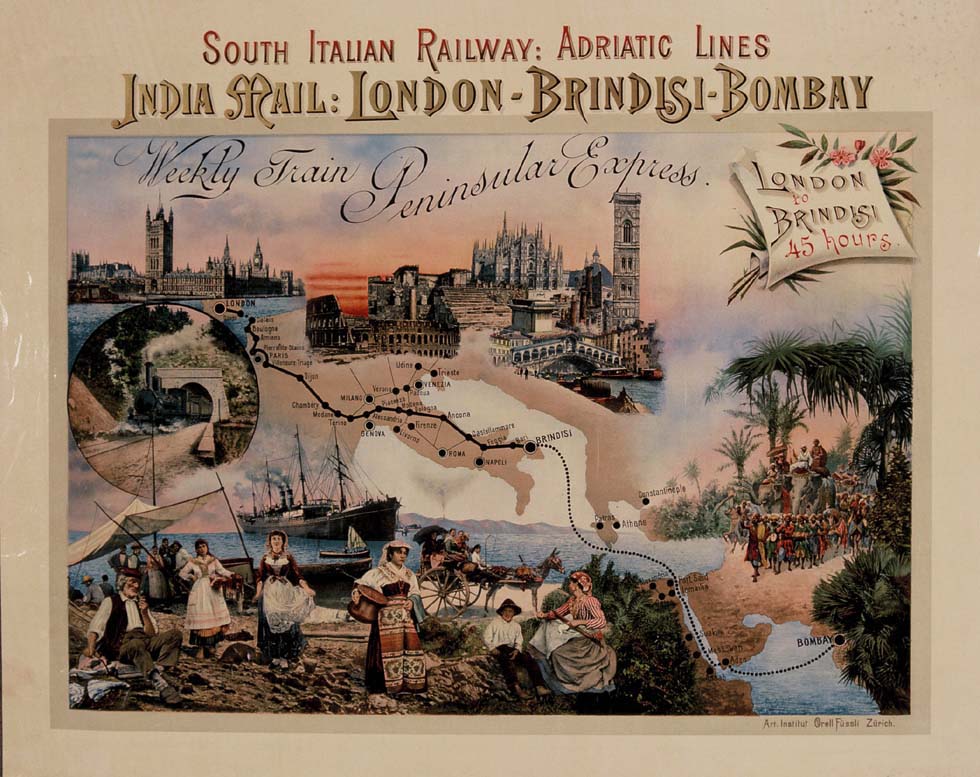
Indian Mail

"In 1897, Queen Victoria ruled over a quarter of world's population and a fifth of its territory, all connected by the latest marvel of British technology, the telegraph, and patrolled by the Royal Navy, which was larger than the next two navies put together".

Fareed Zakaria, Newsweek 2006


Advertisement, probably of 1890 (coll. Juergen Klein)

Under the reign of Queen Elizabeth I the East India Company was founded in 1600. Their ships took almost six months to sail from England to India round the Cape of Good Hope. Historians discovered also some "Overland Despatches" which in 1676 were carried through Mesopotamia. In 1698 Henry Tistew, British consul in Tripoli, agitated in vain for an "Overland Route" through Egypt, around 1775 George Baldwin organized it, but the Sultan excluded Christian merchantmen from the Red Sea. Baldwin was convicted (he escaped), in 1780 two couriers were arrested at Kosseir on the Red Sea and the captain shelled the city. In 1798 Napoleon started to conquer Egypt, with India and a Suez Canal as his final target. When he was defeated at Waterloo in 1815, he no longer could menace the way to the Indian Ocean.

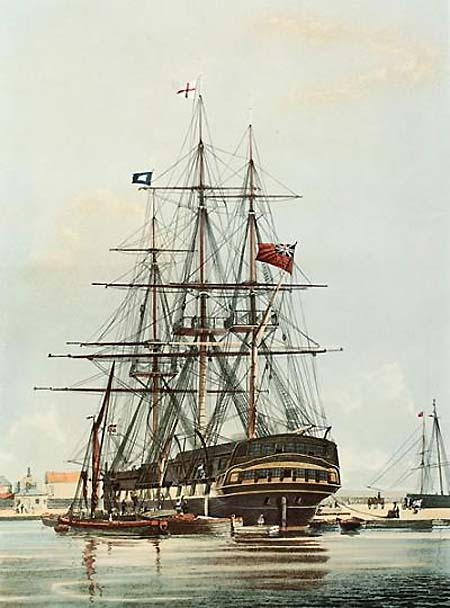
An East Indiaman (via flickr.com)

The Steam Age
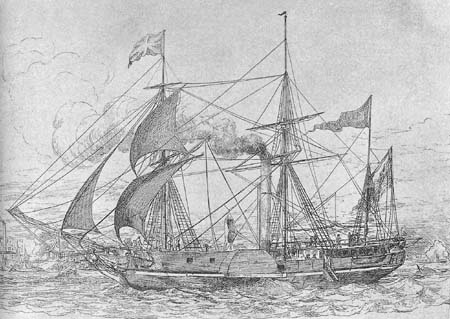
In 1822, only 15 years after the first commercial steamship was built by Robert Fulton in America, Arthur Anderson and Brodie M'Ghie Willcox proposed a steamship service from England to India, whereupon the governor of Calcutta, Lord Amherst, promised a reward for everyone who makes the journey in less than 70 days. A "Steam Committee" was called together by Lieutenant James Henry Johnston in Calcutta to get the paddle-steamer "Enterprize" of only 479 tons built in England at Gordon & Co. (the spelling "Enterprize" is in accordance with H.L. Hoskins, while generally "Enterprise" is written). On 16 August 1825 Johnston went aboard this small steamer on the voyage from Falmouth via the Cape of Good Hope to Calcutta, where he arrived after 113 days.

"Enterprize" (old publication)

Another idea of a steamship line in connection with the Overland Route through Egypt was pursued by the governor of Bombay, Mountstuart Elphinstone, and his successor, John Malcom. It was announced that the "Enterprize" should leave Bombay (Mumbai) for Suez. In the meantime the 27 years old Thomas Fletcher Waghorn, who had piloted the ship on the Hooghly river at Calcutta, got order by Lord Ellenborough of the East India Company to convey some British mail from London to India as a test by the way of Suez, where the "Enterprize" was to wait for him. His adventure was described by John K. Sidebottom ('The Overland Mail'): On 28th October Waghorn left London by an Eagle stage coach, crossed the Channel by steamer, learned in Paris that the Simplon was closed on account of snowfall, took the coach via the Mount Cenis, arrived at Trieste, missed an Austrian sailing-vessel which immediately before had left, tried in vain to overtake it by coach, then caught in Trieste a Spanish ship, paid the captain an immense sum, disembarked in Egypt where the Nile river boat stranded, changed to donkeys and reached in the end Suez on 8th December, but the "Enterprize" was not there. He rent an open boat without compass and arrived at Jeddah, Arabia, after other 6 1/2 days. There he learned that the "Enterprize" had been staying in India on account of engine troubles. Suffering from fever, Waghorn reached Bombay on 21st March 1830 aboard the sailing-vessel "Thetis". Reportedly he met aboard his rival James W. Taylor, who fought for an England - India steamer service, too. In the meantime a new paddle steamer, the "Hugh Lindsay" (411 gt), had left Bombay on 20th March 1830 and arrived at Suez on 2nd April. And in 1834 the steamer "Forbes" set out for the longer trip from Calcutta to Suez. With her 161 tons she was so tiny that even the cabins had to be filled with coal.

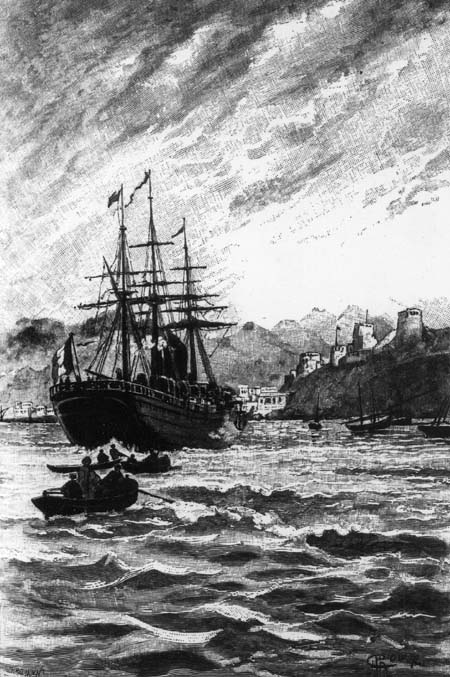
British mail steamer at Muscat (coll. v. Schweiger-Lerchenfeld)

The Euphrates Route
Already in the 17th century some 'Overland Dispatches' were conveyed on a route via Mesopotamia and the port of Basrah. After in 1877 the Sultan had banned Christian merchantmen from the Red Sea, England got permission to use the 'Dromedary Dak' through Mesopotamia. It proved useful after Napoleon had occupied Egypt in 1789. The mail took the way via Vienna, Bucharest and Constantinople, where every two weeks a Tartar rider departed to the east. Generally however, the mail was conveyed by the sailing ships of the East India Company round the Cape of Good Hope. After the struggle for a faster route had begun, James W. Taylor tried the Euphrates route when he returned from Bombay - and was killed by natives. An expedition to Mesopotamia was started by Francis Rawdon Chesney, who delivered a report to King William IV. It resulted in building the Euphrates river steamers "Euphrates" and "Tigris", tested in 1836 on the Euphrates. The "Tigris" capsized during a sandstorm. The "Euphrates" took over in October 1836 the mail from the "Hugh Lindsay" at Basrah, suffered an engine failure in the Lamlun swamps, the mail had to be reloaded to native boats, they were attacked by Arabs and finally the letters arrived in London three months late, whereupon the Government decided in favour of the Egyptian route

Via France and Egypt
Now the Steam Committees in India and the London "Times" took up the subject and in 1834 the House of Commons recommended extension of the Admiralty's Malta steamship-line to Alexandria, the port of Egypt. The East India Company introduced in 1837 the mail steamers "Berenice" and "Atalanta" on the Suez - Bombay line, then followed by other ships, providing a regular service, while the "Hugh Lindsay" was bound for trips to Basrah. On the Red Sea route, the main coaling station had been Mocha. Due to its limitations, coaling was relocated to Aden, occupied in 1839 in response to a pirates' attack. The Bengal Steam Fund commissioned in 1839 an own steamer, the "Precursor", aiming to connect also the capital Calcutta with Suez.


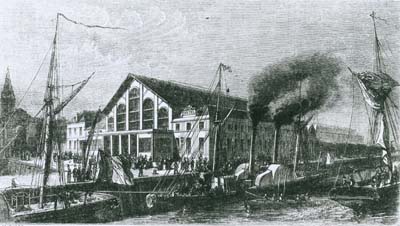
Unloading the Indian Mail at Calais, around 1880 (contemporary press)

Terminal at Calais, 19th century (contemporary press)

A British-French convention from 30th March 1836, completed on 10th May 1839, concluded the use of a mail route through France in order to reduce traveling time, first by coach, from 1847 step by step changed to train - which became famous as "La Malle des Indes". Cross-Channel steamer services had been opened in the 1820s and from the late 30s British steamers operating for the Post Office and French government-owned steamers provided regular services to and from Calais (see chapter Branch Lines/ Channel). The 12th August 1839 is the date of official mail departure through France, the track passengers had used already before. British Admiralty steamers provided a service from Marseilles via Malta and - as before - from Falmouth to Alexandria.


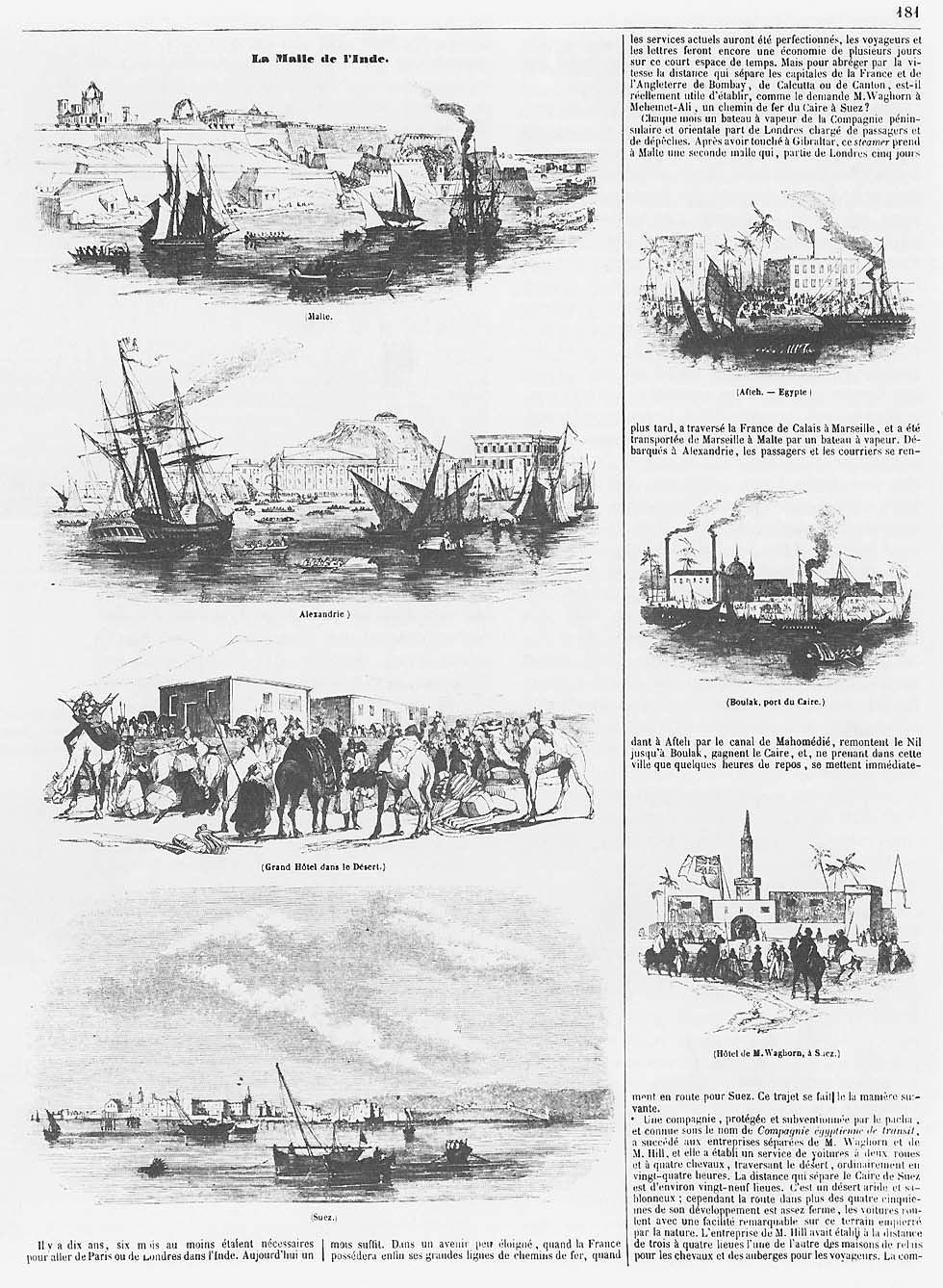
The Indian Mail route (published in1844)


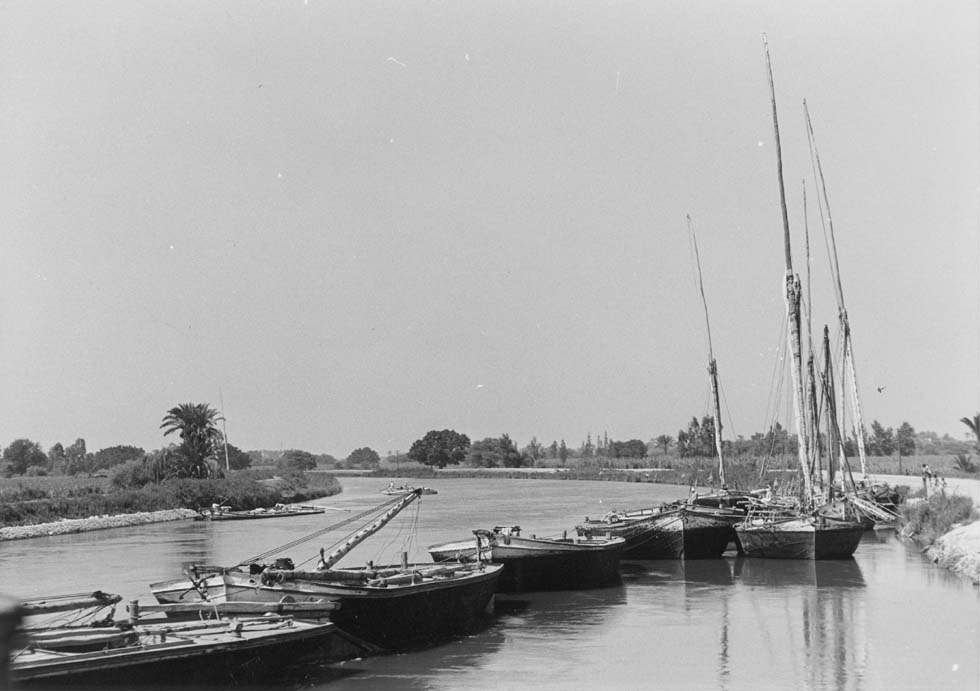
Canal in the Nile delta (WS)

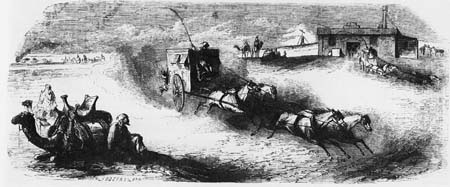
Egypt's ruler Mehmet Ali required more independence from the Sultan, and that was a chance for the "Overland Route " through Egypt. In order to avoid any disagreement with the Sultan, the British government left it to private entrepreneurs - and one of them was Waghorn's firm, then swallowed by the competitor J.R. Hill & Co. Passengers between Alexandria and Suez had to use horse-drawn boats (a 60ft long boat with deck cabins and an accompanying one for luggage was reported) and then a screw-streamer on the Mahmoudieh Canal. It had been built by slaves and thousands of them died. At Aft the passengers changed to sailing-vessels on the Nile and from 1841 to Hill's tiny steamer "Jack o' Lantern", laid out for only 10 passengers. At Boulak they had to take a horse, camel or donkey for reaching Cairo. There they stayed in Mr. Shepheard's hotel (opened in 1841) until a message informed of a steamer's arrival at Suez. Then they took horses, camels and later horse-drawn "buses" on the Cairo - Suez track. Only the mail was carried through Egypt by donkeys.

On the way to Suez (contemporary press)

Peninsular & Oriental
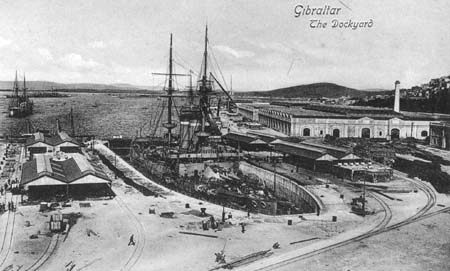
A multitude of organizations shared the conveyance of the Indian Mail, a situation rather inconvenient for the General Post Office. A reliable shipping firm had to be found and that was the Peninsular Steam Navigation Co. The company was established by Arthur Anderson, Brodie M'Ghie Willcox, the early promoters of a steamer line to India, and Captain Richard Bourne, owner of the City of Dublin S.P.Co. In 1835 he had taken up negotiations with the Spanish government aiming to start a steamer service to the Iberian peninsula. In 1837 the Peninsular Co., founded in association with Anderson and M'Ghie Willcox, got a contract by the British government for a mail service from Falmouth to Gibraltar, since 1704 the British outpost at the entrance to the Mediterranean.

Gibraltar before WWI (old card, coll. WS)

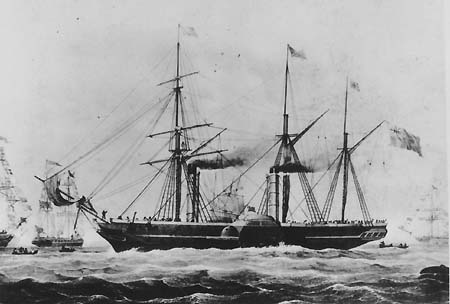
In 1837 the late Governor-General of India, Lord William Bentinck, asked Willcox and Anderson if they could build up a service Suez - India. In 1840 the Peninsular received the contract for a fast mail service England - India. The Peninsular & Oriental Steam Navigation Company, the P. & O. (later P&O), was born. Its first steamers (according to D. Divine) were the "William Fawcett" of 1827, the "Royal Tar", the "City of Londonderry" and the "Great Liverpool". The P&O took over other companies and during a full century the P&O under steadily renewed contracts carried the Indian Mail.

On 1st September 1840 the "Oriental" departed for Alexandria (according to D. Divine: These Splendid Ships) and on 23rd September 1840 the "Great Liverpool" started Mediterranean services of the P&O at Alexandria (according to R. Kirk). Nevertheless for some years also the steamers of the Admiralty provided mail services in the Mediterranean. In England, the London & South Western Railway, initially from London Nine Elms, reached Southampton in 1840. The first dock at Southampton was completed in 1843 and from 18 September of that year the P&O steamers with the Indian Mail started from that port and no longer from Falmouth.

On 24th September 1842 the "Hindostan" was the first P&O steamer to undertake the voyage to India via the Cape of Good Hope and in January 1843 she started mail services between Calcutta and Suez. Then she was joined on the Suez - Aden - Ceylon - Madras - Calcutta route by her sister ship "Bentinck". The P&O acquired also the "Precursor" from the Eastern Steam Navigation Company, which never before had realized the planned service Calcutta - Suez. Another firm, the East India Steam Navigation Company, had undertaken mail services Calcutta - Red Sea from 10th January 1842 with the steamer "India", but lacking support they sold the ship in 1845 to the P&O. These four vessels mentioned provided the early P&O services on the Suez - Calcutta route.

The ailing East India Company had maintained the service Suez - Bombay, in 1852 however one of her ships suffered an engine failure: "Forced to put in to Aden for repairs, her captain sent the mail on in a native dhow and the mail were lost at sea. This was the final straw. (...) the government offered the route to the P&O" (D. Divine). In 1854 the East India Company abandoned that service for which they received 50,000 pounds a year. In 1858 this famous institution was dissolved by reason of colonial politics.

For acceleration of the Indian Mail by taking a route via Trieste, the port of the Habsburg Empire, a severe struggle was carried out in the 1840s. Once again Waghorn appeared as a daring pioneer. The Austrian Lloyd, officially Oesterreichischer Lloyd, was interested in getting the mail business, but finally it remained in the hands of the P&O (for more information see the chapter Branch Lines/ Levant).


"Hindostan", departing in September 1842 from Southampton to the Indian Ocean (archives P&O)

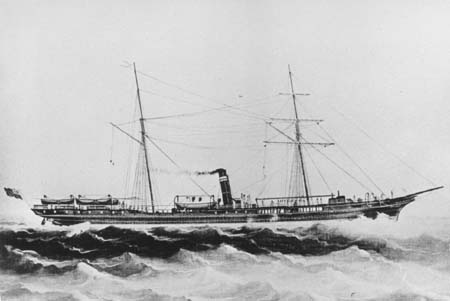
"Busheer" of 1864 (archives P&O)


Suez Canal
In 1841 Arthur Anderson travelled to Egypt, evaluating a cooperation with Waghorn, which however was not achieved. But the P&O strengthened its position, enabling to introduce on the Mahmoudieh Canal the tug "Atfeh" and on the Nile the steamers "Lotus" and "Cairo" in competition to Hill's "Jack o' Lantern". Mehemet Ali was in a stronger position and he took over Hill & Co. under a new name "Egyptian Transit Company". From 1846 his "Administrations du Transit" controlled the entire traffic and refused passage rights for the P&O Nile steamer "Delta". Mehemet Ali intended to build a railway Cairo - Suez, the General Post Office however rejected a contract. Mehemet Ali had even the more fantastic idea of a railway to Massawa on the Red Sea as a new port of departure for the India steamers, which would have shortened the travelling time of the Indian Mail by 3 days, but the dream remained unfulfilled.

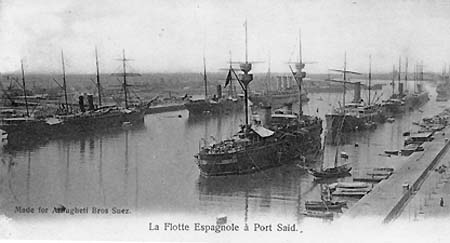
Mehemet Ali died in 1849, France started negotiations to build the Suez Canal (already Napoleon's dream!) and now England supported the railway Alexandria - Suez. It was completed to Cairo under Abbas I Pasha in 1856. Initially the Nile had to be crossed at Benha and at Kafr el Zaiat by train ferries. Abbas' successor, Said Pasha, preferred the Suez Canal project and the rail link Cairo - Suez was delayed until 1858. At that time the Suez Canal, designed by the Austrian engineer Alois von Negrelli and realized by the French diplomat and engineer Ferdinand de Lesseps, was already under construction. The canal has a length of 160 km and it needed no locks as it crosses only plain country, mainly desert. On 16th November 1869 the festive inauguration took place in presence of Imperatrice Eugenie and the Pasha aboard the French frigate "L' Aigle", the Kaiser of Austria aboard the "Greif" and the Prussian crown prince aboard the "Grille". The Suez railway had been abandoned the year before (and was re-opened in the 1930s). The British Indian mail surprisingly did not take the canal route, but a new railway link via Alexandria - Ismailia. Even after the P&O had inaugurated the new steamers "Khedive", "Pekin", "Mirzopore" and Peshawur", built for services Southampton - Bombay, no British mail passed the canal before 1874. Historian Ernest A. Ewart obviously found the reason: The General Post Office lowered the payment to the P&O if the mail was conveyed on that easier way. Therefore it had to get unloaded at Alexandria and taken aboard at Suez. Often it was the same steamer with the passengers staying on board of course. In 1875 Disraeli acquired the Egyptian share in the canal company for England and at least during the cholera quarantine in 1883 P&O steamers passed the canal without a stop at Alexandria. Only from 1888 however all the Indian mail was conveyed through the Suez Canal. Already before, in 1882, England had submitted Egypt, shelling Alexandria.


Suez Canal, Port Said (old card, coll. WS)

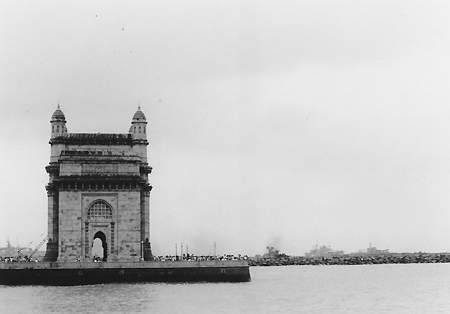
'Gateway of India', Bombay 1975 (WS)

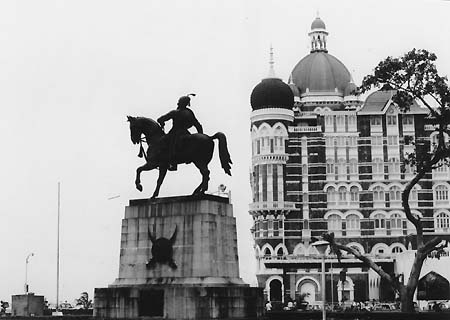
Bombay, the traditional Taj Hotel (WS)

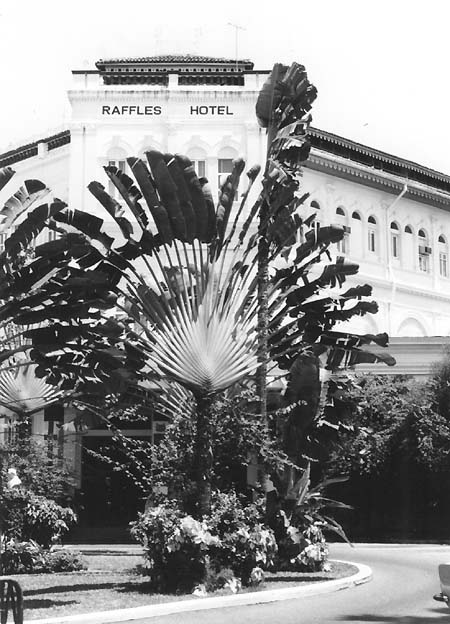
Singapore, Raffles Hotel, the refuge of P&O travellers (WS)


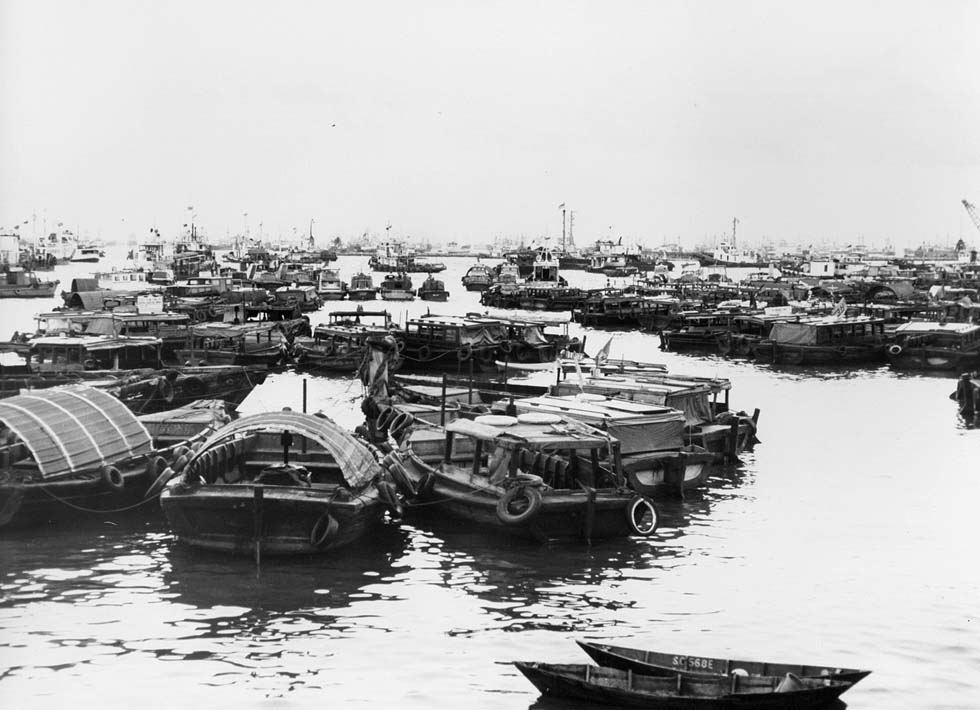
Singapore port in the past (WS)


An Indian Money Changer 1895


SHIP FOR THE ROYAL VISIT AT BOMBAY 1875


LIFE ON THE SHIP 1875

CEREMONY PERFORMED BY NATIVE GIRLS FOR THE BRITISH PRINCE -BOMBAY 1875